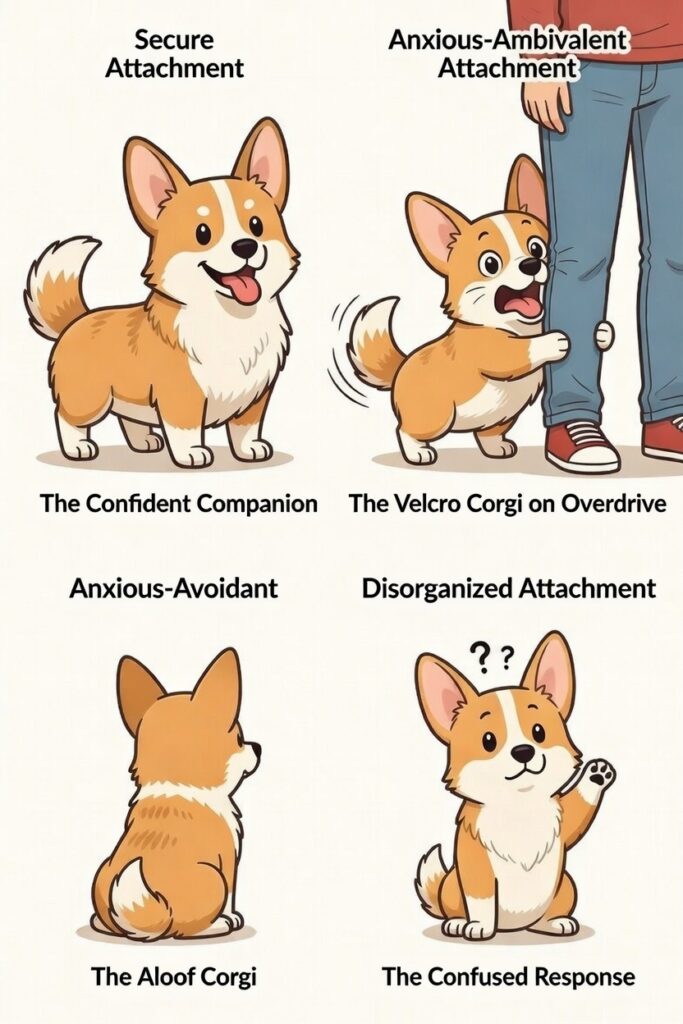
When your Pembroke Welsh Corgi greets you at the door with unbridled enthusiasm after you've been gone for just twenty minutes, or when they press themselves against your leg during a thunderstorm, you're witnessing attachment in action. But not all Corgis bond in the same way, and understanding the nuances of canine attachment styles can transform how you relate to your four-legged companion. Canine behaviorists have adapted attachment theory—originally developed by psychologist John Bowlby to understand infant-caregiver bonds—to describe dog-human relationships. What researchers have discovered is both fascinating and practical: the emotional patterns that shape human development also apply to our dogs, and Corgis, with their intense predisposition toward human bonding, offer a particularly compelling window into this science.
The Origins of Attachment Theory
Before diving into how this applies to Corgis specifically, it's worth understanding the foundation. In the 1950s and 60s, John Bowlby revolutionized our understanding of emotional development by proposing that infants are biologically programmed to form attachments with caregivers. These early bonds, he argued, create internal working models—mental templates that shape how individuals relate to others throughout their lives.
Mary Ainsworth expanded this work with her famous "Strange Situation" experiments, identifying distinct attachment patterns in human children: secure, anxious-ambivalent, anxious-avoidant, and disorganized. Each pattern reflected different relationship dynamics and predicted different developmental outcomes.
In the late 1990s and early 2000s, researchers began wondering whether these same patterns might apply to dogs. After all, domestic dogs have evolved alongside humans for thousands of years, developing social-cognitive abilities that mirror aspects of human attachment. The results were striking: dogs do indeed display attachment behaviors remarkably similar to human infants, and these behaviors cluster into recognizable patterns.
The Canine Attachment Styles
Research has identified four primary attachment styles in dogs, each with distinct behavioral signatures. While these categories apply across breeds, Corgis—given their herding heritage and intense human focus—often display these patterns with particular clarity.
Secure Attachment
The Confident Companion
Securely attached Corgis represent the healthy baseline that most well-socialized dogs achieve. These dogs use their owner as a "secure base" for exploration. In practical terms, this means your Corgi feels comfortable investigating new environments, greeting strangers, or playing independently—but regularly checks in with you, seeks proximity when uncertain, and shows clear preference for your company.
Behavioral markers of secure attachment in Corgis include enthusiastic but not frantic greetings upon reunion after separation, the ability to settle and relax in your presence, moderate distress when you leave (they might watch you go or whine briefly but then settle), and easy comforting when upset or frightened. These Corgis display the classic "Velcro dog" tendency of following you around the house, but they can also entertain themselves or rest calmly when you're occupied.
Dr. Theresa Fisher's research at the University of Vienna found that securely attached dogs perform better on problem-solving tasks, show greater resilience to stress, and generally exhibit more balanced emotional regulation. For Corgis, whose intelligence and herding instincts already predispose them toward intense observation of their humans, secure attachment allows these traits to manifest as attentive partnership rather than anxious dependence.
The securely attached Corgi might position themselves where they can see you while you work, occasionally bringing you a toy for interaction but equally content to chew on it alone. During walks, they explore with confidence but check in regularly, and they greet friendly strangers with interest rather than fear or excessive excitement. This is the attachment style that allows the Corgi-human bond to reach its fullest, healthiest potential.
Anxious-Ambivalent Attachment
The Velcro Corgi on Overdrive
Some Corgis develop what researchers call anxious-ambivalent or anxious-resistant attachment. These dogs are hypervigilant about their owner's location and emotional state, displaying exaggerated distress at separation and difficulty settling even when the owner is present. The reunion behaviors can be intense and prolonged—jumping, whining, spinning, and demanding attention that doesn't quickly resolve into calm interaction.
This attachment style manifests distinctively in Corgis due to their herding background. Remember, these dogs were bred to monitor and maintain group cohesion, so an anxiously attached Corgi may become almost frantic about keeping family members together. They might bark insistently when family members are in different rooms, attempt to physically herd people into one space, or become distressed when anyone leaves the house—even if other family members remain.
Anxious-ambivalent Corgis often struggle with independence. They may follow you from room to room with an intensity that goes beyond normal breed behavior, becoming agitated if a door closes between you. They might bring toy after toy for play but never seem satisfied, or seek petting but remain tense and vigilant rather than relaxing into the touch.
The underlying psychology resembles an insecure infant who can't quite trust that the caregiver will remain available. For Corgis, this often develops from inconsistent care, early separation from the mother or littermates, or well-meaning owners who inadvertently reinforce anxious behaviors by providing attention primarily when the dog is distressed. Interestingly, this attachment style can develop even in Corgis from excellent backgrounds if owners fail to teach independence skills. Because Corgis are so naturally inclined toward proximity and human focus, they need deliberate practice with separation and independent activities. Without this scaffolding, their innate attachment tendencies can tip into anxiety.
Anxious-Avoidant Attachment
The Aloof Corgi
While less common in Corgis than in more independent breeds, anxious-avoidant attachment does occur. These dogs appear emotionally detached, showing minimal distress at separation and limited enthusiasm at reunion. They may avoid physical contact, seem indifferent to their owner's presence, and prefer to handle stress independently rather than seeking comfort.
This pattern might seem puzzling in a breed known for intense loyalty, but it typically develops in response to specific experiences. Corgis who experienced neglect, repeated abandonment, or punishment for normal attachment behaviors (like following or seeking attention) may learn that emotional investment in humans leads to disappointment or pain. They develop a protective strategy of emotional distance.
The avoidant Corgi might not greet you at the door, may walk away when you offer petting, and seems unbothered by your comings and goings. During stressful situations—veterinary visits, thunderstorms, or encounters with unfamiliar dogs—they handle their distress internally rather than seeking reassurance. Some may even show stress signals (panting, yawning, lip licking) while simultaneously moving away from offered comfort.
This doesn't mean these Corgis don't form attachments at all. Research using physiological measures like cortisol levels and heart rate variability shows that avoidant dogs often experience internal stress despite their outward appearance of indifference. They've simply learned to suppress attachment behaviors rather than risk rejection.
The good news is that avoidant Corgis often respond well to patient, consistent care that respects their boundaries while gently encouraging connection. Unlike anxious-ambivalent dogs who need help developing independence, avoidant dogs need help learning that attachment is safe.
Disorganized Attachment
The Confused Response
The rarest and most concerning pattern is disorganized attachment, characterized by contradictory or seemingly random behaviors. A Corgi with disorganized attachment might approach and then immediately retreat, seek attention but freeze or show displacement behaviors when it's offered, or display both avoidant and anxious behaviors unpredictably.
This pattern typically emerges from traumatic early experiences or when the caregiver is both the source of comfort and the source of fear. A puppy repeatedly punished for seeking attention but also denied affection may develop this confused attachment pattern. Fortunately, it's relatively uncommon in Corgis from responsible breeders and caring homes.
Disorganized attachment requires professional intervention from a veterinary behaviorist or certified applied animal behaviorist, as these dogs need specialized behavior modification protocols and sometimes medication to help regulate their stress responses while developing healthier attachment patterns.
The Corgi Factor
Breed-Specific Considerations
Understanding these general attachment patterns is essential, but Corgis add their own unique dimensions to the attachment equation. Several breed-specific traits influence how attachment styles manifest:
The Herding Instinct Amplifier: A Corgi's innate drive to monitor and maintain group cohesion can intensify any attachment pattern. A securely attached Corgi still follows you everywhere—that's breed-typical behavior. But an anxiously attached Corgi may take this to extremes, becoming distressed by normal household separation like someone going upstairs while others remain downstairs.
Vocal Expression
Corgis are notably vocal dogs, and their attachment style often determines how they use their voice. Securely attached Corgis might bark to alert you to arrivals or to request interaction, while anxiously attached Corgis may bark almost constantly when you're out of sight, creating a challenging feedback loop where the barking itself becomes stressful for both dog and owner.
Intelligence and Pattern Recognition: Corgis are smart enough to recognize departure cues—you picking up keys, putting on shoes, or checking your phone in that particular way. This intelligence means anxiously attached Corgis can anticipate separation well in advance, extending their distress period. Conversely, it means securely attached Corgis can also learn to distinguish between departures that mean "back in five minutes" versus "gone for hours," moderating their response accordingly.
Stubborn Streak
The same determination that made Corgis effective at herding cattle despite their small size can make addressing attachment issues challenging. An anxiously attached Corgi might persist in attention-seeking behaviors with remarkable tenacity, while an avoidant Corgi may stubbornly resist attempts at increased closeness.
Understanding these attachment styles and how they manifest uniquely in Corgis is the crucial first step in nurturing a healthy, fulfilling relationship with your dog. But knowledge alone isn't enough—you need to be able to recognize which pattern your own Corgi displays, understand how your behavior influences their attachment development, and know what steps to take if you've identified an insecure pattern.
In our next article, we'll explore the practical side of attachment. How to assess your Corgi's attachment style through specific behaviors, what you can do to foster secure bonding, and when professional intervention might be necessary. Whether you're raising a puppy or working with an adult rescue, the path to secure attachment is achievable with patience, consistency, and understanding.
Quick Summary
Grasp the full article in under 60 seconds
Attachment theory applies to dogs too — Originally from human infant research (Bowlby & Ainsworth), it identifies four styles: secure, anxious-ambivalent (resistant), anxious-avoidant, and disorganized. Dogs show remarkably similar patterns in bonds with owners. Corgis are attachment superstars — Their herding background and intense human focus make attachment styles especially clear and amplified in Pembroke Welsh Corgis (often called "Velcro dogs" for good reason).
Secure Attachment (the ideal) — Confident, balanced Corgis use owners as a "secure base": explore freely, check in, greet enthusiastically but calmly, settle easily, and handle mild separation well. This maximizes their smarts and loyalty as true partners.
Anxious-Ambivalent (overdrive Velcro) — Hyper-clingy, distressed by any separation, intense reunions, constant following/herding people, vocal barking when apart. Often from inconsistent care or lack of independence training—common in Corgis due to breed traits.
Anxious-Avoidant (aloof/independent) — Less common in Corgis; appear detached, minimal greetings, avoid contact, handle stress alone. Usually from past neglect or punishment—internal stress exists despite outward coolness.
Disorganized (rare/confused) — Contradictory behaviors (approach then retreat, freeze); tied to trauma or inconsistent/fearful caregiving. Needs professional help. Corgi-specific twists — Herding instinct intensifies closeness or anxiety; vocal nature shows in barking; high intelligence spots separation cues early; stubbornness can make fixes harder. Why it matters — Recognizing your Corgi's style helps build a healthier bond. Secure is achievable with patience/consistency; insecure styles can improve. Next article covers assessment + practical fixes.