Pember Diamonds – A Member Of KUSA, Registration Number 1031350
Breeder Puppy Prep Checklist for Show Prospects
Producing a show Corgi puppy is not an act of luck. It is the result of deliberate, structured preparation that begins weeks before a puppy ever enters a ring — and in many cases, before it opens its eyes.
For breeders operating at the intersection of ethical foundations and early socialisation, the gap between a promising litter and a genuine show prospect is almost always a programme gap, not a genetic one. The raw material may be excellent. What separates champions from also-rans is the environment, the handling, and the systematic exposure that shapes a puppy's neurological development during its most plastic weeks.
This checklist gives you a professional, stage-by-stage framework for preparing show Corgi puppies — from the neonatal period through to ring-readiness — covering temperament management, coat care, presentation skills, and the confidence-building work that judges notice before a handler takes a single step.
QUICK ANSWER
What Does a Breeder Puppy Prep Checklist for Show Corgi Puppies Include?
A breeder puppy prep checklist for show Corgi puppies covers developmental stage milestones from birth to sixteen weeks, including early neurological stimulation, progressive socialisation, coat conditioning, ring environment exposure, handler desensitisation, and temperament evaluation protocols. Preparation begins in the neonatal period and intensifies through the critical socialisation window between three and twelve weeks.
Why Preparation Outperforms Genetics Alone
A Pembroke Welsh Corgi with flawless conformation and impeccable breed standard credentials can still fail in the ring. The cause is almost never structural — it is behavioural. A puppy that freezes at the sight of unfamiliar flooring, flinches during the judge's table examination, or loses focus under noise and crowd pressure will not present well, regardless of how correct its movement or coat may be.
Research from the Scott and Fuller studies on canine development — still the most cited longitudinal work in the field — established that behavioural outcomes are as heritable and as environmentally shaped as physical traits. A puppy raised in an impoverished sensory environment during weeks three through twelve will carry that deficit into the ring. No amount of training after sixteen weeks fully compensates for what was missed during the critical period.
Breeders who track developmental stage milestones are better positioned to identify both high-potential and high-risk individuals early.
Environmental enrichment from day three measurably improves stress tolerance, trainability, and novel-stimulus recovery.
Temperament evaluation at six to eight weeks — using a standardised protocol such as the Volhard Puppy Aptitude Test — predicts show suitability with reasonable reliability when conducted by an assessor not emotionally attached to the litter.
The investment in structured preparation pays dividends not only in the ring but in the quality of puppies placed with owners — whether show homes or companion placements.
The Developmental Stage Timeline
Birth to Sixteen Weeks
Understanding the developmental stage sequence is the foundation of every decision in this checklist. Each stage carries distinct neurological windows. Missing a window does not mean the door closes permanently — but it does mean you are working against a higher threshold later.
StageAge RangeKey Developmental FocusNeonatal0–2 weeksThermal and tactile sensitivity; early handling toleranceTransitional2–3 weeksEyes and ears open; startle response emergesSocialisation (Primary)3–5 weeksCanine social bonds form; play behaviours beginSocialisation (Human)5–12 weeksHuman attachment window; fear threshold lowestJuvenile / Fear Imprint8–11 weeksPeak fear imprint period — avoid negative show experiencesSecondary Socialisation12–16 weeksReinforcement of prior learning; ring exposure appropriate
Critical note for show breeders
The fear imprint period between weeks eight and eleven is frequently mismanaged. This is the window during which a single frightening experience — a dropped gate, a slipping surface, an aggressive dog in proximity — can produce a lasting avoidance response. Puppy evaluations and ring visits during this phase must be carefully controlled.
Early Neurological Stimulation and Neonatal Handling
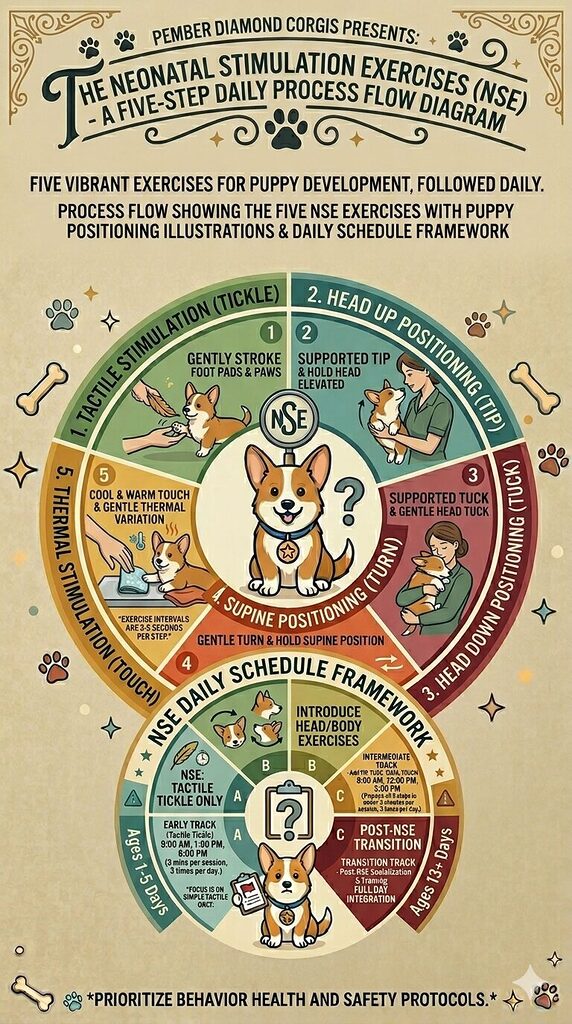
The U.S. Military Working Dog programme popularised a neonatal handling protocol — often referred to as the Bio-Sensor or "Super Dog" programme — in which puppies receive five specific exercises daily from day three to day sixteen. While the military context differs from companion or show breeding, the neurological outcomes are well-documented and directly applicable. The five exercises are brief (three to five seconds each per puppy) and performed once daily:
Tactile stimulation — tickle between the toes with a cotton bud
Head-held erect — hold the puppy perpendicular, head up
Head-pointed down — invert the puppy gently, head toward the ground
Supine position — hold on its back in the palm of one hand
Thermal stimulation — place on a cool, damp towel for a defined period
Studies cited in the Journal of Veterinary Behavior have noted that neonatal stimulation programmes correlate with improved cardiovascular performance, stronger adrenal systems, and greater tolerance for novel stimuli at eight weeks. For show Corgi puppies, the practical outcome is a puppy that recovers faster from handling stress and habituates more quickly to examination.
Implementation note
These exercises are distinct from general socialisation handling. They are not a substitute for ongoing human contact — they are a neurological priming tool used during the window before the eyes open.
Socialisation Protocols for Show Prospect Puppies
Socialisation for a show puppy is not the same as socialisation for a companion animal. The objectives overlap — produce a confident, adaptable animal — but the specific stimuli required for ring success go beyond routine exposure.
Between weeks five and eight, the priority is breadth of positive human contact. Every person who handles a puppy during this window should use calm, confident touch. Avoid rough handling. The hands of a judge examining a show dog move with deliberate, systematic purpose — a puppy that has only experienced affectionate, owner-style handling will read that clinical touch as unfamiliar and potentially threatening.
Between weeks eight and twelve, introduce environment-specific stimuli:
Non-slip rubber matting and hard, smooth flooring (both will be encountered in show environments)
Crowd noise and applause (audio tracks played at low volume, gradually increased)
Unfamiliar adults approaching directly and making sustained eye contact
Other dogs at controlled proximity — not interaction, proximity
Grooming table work at low height, with brief examination sequences
Between weeks twelve and sixteen, begin ring simulation:
Gaiting in a straight line on a lead, both directions
Stacking on command (or shaping toward a natural stand)
Table examination by a person who is not the primary handler
Exposure to tents, marquees, or unfamiliar outdoor environments
A minimum of three to five structured socialisation sessions per week during the human socialisation window is considered standard in professional show kennels. Sessions should not exceed fifteen minutes for puppies under eight weeks and twenty minutes for older puppies — mental fatigue reverses the gains.
For breeders looking to understand how early socialisation translates into day-to-day training foundations for new owners, the article Basic Corgi Training Techniques for Beginners on CorgiCrew provides a practical owner-facing companion to this professional framework.
Coat Care and Presentation Conditioning
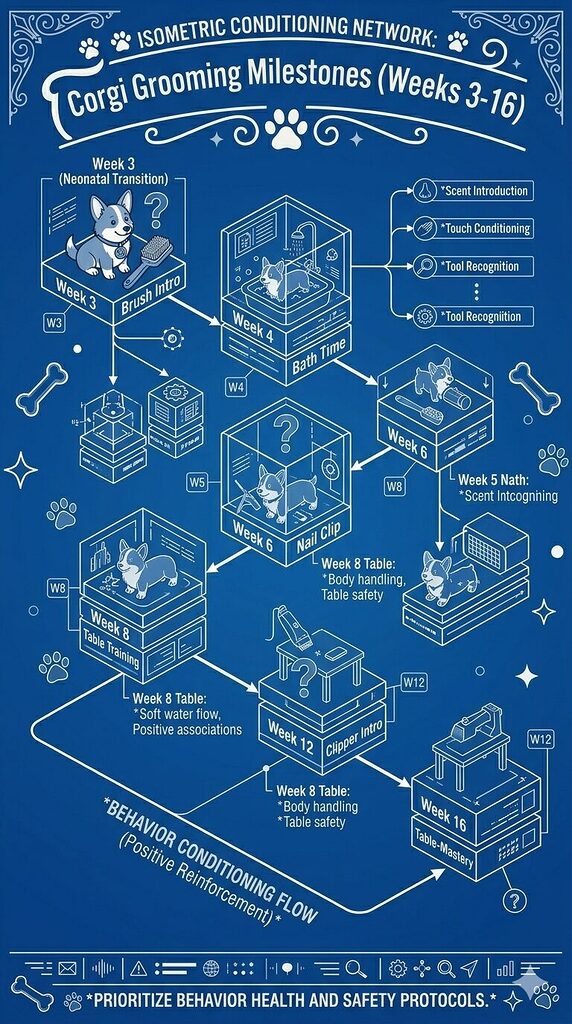
A Pembroke Welsh Corgi's double coat requires conditioning from the first weeks of life — not because the puppy coat needs specialist care, but because the handling behaviours associated with grooming must become a neutral, accepted routine before they are ever performed for practical necessity. Weeks three to eight: Introduce touch around the ears, muzzle, feet, and tail dock area (where applicable) daily. Use a soft brush across the body for thirty seconds. The objective is not grooming — it is desensitisation to the sensation and position.
Weeks eight to twelve
Introduce the grooming table. Begin with the puppy placed on the table for brief periods (two to three minutes) with calm praise and minimal restraint. Add a non-slip surface. Practise the examination sequence: fingers under chin, hands along the topline, feet lifted individually.
Weeks twelve to sixteen
Begin actual coat work appropriate to the puppy stage. For Pembrokes being prepared for the ring, this includes:
Ear fringe tidying with blunt-nosed scissors
Hock and foot neat-up
Whisker assessment (breed standard does not require removal, but judges' hands will move around the muzzle area)
Brushing against and with the coat lay to assess texture and density
Coat conditioning note
Show coat quality is substantially genetic, but condition — sheen, suppleness, and cleanliness — is a management outcome. Puppies raised on quality nutrition, with clean bedding and regular brushing, will enter their adult coat in superior condition to litter-mates raised in neglect. Diet influences coat from the inside; grooming routine influences it from the outside.
Ring Environment Exposure and Confidence Building
The show ring is, objectively, a high-stimulation environment. Unfamiliar surfaces, unfamiliar dogs, unfamiliar people, noise, movement, and the particular tension of competitive handling. A puppy encountering this environment for the first time at six months — without prior exposure — is placed at an immediate disadvantage, regardless of its conformation.
Confidence building is not a training technique. It is an environmental management strategy. Gradual exposure hierarchy for show Corgi puppies:
Home environment variety — rotating flooring surfaces, different rooms, outdoor terrain changes
Vehicle travel — short trips from week five onward, with positive associations built before any destination is associated with veterinary or examination stress
Public environments — markets, car parks, outdoor events; not dog shows, but environments with crowd density and ambient noise
Dog training clubs — observation of other breeds being handled; the smell, sound, and visual complexity of a training environment
Championship show attendance (as a passenger) — attend a show with the puppy not entered, simply to observe, from week fourteen onward
First ring entry — ideally a local, low-pressure match or breed club fun day before any formal championship entry
Each stage should be repeated a minimum of three times with positive outcomes before the next stage is introduced. A single difficult experience does not disqualify progression — but it should prompt a return to the previous stage for consolidation.
Breed club mentors and experienced handlers are an underutilised resource here. A puppy passed briefly to an experienced handler at a training session — even twice — gains exposure to the physicality of professional handling that the breeder's own touch cannot replicate.
Temperament management is perhaps the most misunderstood element of show puppy preparation. It is not about producing an artificial version of a dog's natural character — it is about creating the conditions in which a puppy's best temperament can express itself reliably, under pressure.
Temperament evaluation at six to eight weeks should be conducted by a person other than the primary breeder. The Volhard Puppy Aptitude Test (PAT) assesses ten attributes including social attraction, following, restraint, social dominance, elevation tolerance, retrieving, touch sensitivity, sound sensitivity, sight sensitivity, and stability. Scores are recorded on a 1–6 scale; show prospects typically fall in the 2–4 range across most categories — confident but not dominant, responsive but not reactive.
Red flags in show prospect temperament evaluation:
Consistent score of 1 (dominant/aggressive) in social dominance and restraint, management challenge in group classes and examination
Consistent score of 6 (highly submissive/fearful) in elevation and restraint, table examination will be problematic
Sound sensitivity score of 5 or 6, crowd environments will cause chronic stress — reconsider show placement
Touch sensitivity score of 1: may resist grooming and judge's examination, training investment will be significant
Ongoing temperament management between evaluation and ring entry:
Avoid inadvertently reinforcing fearful responses. Do not comfort a puppy that shies at a novel stimulus — redirect to a positive engagement instead. Use positive reinforcement consistently for examination tolerance and stillness. Food reward for stack position, for feet examination, for ears handled, creates a reliable behavioural foundation before formal show training begins.
Avoid harsh corrections during the fear imprint period (weeks eight to eleven). A single punishment-based interaction during this window can produce a lasting association between the examination context and negative experience.
Handler Training and Puppy Presentation Skills
The most correctly prepared puppy will underperform if the handler lacks skill. For breeders who intend to show their own dogs — or who place puppies with owner-handlers — presentation training must begin alongside puppy conditioning.
Stacking
The free stack (a naturally assumed show pose) and the hand stack (a position shaped and held by the handler) are both tools in a show handler's repertoire. Begin shaping the free stack using lure-based positive reinforcement from approximately ten weeks. The hand stack requires the puppy to accept physical positioning — this is only achievable if the handling desensitisation work described in Sections 3 and 4 has been completed.
Gaiting
Corgi puppies should begin lead work no later than seven to eight weeks on a lightweight slip lead or flat collar. The objective at this stage is not structured gait assessment — it is lead acceptance and directional following. By fourteen to sixteen weeks, straight-line gaiting with a consistent pace should be achievable. Circular gaiting (for ring presentation) is introduced once the puppy is comfortable and confident on a lead in outdoor environments.
Table presentation
The judge's examination table is the moment of greatest risk for a poorly prepared puppy. The examination sequence — head, mouth, body, testicles (males), feet, topline, tail — should be practised as a routine from week eight. Use a distinct verbal cue ("stand") paired with positive reinforcement. By sixteen weeks, a show prospect should remain still for a forty-five to sixty-second examination sequence performed by an unfamiliar adult.
Health Certificate Requirements and Pre-Show Documentation
No show preparation checklist is complete without the administrative and veterinary layer. A physically and behaviourally prepared puppy that lacks correct documentation cannot be entered in a sanctioned show, regardless of its quality.
Minimum veterinary requirements before first ring entry:
Full vaccination course completed per the current SAVA/WSAVA schedule (typically eight, ten or twelve, and sixteen weeks, depending on the protocol used)
Microchip implanted and registered to the breeder or new owner
KUSA registration confirmation (for puppies entered under owner's name, transfer must be complete)
Health certificate confirming puppy is free of parasites and in condition to exhibit
Breed-specific health screening considerations for Pembroke Welsh Corgis:
Hip evaluation (BVA/KUSA scheme or OFA): not required for puppies but should be planned for prior to first breeding use
Eye examination (ECVO/BVA scheme): progressive retinal atrophy (PRA) testing is strongly recommended in the breed
Von Willebrand's Disease (vWD) DNA testing: available and recommended, particularly for show-line Corgis
Degenerative Myelopathy (DM) DNA testing: SOD1 mutation test; both sire and dam should be tested before breeding
EXPERT INSIGHT
Specialist Observation — from an experienced Pembroke Welsh Corgi show breeder:
"The single most undervalued preparation tool in show puppy development is the thirty-second stranger examination. Not a long, thorough check — thirty seconds. The objective is not to simulate the judge's full examination; it is to build the puppy's expectation that unfamiliar hands mean something neutral or positive, and then end. Most breeders who struggle with puppies that shut down on the table have inadvertently conditioned them to find examination aversive by making early handling too long, too intense, or too corrective. The puppy that has been touched briefly and positively by forty different people before it is twelve weeks old will stand calmly for a judge it has never met, because it has learned — through sheer repetition — that strangers touching it means nothing bad ever follows.
The second insight most breeders discover too late. Floor surface matters more than almost any other single environmental variable. A puppy that has only ever stood on carpet or grass will falter on the rubber matting of an indoor ring. This one variable — rotating the surfaces a puppy walks on from week five onward — explains a significant portion of the confidence difference between puppies from the same litter at their first show."
FAQ SECTION
1. At what age should I start preparing a show Corgi puppy for the ring?
Preparation begins from day three with neonatal handling stimulation. The critical human socialisation window opens at five weeks. Ring-specific preparation — surface exposure, gaiting on lead, and table examination — is appropriate from twelve to fourteen weeks. The short answer is: there is no stage during which active preparation is premature, only stages where the type of preparation must be matched to neurological readiness.
2. How many times should a puppy be examined by a stranger before its first show?
A practical target is forty or more brief stranger examinations before sixteen weeks. This sounds demanding but is achievable across family members, veterinary staff, breed club contacts, and controlled public exposure. The emphasis is on variety — different heights, gender presentations, and handling styles — and brevity. Thirty seconds per interaction is sufficient; longer sessions risk fatigue and sensitisation.
3. What is the ideal temperament score for a show prospect on the Volhard PAT test?
Show prospects typically score 2–4 across most of the ten Volhard categories. A score of 2 indicates confident, trainable, and willing to work with people — the ideal show temperament. Scores of 1 (dominant) and 5–6 (fearful/submissive) in restraint and elevation categories are the most predictive of ring-handling challenges. No single score disqualifies a puppy, but consistent patterns across categories carry strong predictive weight.
4. Can a puppy with a fear response during the imprint period still become a show dog?
Yes — but recovery requires targeted desensitisation work and time. The fear imprint period (weeks eight to eleven) is the most sensitive window, not an irreversible one. A single negative experience can be countered with multiple carefully managed positive re-exposures to the same stimulus. The key is not to avoid the stimulus entirely — avoidance confirms the fear — but to re-introduce it at a sub-threshold intensity with positive reinforcement.
5. How should breeders handle socialisation for show puppies during the period between eight and twelve weeks when they cannot yet be vaccinated in public?
This is a documented veterinary tension. The WSAVA's revised guidance acknowledges that the behavioural cost of under-socialisation during the critical window can exceed the infectious disease risk in many environments. Breeders should seek guidance from their veterinarian on a contextual risk assessment, and focus on controlled, low-exposure environments: the homes of vaccinated-dog owners, training clubs with entry hygiene protocols, and carry-in (rather than walking) public exposure until vaccination is complete.
6. What coat care routine is appropriate before a puppy’s first show?
From twelve weeks, a show Corgi puppy should be on a weekly brushing and examination routine. Two to three days before any show, perform a full tidy: ears, hocks, feet, and any flyaway coat on the hindquarters. Bathing should occur four to seven days before the show — not the day before, as a freshly bathed coat often lacks the texture and density that judges assess. Coat conditioner is used sparingly; the Pembroke's double coat should have a hard outer layer, not a soft conditioned finish.
7. When should health certificate documentation be arranged for a show puppy?
A health certificate from a registered veterinarian should be obtained within seven to ten days of the intended show date. Most show schedules specify the required documentation in the entry conditions. KUSA registration must be confirmed — and, where applicable, transfer of ownership completed — before the entry closing date, not the show date. Allow a minimum of three to four weeks for any administrative processes with KUSA.
8. What is the most common mistake breeders make when preparing show Corgi puppies?
Over-protection during the fear imprint period. Breeders who restrict exposure during weeks eight to eleven to avoid negative experiences frequently produce puppies that have insufficient resilience to the novel stimuli of a show environment. The objective is not to expose puppies to stressful experiences — it is to ensure that the show ring is not the first complex environment they have encountered. Controlled, positive, varied exposure during this period builds the resilience that formal show preparation later relies on.
9. How do I assess whether a puppy should be placed as a show prospect versus a companion placement?
Conformation assessment is ideally conducted at approximately seven to eight weeks by an experienced breeder or specialist who can evaluate structure objectively. Temperament assessment using the Volhard PAT complements the structural evaluation. A puppy may have excellent structure but a temperament profile (high fearfulness or high dominance) that makes show placement unethical or impractical. The most responsible placement decisions weigh both dimensions equally.
10. How does early socialisation by the breeder affect the training that show puppy owners will undertake?
Substantially. A well-socialised puppy that has been exposed to lead work, examination, varied surfaces, and positive reinforcement during the breeder's care period will progress through owner-led training at a significantly faster rate. The owner is not starting from zero — they are building on a neurological and behavioural foundation that the breeder established. This is one of the clearest arguments for the show community investing in structured breeder preparation programmes. For a practical guide on what owners can build on this foundation, see Basic Corgi Training Techniques for Beginners on CorgiCrew.
CONCLUSION
Three takeaways define the breeder puppy prep checklist for show prospects:
Firstly, the developmental stage timeline is not a guideline — it is a neurological reality. The windows for socialisation, exposure, and conditioning are finite. A puppy prepared systematically across each stage arrives at ring age with a resilience and adaptability that training alone cannot replicate.
Secondly, temperament management and coat conditioning are equally important as conformation assessment. A correctly structured puppy with poor ring temperament or inadequate presentation conditioning will consistently underperform. Both are manageable outcomes — but only if the preparation work begins before the critical windows close.
Thirdly, documentation and health certificate compliance are not administrative afterthoughts. They are the professional layer of show puppy preparation that distinguishes an organised breeding programme from an ad hoc one.
For breeders in the Show Puppies & Competitions category, the preparation work described here is not extra effort — it is the work. Every hour invested before sixteen weeks compounds into the performance outcomes that define a kennel's reputation over time. The ring reveals what the whelping room built.
CALL TO ACTION
If you found this checklist useful, explore the full training and development resource library on PemberDiamonds — where the series on Pembroke Welsh Corgi champion development and the attention and focus framework for show dogs provide the next layer of professional preparation that this checklist introduces. PemberDiamonds exists to support breeders who take preparation as seriously as their breeding programme — because the two are inseparable.