
What Is Your Corgi Actually Saying? Introducing the Corgi Body Language Decoder
A free interactive tool — grounded in Corgi Chronicles — that helps you understand every signal your Corgi sends, in real time.
Imagine being able to look at your Corgi right now — tail up, ears pricked, body very still — and know exactly what is going through that brilliant, stubborn, utterly endearing mind.
That is precisely what the Corgi Body Language Decoder is designed to help you do.
We built this tool because one of the most common questions we hear from Corgi owners — whether they are welcoming their first puppy or living with their fifth — is some version of: "I can't always tell if my Corgi is happy, anxious, excited, or about to do something I'm going to regret." And that question deserves a proper answer, rooted not in guesswork but in the frameworks developed in Corgi Chronicles: A Training Guide for Pembroke and Cardigan Welsh Corgis by Morgan Heeler-Davies.
Why Body Language Is the Real Conversation
 Corgi Chronicles opens with a statement that we think every Corgi owner needs to hear: Corgis are far more than their charming, stumpy-legged exterior suggests. Beneath their cute appearance lies a sophisticated communication system.
This isn't poetic licence. Corgis are working dogs at their core — bred in Wales to herd cattle many times their size, making rapid, independent decisions in high-stakes environments. That heritage has produced a dog with a multilayered communication strategy that goes well beyond simple barks and tail wags.
"Their communication is a delicate blend of body language, vocal expressions, and subtle physical cues that reveal their emotional and mental states. Understanding this language requires patience, observation, and a willingness to see beyond surface-level interactions." — Corgi Chronicles, Chapter 1
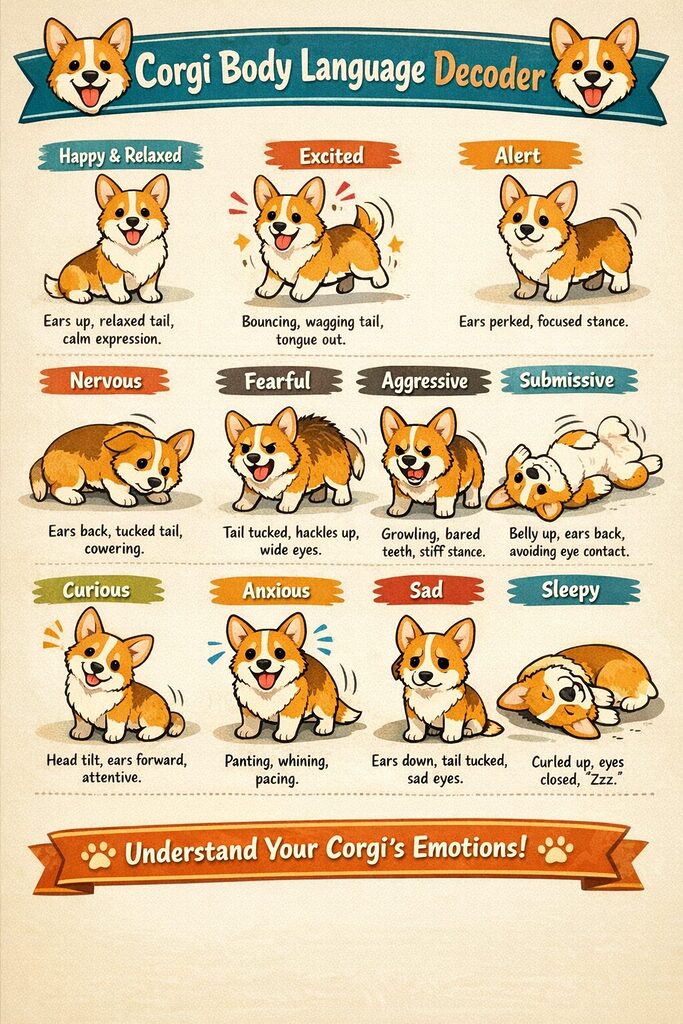
The problem is that most of us were never taught to read it. We learn that a wagging tail means happiness — and sometimes it does. But Corgi Chronicles distinguishes between a raised and rapidly wagging tail (excitement and joy), a horizontal and still tail (calm alertness), a tucked tail (fear or submission), and a stiff, high tail (potential aggression or intense focus). Same body part, four entirely different conversations.
Multiply that across ears, eyes, posture, and vocal patterns — and you begin to understand just how much your Corgi is telling you every single moment of every day.
What the Decoder Is — and What It Isn’t
The Corgi Body Language Decoder is a free, interactive web tool. It does not require an internet connection after it has been opened, does not collect any data, and does not need an account. You open it, tell it your name, your Corgi's name, age, and gender — and from that moment, everything it says is personalised to your dog.
It is not a diagnostic tool and it is not a replacement for a veterinarian or a professional trainer. What it is is a guided reference — a way to make the frameworks in Corgi Chronicles accessible and immediately useful in the middle of an ordinary day with your Corgi.
| Every interpretation in this tool is drawn directly from Chapter 1 (Understanding Corgi Communication) and Chapter 3 (The Art of Canine Communication) of Corgi Chronicles by Morgan Heeler-Davies. The book's exact terminology, case studies, and frameworks are used throughout. |
How to Use It
Step 1: The welcome screen
When you open the tool, you will see a welcome card featuring the Corgi Chronicles pencil illustration. You will be asked for four things: your name, your Corgi's name, your Corgi's age, and their gender. This information is used only to personalise what the tool tells you — every explanation, every response suggestion, every fun fact will refer to your Corgi by name and use the correct pronouns throughout.
Step 2: Select a body part
Once inside, you will see the main decoder interface. On the left is the Corgi illustration and five selection buttons: Ears, Eyes, Posture, Tail, and Mouth. These correspond to the five signal systems that Corgi Chronicles identifies as primary communication channels.
Tap or click whichever body part is most relevant to what you are observing in your Corgi right now.
Step 3: Choose a signal
Each body part reveals four specific signals — each one drawn directly from the book. For Ears, for example, you can select from: Erect and forward, Slightly back and relaxed, Pinned flat back, or One ear up and one down. For Tail: Raised and wagging rapidly, Horizontal and still, Tucked under, or Stiff and high.
Select the one that best matches what you are observing.
Step 4: Read the interpretation
The tool immediately displays three things:
- The emotional state label — drawn directly from Corgi Chronicles' terminology (for example: "Attentive and Interested" or "Fear or Potential Aggression")
- A full explanation of what the signal means — what Corgi Chronicles says about it, including the contextual nuances that make all the difference
- A specific response suggestion — what Corgi Chronicles recommends you do right now, in plain language
Below the interpretation you will also find a Corgi Chronicles fact — a piece of breed-specific insight from the book that gives you a deeper understanding of why your Corgi communicates this way.
Step 5: Build a picture across multiple signals
This is where the tool becomes genuinely powerful. The progress bar at the top of the screen tracks how many of the five body areas you have observed. As you select signals across multiple areas, the Observed Signals panel on the left builds up a running summary.
When two or more signals are selected, the tool generates a combination reading — a synthesis of what the combined picture most likely means. A loose wiggly body paired with soft eyes and a mid-height tail wag reads very differently from a stiff body, hard stare, and high rigid tail. The combination reading helps you see the whole conversation, not just individual words.
Step 6: Reset and start again
The Reset button in the top bar clears everything and returns you to the welcome screen. This is useful when your Corgi's mood has shifted, when you want to observe a different situation, or when you are using the tool with a puppy and want to track changes over time.
What You Will Learn to Recognise
Corgi Chronicles identifies three categories of signals that every Corgi owner should be able to read fluently. The decoder is built around all three.
Stress indicators
Corgi Chronicles lists these specifically: lip licking, yawning when not tired, avoiding eye contact, rapid panting, dilated pupils. These are subtle signals that appear before more obvious behaviour — if you can read them early, you can help your Corgi before they ever need to escalate.
Confidence signals
Relaxed posture, soft eye contact, loose body movement, the mid-height relaxed tail wag. These tell you your Corgi feels safe, settled, and ready to engage. Corgi Chronicles emphasises that these signals should be actively reinforced — they are the emotional foundation of a well-trained, happy Corgi.
The Iconic Corgi Lean
Corgi Chronicles devotes an entire section to this. When your Corgi leans against you, they are not just seeking physical comfort — they are establishing pack connection, showing profound trust, and seeking emotional reassurance. The decoder has a specific signal for this, with the full context from the book.
The Case of Max — Why This Matters in Practice
 Corgi Chronicles includes a case study that illustrates exactly why understanding body language changes everything. Sarah's Corgi, Max, displayed reactivity toward other dogs. His tail positioning and ear movements indicated anxiety — but because this wasn't recognised, his behaviour was initially treated as aggression.
The shift in approach — once Sarah could read Max's signals correctly — was transformative. Positive reinforcement, controlled socialisation, and a recognition that reactive behaviours often stem from fear rather than hostility turned Max's training around entirely.
"Reactive behaviors may stem from fear or insecurity, not hostility. Observing body language such as tucked tails or flattened ears can guide more effective training interventions." — Corgi Chronicles, Chapter 1 Case Study
This is what the decoder is ultimately about — not just understanding what your Corgi is doing, but understanding why, so that your response comes from knowledge rather than frustration.
Five Benefits of Using the Decoder Regularly
- You respond to your Corgi's actual emotional state — not your interpretation of it. This reduces miscommunication and builds genuine trust.
- You catch stress signals early, before they escalate. Corgi Chronicles is clear that prevention is always easier than correction.
- Training sessions become more effective. Corgi Chronicles notes that erect, forward ears during a session indicate your Corgi is in peak learning mode — the decoder helps you time your training to match that state.
- You strengthen the bond. Corgi Chronicles describes the relationship between owner and Corgi as a "reciprocal dialogue" — the decoder helps you hold up your side of that conversation.
- You develop lasting fluency. Over time, you will stop needing the tool — because you will have internalised its frameworks and will read your Corgi naturally, the way fluent speakers read a language.
| The Corgi Body Language Decoder is one of ten interactive tools being developed from the frameworks in Corgi Chronicles. Each tool is designed to take a specific chapter of the book and make it immediately, practically useful for Corgi owners in their everyday lives. |
A Note on Corgi Chronicles
Everything in the Corgi Body Language Decoder is grounded in Corgi Chronicles: A Training Guide for Pembroke and Cardigan Welsh Corgis by Morgan Heeler-Davies — the definitive training manual available through our kennel websites.
The book covers eleven chapters, from understanding Corgi communication and the science of positive reinforcement, through behavioural challenges, nutrition, life stages, and common training mistakes. The decoder draws primarily from Chapters 1 and 3 — but the full book is essential reading for any Corgi owner who wants to understand their dog at the deepest level.
If you don't yet have your copy, visit the link below. It is one of the most valuable investments you will make in your relationship with your Corgi.