Vaccines, vet visits, developmental stages, and what to watch for — from 8 weeks to 12 months. Applies to: Beagle and Pembroke Welsh Corgi puppies · Published by the Pember Diamonds Knowledge Network.
The first year of a puppy's life is the most medically and developmentally dense period they will ever go through. More happens between 8 weeks and 12 months — physically, neurologically, behaviourally, and immunologically — than in all the years that follow combined.
This guide gives you a clear picture of what to expect each month: which vaccines are due, what developmental shifts are happening, what your vet is looking for, and where Beagles and Corgis differ in ways that matter. It is not a substitute for your own vet's advice, but it will help you walk into every appointment as an informed owner rather than a passive one.
One important note on timing. Your puppy left its breeder at 8 weeks. Everything in this guide counts from that point. If your puppy arrived later — say, at 10 weeks — simply adjust accordingly.
Before We Begin
Understanding Puppy Vaccinations
Vaccines work by prompting the immune system to build antibodies against specific diseases. In young puppies this process is complicated by one important factor: maternal antibodies. Puppies receive antibodies from their mother through her milk, particularly in the first 24–48 hours via colostrum. These maternal antibodies provide early protection but also interfere with vaccines — they can neutralise a vaccine before the puppy's own immune system has a chance to respond. The problem is that maternal antibody levels vary between individual puppies and decline at different rates, typically somewhere between 6 and 16 weeks of age.
This is why vaccines are given in a series rather than a single shot. By vaccinating repeatedly across several weeks, we increase the probability that at least one dose lands after maternal antibodies have faded — and the puppy's immune system can finally mount its own full response.
Core vaccines your puppy will receive (South African context):
DHPPi — Distemper,
Hepatitis (Adenovirus),
Parvovirus,
Parainfluenza.
The non-negotiable foundation of any puppy vaccination protocol.
Rabies — Legally required in South Africa. Given as a single injection, typically from 12 weeks onwards.
Leptospirosis (Lepto 4) — Recommended in most South African urban and peri-urban environments. Leptospira bacteria are spread through the urine of infected animals (including rats) and can survive in standing water and damp soil. Given as two doses, 3–4 weeks apart.
Kennel Cough (Bordetella / Parainfluenza) — Recommended if your dog will attend puppy classes, boarding facilities, dog parks, or groomers. Often given as an intranasal spray. Some vets include Parainfluenza in the DHPPi combination; others vaccinate separately.
Non-core vaccines (discuss with your vet based on lifestyle and region):
Canine coronavirus
Lyme disease (less relevant in most of South Africa)
A note on vaccine brands. Your vet will use whatever quality products they stock — Nobivac, Eurican, Vanguard, and Canigen are among the brands commonly available in South Africa. The brand matters less than the protocol being followed correctly.
Deworming
The Ongoing Commitment
Deworming is not a once-off event. Puppies are routinely born with roundworm (Toxocara canis) passed from the mother, and they continue to be exposed to intestinal parasites throughout their lives.
Standard protocol for puppies:
Deworm every 2 weeks from 2 weeks of age until 12 weeks
Monthly from 12 weeks to 6 months
Every 3 months for life thereafter
Your breeder will have started this process before your puppy came home. Ask them for the deworming record so your vet can continue from the right point. Products commonly used in South Africa. Drontal, Milbemax, Cazitel, and Panacur are widely available. Some products cover roundworm and tapeworm only; others include whipworm and hookworm. Your vet can advise on what's appropriate for your puppy's lifestyle and region. Tapeworm is transmitted via fleas — another reason tick-and-flea prevention is not optional. If your puppy has fleas, treat for tapeworm too.
Tick, Flea & Heartworm Prevention
South Africa has significant tick pressure in many regions, and ticks carry serious diseases including tick-bite fever (ehrlichiosis, anaplasmosis) and babesiosis (biliary), which can be fatal in dogs if not treated promptly.
Prevention should begin as soon as your puppy is old enough for the chosen product — usually from 8 weeks, though this varies by product. Discuss with your vet which format suits your situation: spot-on, collar, or oral chewable.
Heartworm (Dirofilaria immitis, transmitted by mosquitoes) is present in South Africa, particularly in warmer, more humid coastal regions. Monthly preventatives cover heartworm alongside intestinal worms in many combination products. Ask your vet whether heartworm prevention is relevant in your area.
Month-by-Month Timeline
8 Weeks — Arrival
What's happening developmentally: Your puppy has just entered the second half of the primary socialisation window (which runs from approximately 3 to 12 weeks). This is one of the most neurologically sensitive periods of their life. Positive exposures to people, sounds, surfaces, other animals, and environments during this window shape how the adult dog relates to the world. The brain is laying down emotional and behavioural templates that are difficult to rewrite later.
At the same time, your puppy is also at peak vulnerability — their immune system is still maturing, maternal antibodies are declining, and the stress of leaving their mother and littermates temporarily suppresses immune function. These two realities — socialise urgently, but protect carefully — create the central tension of early puppyhood.
Health priorities:
Your puppy should have received at least one DHPPi vaccine from the breeder, typically at 6 weeks. Confirm this from the vaccination booklet. Book a new-puppy vet check within the first 48–72 hours of arrival if possible. This is not just about vaccines — it is your vet's opportunity to examine the puppy before you become attached, and to identify any congenital issues the breeder may not have disclosed or noticed. Confirm the deworming schedule and continue without a gap. Begin tick-and-flea prevention immediately if not already started.
What your vet will check: Heart (murmurs are not uncommon in young puppies and most resolve), eyes, ears, bite alignment, umbilical area, genitalia, coat and skin condition, lymph nodes, and overall body condition score.
Breed watch — Corgi: Pembroke Welsh Corgis can carry the MDR1/ABCB1 gene mutation (a drug sensitivity issue more commonly associated with herding breeds like Collies but occasionally seen in Corgis). While this is not routine screening in South Africa, it is worth mentioning to your vet if your puppy ever reacts unexpectedly to medications.
Breed watch — Beagle: Beagles are generally robust at this age, but are known to carry genetic conditions including Musladin-Lueke Syndrome (MLS), Beagle Pain Syndrome (Steroid-Responsive Meningitis-Arteritis), and factor VII deficiency. A reputable breeder will have health-tested their breeding stock — confirm this with your breeder's documentation.
9–10 Weeks — First Vet Appointment
What's happening developmentally: The socialisation window is still wide open. Your puppy's brain is absorbing and categorising experiences at a rate it will never match again. Fear responses are beginning to emerge — a puppy that was bold at 7 weeks may seem more cautious now. This is normal. Keep introductions gentle, positive, and low-pressure. Sleep is still enormous — 16–18 hours per day is not unusual and is entirely healthy. Growth is rapid.
Health priorities:
DHPPi booster — due at approximately 9–10 weeks if the first dose was given at 6 weeks, or at 8 weeks if this is the first dose.
Leptospirosis — first dose — can often be given at the same appointment as the DHPPi.
Continue deworming every 2 weeks.
Socialisation note:
Your vet clinic waiting room is a significant infection risk at this age — your puppy is not yet fully protected. Carry your puppy rather than placing them on the floor. Ask your vet whether they have a separate waiting area for unvaccinated puppies.
Practical tip:
Start handling exercises at home now — gently touching paws, ears, mouth, and tail daily. This makes every future vet examination, grooming appointment, and nail trim significantly easier for everyone involved.
11–12 Weeks — Second Booster & Rabies
What's happening developmentally: Many puppies pass through a brief fear imprint period around 8–10 weeks, and again around 6–14 months. Between these, most puppies are in a relatively confident phase — curious, playful, and increasingly bold. Make the most of this window for positive new experiences. Teething has not yet begun in earnest (that comes around 4 months), but chewing behaviour is already present. Provide appropriate outlets.
Health priorities:
DHPPi — second or third booster, depending on when the series started. Your vet will advise.
Leptospirosis — second dose (3–4 weeks after the first).
Rabies vaccination — can be given from 12 weeks. In South Africa, annual rabies boosters are required by law.
Kennel cough — if your puppy will attend puppy classes (strongly recommended), the kennel cough vaccine should be given at least one week before the first class. Intranasal vaccines take effect within 3–5 days; injectable forms require longer.
Deworming:
Continue monthly from 12 weeks onwards.
Puppy classes:
Socialisation in a structured class environment is one of the most valuable investments you will make in your puppy's future behaviour. The South African Veterinary Association and most veterinary behaviourists endorse puppy socialisation classes from as early as 7 days after the first vaccine dose, provided the class environment is clean and the other puppies are also vaccinated. The risk of a behavioural problem from inadequate socialisation significantly outweighs the (small, manageable) infection risk of a well-run puppy class.
13–16 Weeks — Final Primary Course Vaccine
What's happening developmentally: This is often when the primary socialisation window closes. After roughly 12–14 weeks, new experiences begin to be approached with more caution, and the foundation of what is "normal and safe" has largely been laid. Continued exposure remains important — the window closing does not mean socialisation stops — but the neurological scaffolding is largely in place.
Puppies at this age are increasingly interactive, testing boundaries, and beginning to show more of their adult personality. Sleep is still substantial but decreasing.
Health priorities:
DHPPi — final booster in the primary course, typically at 14–16 weeks. This dose is critical: it is the one most likely to land after maternal antibodies have fully cleared, ensuring the puppy's immune system generates a complete, durable response.
Some vets recommend a titre test (blood test measuring antibody levels) 2–3 weeks after this final booster to confirm the puppy has seroconverted. This is not universally offered in South Africa but is becoming more accessible and is worth asking about.
Breed watch — Corgi:
Corgi puppies begin showing more herding instincts around this age — circling, chasing, and occasionally nipping at heels (including children's). This is entirely normal breed behaviour and should be redirected rather than punished. Puppy classes and consistent positive training are essential.
Breed watch — Beagle:
Beagle puppies are increasingly driven by scent at this age. A Beagle that gets its nose down can become oblivious to everything else — including recall cues. Begin recall training in very low-distraction environments now, while the habit is still easy to build. A Beagle that is unreliable on recall is a Beagle that cannot be safely exercised off-lead.
4 Months — Teething Begins
What's happening developmentally: The deciduous (baby) teeth begin to be replaced by permanent teeth from approximately 3.5–4 months. This process continues until about 6–7 months. Puppies chew more, may be briefly off their food, and gums can be tender. Occasionally a retained deciduous tooth (one that doesn't fall out when the permanent tooth erupts) needs veterinary attention — your vet will check for this at routine appointments.
Health priorities:
No new vaccines are typically due at this appointment unless catch-up is needed.
Check teeth: Note any retained baby teeth — particularly canines — and mention them to your vet.
Continue monthly deworming.
Review tick-and-flea prevention — your puppy is growing and product dosing may need to be adjusted.
Nutrition check:
By 4 months, most puppies have settled into their feeding routine. This is a good time to reassess whether you're feeding the right amount — growth rates vary considerably between individuals, and both Beagles and Corgis have a strong tendency toward weight gain if portions are not carefully managed.
Breed watch — Beagle:
Beagles are notorious food thieves and counter-surfers. Management now — securing bins, not leaving food accessible, teaching "leave it" — is far easier than trying to break well-rehearsed habits later.
5–6 Months — Adolescence Begins
What's happening developmentally: This is when many owners feel they have "lost" the puppy they knew. Adolescence is real, it is neurological, and it is temporary — but it can be profoundly frustrating if you are not expecting it.
The adolescent brain is undergoing significant remodelling. The limbic system (emotion, impulse) is running hot; the prefrontal cortex (impulse control, decision-making) is lagging behind. The result is a dog that seems to have forgotten everything you taught it, is more easily distracted, more reactive, and more likely to take off after a scent or a squirrel than return to you on cue.
This phase typically peaks between 5–8 months and gradually eases through the first and second year as the brain matures. Consistency, patience, and continuing to train — even when it feels futile — are the prescription.
Health priorities:
Spay/neuter discussion
If you are considering neutering, discuss timing with your vet now. The evidence around optimal neutering age has shifted considerably in recent years. Earlier research suggesting early neuter (before 6 months) is being revisited in light of studies showing associations between early gonadectomy and increased risk of certain joint disorders and some cancers — particularly in larger breeds. For Beagles and Corgis, the risk profile is less pronounced than in large breeds, but the conversation is worth having. Many South African vets now recommend waiting until after the first heat in females and between 9–18 months in males.
Continue monthly deworming through 6 months, then move to every 3 months.
Breed watch — Corgi:
Corgis can become noticeably more reactive and vocal during adolescence. Barking that felt manageable at 10 weeks can escalate quickly. Address it early with training rather than waiting for it to pass — it typically doesn't.
6 Months — Mid-Year Health Check
What's happening developmentally: Most puppies have their full set of permanent teeth by 6–7 months. Physical growth continues, particularly in terms of muscle development and body fill, but the most rapid height gains are behind them.
Health priorities:
6-month vet check — a good time for a general health review even if no vaccines are due.
Teeth: confirm all permanent teeth have come through and no deciduous teeth are retained.
Body weight and condition score: Beagles and Corgis both tend to gain weight easily. Assess whether the current feeding amount is still appropriate.
Heartworm test (if relevant to your region) before starting or continuing preventatives.
Hip and joint note:
While formal hip scoring in Corgis and Beagles is less common than in large breeds, joint development is still worth monitoring. If you notice any changes in gait, reluctance to use stairs or jump, or stiffness after rest, mention it to your vet.
7–9 Months — Deep Adolescence
What's happening developmentally: This is frequently the hardest stretch. The dog is physically large enough to be strong and fast, but neurologically still an adolescent. Many dogs are surrendered during this period by owners who mistake normal adolescent behaviour for permanent character flaws.
In intact males, testosterone is rising and social behaviour toward other dogs may begin to change — increased interest in females in season, and occasionally more assertiveness with other male dogs.
In females, the first season typically occurs between 6–12 months, though Beagles and Corgis vary. Signs include a swollen vulva, bloody vaginal discharge, and increased attention-seeking or restlessness. A season lasts approximately 3 weeks. Keep intact females away from intact males throughout.
Health priorities:
No vaccines due in most protocols during this period.
If your dog will be kennelled, confirm kennel cough vaccination is current.
Continue tick-and-flea prevention; reassess dosing as body weight increases.
Quarterly deworming from 6 months onward.
Training note:
Do not abandon training during adolescence. Keep sessions short (5–10 minutes), positive, and frequent. Lower your expectations, increase your reinforcement rate, and manage the environment to prevent unwanted behaviours from being rehearsed. This phase ends.
10–11 Months — Approaching the First Birthday
What's happening developmentally: Many puppies begin to settle noticeably around 10–12 months — not fully, but the edge starts to come off. Concentration improves, recall becomes more reliable, and the dog's personality clarifies into something more predictable and consistent. Physical development is largely complete in both Beagles and Corgis by 12 months, though muscle tone and mental maturity continue to develop into the second year.
Health priorities:
Begin thinking ahead to the 12-month booster appointment.
If your dog hasn't been microchipped, now is a good time (if not done by the breeder). Microchipping is not yet legally mandated across all South African provinces but is strongly recommended and increasingly required by local authorities.
12 Months — The First Annual Booster
What's happening developmentally: Happy first birthday. Your puppy is technically a young adult dog. The hardest neurological and immunological work of the first year is behind you.
Health priorities:
Annual booster. DHPPi (or a triennial DHPPi protocol, depending on your vet's approach and the products used), Leptospirosis, and Rabies (legally required annually in South Africa).
Full annual health check. Weight, teeth, ears, eyes, heart, abdomen, skin and coat, joints. Establish a baseline now that your vet can track against in future years.
Discuss adult feeding. Transition from puppy food to adult food typically happens around 12 months for Beagles and Corgis. Your vet can advise on appropriate adult portion sizes.
Dental health:
Begin a toothbrushing routine if you haven't already. Dental disease is the most common preventable health problem in adult dogs.
Expert Perspective
'The first year of a puppy's life is genuinely the most consequential window a veterinarian gets to work in. What we do — and what owners do — in those first twelve months has an outsized effect on the animal's long-term physical health, behavioural stability, and quality of life. The vaccine schedule is the obvious priority, and this guide covers it accurately, but in my experience the piece owners most frequently underestimate is the relationship between the socialisation window and the vaccination timeline. These two imperatives overlap uncomfortably, and the temptation to keep an incompletely vaccinated puppy at home until the course is finished is understandable — but the cost to behavioural development can be significant and lasting. A well-run puppy class with vaccinated animals in a clean environment is, in most cases, the lower-risk choice. The diseases we vaccinate against are serious; so is a fearful or reactive adult dog. What I would add to any first-year guide is this: build the habit of observation early. Owners who learn to read their dog — body condition, energy levels, stool quality, coat, gait, appetite — become far more effective partners in their animal's health than those who rely solely on annual appointments. Most of the serious problems I catch in young dogs were preceded by subtle changes the owner noticed but didn't know were worth mentioning. There are no stupid observations in a consult room. The owners who say "this is probably nothing, but I noticed..." are frequently the ones who catch something early enough to matter. That habit, built in the first year, tends to last a lifetime."
1. My puppy came home at 8 weeks. Does the timeline count from birth or from when I got them?
From when you got them — or more precisely, from 8 weeks of age, which is the standard age at which puppies leave their breeder in South Africa. Everything in the timeline is anchored to that point. If your puppy arrived at 10 weeks rather than 8, simply shift each milestone forward by two weeks and discuss the adjusted schedule with your vet.
2. Why does my puppy need so many vaccine doses? Can’t one injection do the job?
The short answer is that one injection often can't — at least not reliably. The complicating factor is maternal antibodies: protective antibodies passed from mother to puppy through colostrum in the first 24–48 hours of life. These antibodies provide early protection but also interfere with vaccines, essentially neutralising them before the puppy's own immune system can respond. Because maternal antibody levels vary between individual puppies and decline at different rates — anywhere between 6 and 16 weeks — we vaccinate repeatedly to improve the odds that at least one dose lands in the clear window after maternal protection has faded. The final booster at 14–16 weeks is the most important for this reason.
3. Which vaccines does my puppy absolutely need?
In South Africa, the non-negotiable core vaccines are DHPPi (Distemper, Hepatitis/Adenovirus, Parvovirus, Parainfluenza) and Rabies — the latter is legally required. Leptospirosis is strongly recommended in most South African urban and peri-urban areas because the bacteria survive in standing water and damp soil and are spread through infected animal urine, including rats. Kennel cough (Bordetella/Parainfluenza) is recommended for any puppy that will attend classes, boarding facilities, dog parks, or groomers. Your vet will advise on anything beyond these based on your dog's lifestyle and region.
4. Does it matter which vaccine brand my vet uses?
Less than you might think. Nobivac, Eurican, Vanguard, and Canigen are among the brands commonly available in South Africa, and all are quality products when used correctly. What matters far more than brand is that the correct protocol is followed — the right doses at the right intervals. If your vet switches brands between appointments it is not a problem, provided the schedule is maintained.
5. My puppy was dewormed by the breeder. Do I need to continue?
Yes, without a gap. Deworming is an ongoing commitment, not a once-off event. Puppies are routinely born with roundworm passed from the mother, and they continue to be exposed to intestinal parasites throughout their lives. The standard protocol continues at fortnightly intervals until 12 weeks, monthly from 12 weeks to 6 months, and then every three months for life. Ask your breeder for the deworming record so your vet can pick up from exactly the right point.
6. When should I start tick and flea prevention, and does it really matter?
From 8 weeks, or as soon as your puppy is old enough for the chosen product — check the age and weight minimums on whatever your vet recommends. It absolutely matters. South Africa has significant tick pressure, and ticks here carry serious diseases including biliary (babesiosis) and tick-bite fever (ehrlichiosis, anaplasmosis), both of which can be fatal if not treated promptly. There is no safe period to skip prevention and see what happens. Your vet can advise whether a spot-on, collar, or oral chewable is the right format for your situation.
7. Is it safe to take my puppy to puppy classes before they are fully vaccinated?
Yes, with sensible precautions — and it is strongly recommended that you do. The risk of a serious behavioural problem from inadequate socialisation during the critical window (which closes around 12–14 weeks) is considerably greater than the infection risk of a well-run puppy class. Most veterinary behaviourists endorse puppy classes from 7 days after the first vaccine dose, provided the environment is clean and all attending puppies are also vaccinated. Have the kennel cough vaccine given at least one week before the first class, and carry your puppy at the vet clinic rather than placing them on the floor.
8. What is the socialisation window and why does it matter so much?
The primary socialisation window runs from approximately 3 to 12 weeks of age. During this period, your puppy's brain is forming the emotional and behavioural templates that determine how the adult dog relates to the world — to people, sounds, environments, other animals, handling, and new experiences. Positive exposures during this window are extraordinarily powerful. The window closing does not mean socialisation stops, but the neurological scaffolding is largely in place by 12–14 weeks, which is why breeders and vets emphasise acting within it. There is also a second, briefer fear phase around 8–10 months — handle new experiences gently during this period.
9. My Corgi puppy keeps nipping at heels and circling family members. Is something wrong?
Nothing is wrong — this is entirely normal herding behaviour, and it typically becomes more pronounced from around 13–16 weeks as the puppy's breed instincts begin to express themselves. Corgis were bred to move livestock by nipping at heels, and your ankles and your children's feet are, to a Corgi puppy, reasonable substitutes. The behaviour should be consistently redirected rather than punished. Puppy classes and positive training are the most effective tools. Left unaddressed, it can escalate during adolescence.
10. My Beagle puppy ignores me completely the moment their nose goes down. Is this fixable?
It is manageable with the right approach — but you are working with the grain of thousands of years of selective breeding, so it requires consistency and realism. Beagles are scenthounds and their nose is their primary sense; once a scent trail is engaged, most other stimuli genuinely fade. The key is to begin recall training early, in very low-distraction environments, and to build the habit before the adolescent brain makes everything harder. A Beagle that is unreliable on recall cannot safely be exercised off-lead. Many experienced Beagle owners manage this through long lines and secure enclosed spaces rather than expecting off-lead reliability in open areas.
11. When should I have my puppy spayed or neutered?
This is worth a dedicated conversation with your vet rather than a fixed answer, because the evidence has shifted. Earlier recommendations favouring neutering before 6 months are being revisited in light of research linking early gonadectomy to increased risk of certain joint disorders and some cancers — particularly in larger breeds. For Beagles and Corgis the risk profile is less pronounced, but many South African vets now recommend waiting until after the first heat in females and somewhere between 9 and 18 months in males. Bring it up at your 5–6 month appointment and discuss your specific dog.
12. My puppy seems to have forgotten everything I taught it. Is this normal around 5–6 months?
Entirely normal, and extremely common. What you are experiencing is adolescence — and it is neurological, not wilful. The adolescent brain is undergoing significant remodelling: the limbic system (emotion and impulse) is running ahead of the prefrontal cortex (impulse control and decision-making). The practical result is a dog that seems distracted, unreliable, and suddenly deaf to cues it knew perfectly well at 12 weeks. This phase typically peaks between 5 and 8 months and eases through the first and second year. Keep training sessions short, positive, and frequent. Do not abandon training because it feels futile — consistency during this phase is exactly what shortens it.
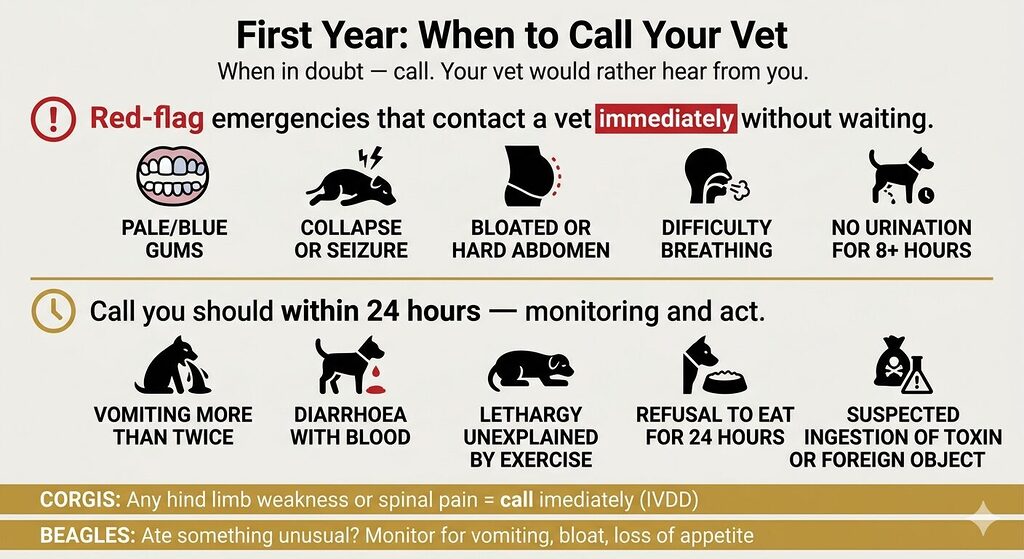
13. What signs should send me straight to the vet without waiting?
Call your vet immediately — do not monitor and wait — if your puppy shows pale, white, or blue-tinged gums; collapse or seizure; a bloated or hard abdomen; difficulty breathing; or no urination for more than 8 hours. For Corgis specifically: any hind limb weakness, dragging of a leg, crying when picked up, or reluctance to jump warrants an urgent call — these can be signs of intervertebral disc disease (IVDD), which can progress quickly in chondrodystrophic breeds. For Beagles: if something unusual has been eaten, watch closely for vomiting, abdominal bloating, or loss of appetite, and call if any appear.
14. What happens at the 12-month vet appointment?
The 12-month appointment is both a vaccine appointment and your puppy's first full annual health check. Vaccines due include the DHPPi booster, Leptospirosis, and the legally required Rabies booster. Your vet will do a comprehensive examination — weight, teeth, ears, eyes, heart, abdomen, skin and coat, and joints — and establish a baseline record to track against in future years. It is also a good time to discuss transitioning from puppy food to adult food, and to start a toothbrushing routine if you have not already. Dental disease is the most common preventable health problem in adult dogs, and starting early makes a significant difference.
15. How do I find a good vet, and what should I do before I urgently need one?
Register with a vet before your puppy arrives, not after. The new-puppy check in the first 48–72 hours of arrival is your first opportunity to establish the relationship and for your vet to examine the puppy without the complication of emotional attachment on your side. When you call with a concern, be specific: describe what you have observed, for how long, and how frequently — this is far more useful to a vet than a general symptom name. Importantly, find out now which 24-hour emergency practice covers your area and save the number. You will likely never need it urgently, but the moment you do, you will be very glad you did it in advance.
This FAQ is produced by the Pember Diamonds Knowledge Network — Pember Diamonds (Corgis), Tanydd Corgi Crew (Corgis), and Tamboeckey Beagles. It is intended as educational support for puppy owners and does not replace individualised veterinary advice. Always consult your own veterinarian for decisions specific to your puppy's health.