Dogs are not spontaneous creatures by nature. Thousands of years of domestication have produced an animal exquisitely attuned to human patterns — the sound of an alarm, the creak of a back door, the rattle of a lead. Before your puppy understands a single word you say, they are already building a mental map of your household's rhythms. The question is not whether your puppy will learn a routine, but whether the routine they learn is one you have designed or one they have improvised for themselves.
A well-designed daily routine does several things simultaneously. It regulates your puppy's nervous system by removing the constant low-level uncertainty of "what happens next." It creates reliable toilet-training windows that prevent accidents not through punishment but through sheer predictability. It carves out natural training moments when your puppy is alert and motivated. And it sets a sleep schedule that supports healthy neurological development — something most new owners dramatically underestimate.
The research on canine stress is clear: dogs in unpredictable environments show higher cortisol levels, more stereotypic behaviour (repetitive, purposeless actions), and slower rates of learning. The inverse is also true. Structure is not restrictive — it is the foundation on which a confident, calm dog is built.
Perhaps most importantly, a good routine benefits you just as much as your puppy. When you know what your dog needs and when they need it, the guesswork disappears. You stop reacting to whining, destructive behaviour, or midnight energy bursts, because you have pre-empted them. A routine is an investment that pays dividends every single day.
How a puppy experiences time
To build an effective routine, it helps to understand something about how your puppy perceives the passing of time. Dogs do not have the same future-orientation that humans do. They live primarily in the present, anchored by memory traces of sensory patterns. Your puppy doesn't think "it is 7am, therefore breakfast." What they experience is more like: the light is this quality, the house smells this way, the human is moving in this particular direction — and from all of this, their nervous system anticipates what comes next.
This is why consistency of cue matters as much as consistency of timing. If you always pick up the lead before a walk, the lead becomes the cue, and reaching for it will visibly excite your puppy within days of bringing them home. If breakfast always follows a particular sequence of sounds, those sounds themselves become settling. You are not teaching your puppy to read a clock — you are teaching them to read the world they live in.
It also explains why very young puppies (8 to 12 weeks) need much shorter intervals between key events — toilet trips every 45 to 90 minutes, for instance. Their bladder capacity is small, their ability to hold discomfort is limited, and their sense of consequence is not yet developed enough to "remember" where the toilet is supposed to be without constant reinforcement. Frequency creates the pattern; pattern creates habit; habit becomes reliable behaviour.
Key insight
Puppies don't understand rules. They understand patterns. Every routine moment is a repetition that either reinforces a helpful pattern or inadvertently teaches an unhelpful one. There are no neutral moments in the first few months.
The five daily pillars
Every puppy's day — regardless of breed, age within puppyhood, or household setup — should revolve around five repeating anchors. These are not optional extras. They are the structural scaffold that holds everything else together.
Feeding - Same times, same place. Sets the body clock and supports digestion.
Exercise - Age-appropriate walks, outdoor time, and physical play.
Enrichment - Mental stimulation through games, sniffing, and problem-solving.
Training - Short, positive sessions embedded into transitions and meals.
Rest - Protected sleep periods. Puppies need 16–18 hours daily.
The critical thing to understand is that these five pillars must be balanced, not maximised. Many first-time owners over-invest in exercise and social interaction while neglecting rest and structured training time. A puppy who is never truly tired from mental stimulation but is always physically active will become overstimulated, anxious, and difficult to settle. A puppy who gets plenty of rest but no enrichment will find their own ways to stimulate themselves — usually involving your furniture, shoes, or garden plants.
Feeding
Timing, amounts, and location Feeding is the cornerstone of a daily routine because it is the one event that happens multiple times every day, at predictable intervals, and involves a strong physiological reward. Getting feeding right sets the rhythm for everything else.
How often to feed Young puppies (8–16 weeks) need three meals per day. Their stomachs are small and their metabolism is high. By four to six months, most puppies transition comfortably to two meals per day, spaced roughly twelve hours apart. Continuing to feed three times daily beyond this point is not harmful, but two meals better suits most owners' schedules and remains adequate for the puppy's needs.
Feeding times The most important principle is consistency. Feeding at 7am, 12pm, and 5pm every day is far better than feeding at roughly morning, lunchtime, and evening with significant variation. Your puppy's digestive system runs on a clock, and predictable feeding times lead to predictable toilet timing — which is the single most important variable in successful house training.
Avoid feeding your puppy last thing at night. A final meal at 5 or 6pm gives enough time for digestion before the last evening toilet trip, significantly reducing the chance of a night-time accident or an early morning wake-up driven by hunger.
Feeding location Always feed in the same location. This seems trivial but matters more than most owners realise. A consistent feeding spot becomes associated with calm, focus, and reward. Over time, bringing your puppy to that spot becomes a natural cue for settling. It also makes the feeding ritual — sit, wait, place the bowl — a daily training repetition that costs you nothing extra.
Mealtime manners Use every meal as a micro-training opportunity. Asking your puppy to sit before the bowl is placed takes three seconds and builds impulse control, focus, and the valuable life skill of waiting calmly for good things. As they progress, you can extend this to a brief stay before releasing them to eat. These habits, established in puppyhood, pay enormous dividends in daily life.
On free feeding
Leaving food down all day (free feeding) removes one of the most powerful tools in your routine-building kit. A puppy who can eat at any moment is also a puppy who cannot be reliably motivated by food in training, and whose toilet timing cannot be predicted. Scheduled meals are strongly recommended.
Exercise
Age-appropriate activity Exercise is perhaps the most misunderstood element of puppy care. The common instinct — a tired puppy is a good puppy, so more exercise is better — is only half right and can be actively harmful if applied too literally to very young dogs.
The five-minute rule The widely cited guideline for puppy exercise is five minutes of structured walking per month of age, twice daily. So a three-month-old puppy needs about fifteen minutes of walking twice a day. A five-month-old can manage twenty-five minutes. This is not a maximum for all activity — free play in a safe, soft-surface garden is less stressful on developing joints than sustained road walking — but it is a useful ceiling for structured exercise on hard ground.
The reason for this caution is the growth plates. In puppies, the ends of the long bones contain cartilaginous growth plates that do not fully close until somewhere between twelve and twenty-four months depending on breed size. Repeated high-impact exercise on hard surfaces before these plates close can cause lasting joint damage. Large and giant breeds close their plates latest and require the most caution.
What counts as exercise Exercise is not only walking. It includes free play in the garden, short games of tug or fetch, and social interaction with other dogs (if appropriately matched). Mental exercise — sniff walks where the puppy is allowed to follow their nose without being hurried along — is often more tiring than physical exercise for the same duration. A fifteen-minute sniff around a park will exhaust a young puppy far more effectively than fifteen minutes of brisk walking on a lead.
Signs of over-exercise Watch for lagging behind on walks, reluctance to continue, lying down mid-walk, or unusual stiffness after rest. These are signals that the exercise load is too high. It is also worth noting that an over-exercised puppy does not become a calmer puppy — they often become more frenetic and harder to settle, because their bodies are overtired but their nervous systems remain activated.
Breed matters
A Border Collie puppy and a Basset Hound puppy of the same age have very different exercise needs, but both are subject to the same growth plate concerns. Adapt the five-minute guideline to your breed's size — smaller breeds mature faster and can handle proportionally more exercise sooner; giant breeds need more time and care.
Play and mental enrichment
Play is not merely entertainment — it is the primary mechanism through which puppies learn how the world works, how to communicate with other animals and with you, and how to regulate their own arousal. Play that is guided and structured teaches impulse control. Play that is unguided teaches your puppy to set their own rules, which is often less convenient for everyone involved.
Types of play to include
Tug. Contrary to old advice, tug does not make dogs aggressive. Played with rules — you initiate, you end it, "drop it" is practised regularly — it builds impulse control, a reliable retrieve, and a strong relationship. It is one of the most valuable play forms for high-drive puppies.
Fetch. Good for burning energy and building recall, but keep sessions short for young puppies. Repetitive hard stops and direction changes on developing joints carry some risk, so grass rather than concrete and five to ten throws rather than twenty is the sensible approach.
Sniff games. Scatter feeding (hiding kibble in grass), snuffle mats, and basic nose work games engage the olfactory system in a way that is extraordinarily tiring. A puppy using their nose is a puppy in a deeply focused, relaxed state — far more useful before a rest period than high-energy play.
Chewing. Chewing is a natural stress-reducing behaviour that lowers heart rate and releases calming neurotransmitters. Providing appropriate chews — raw marrow bones, bully sticks, antlers suited to your puppy's size — during quiet periods satisfies this need in a constructive way. It is also one of the best tools for building independent, settled behaviour.
When to play
Place high-energy play before a rest period, not after. A puppy who goes from frantic tug to being expected to sleep immediately will struggle. But a puppy who progresses from tug to calm chewing to being placed in their crate will settle more reliably. Think of enrichment as a dimmer switch — you are gradually reducing arousal, not slamming it from on to off.
Training windows within the routine
One of the most powerful aspects of a solid daily routine is that it creates natural, recurring training windows without requiring you to carve out dedicated time from an already busy day. The transitions between routine events — waking up, being fed, going for a walk, coming inside — are precisely when your puppy is most alert and most motivated. Using these moments consistently turns ordinary daily life into a continuous, low-effort training programme.
Keep sessions short For puppies under six months, individual training sessions should last no more than three to five minutes. Their attention spans are short and their brains tire quickly. Five short sessions scattered through the day is far more effective than one twenty-minute block. The goal is to finish while your puppy is still engaged and eager — always end on a success, even if that means asking for something easy.
What to work on at each stage Morning feeding: Sit before the bowl, name recognition, eye contact. These are low-threshold asks that your puppy can manage while food-motivated but not yet fully alert.
After morning walk. Come (recall) in the garden, sit-stay while you open doors. Your puppy is physically settled but still engaged.
Midday transition. Down, wait, leave it. These impulse-control exercises suit the calmer mid-day window.
Before evening walk. Lead manners, sitting at the kerb, focus around mild distractions. The anticipation of a walk creates engagement, and working briefly before the walk teaches that calm behaviour produces good outcomes.
Evening wind-down. Calm settling on a mat, go to bed cue. The goal here is to associate this time with lowered arousal, not excitement.
On positive reinforcement
All training embedded in routine should use positive reinforcement. This is not sentimentality — it is the most efficient method. Behaviours rewarded within half a second are learned faster, generalise better, and are more durable under stress. Use small, high-value food rewards during learning phases, then gradually transition to life rewards (the walk itself, the bowl being placed, the door opening) as skills become reliable.
Rest and sleep — the overlooked essential
If there is one aspect of puppy care that new owners most consistently underestimate, it is the need for sleep. Puppies between eight and sixteen weeks need sixteen to eighteen hours of sleep every single day. This is not an exaggeration. It is a biological necessity driven by the extraordinary pace of neurological development happening during this period.
During sleep, the puppy brain consolidates learning, processes social information, and grows the neural connections that will underpin adult behaviour. A puppy who is not getting sufficient sleep is not merely tired — they are neurologically impaired in their learning capacity, emotionally dysregulated, and often misread as hyperactive or "naughty" when they are in fact exhausted.
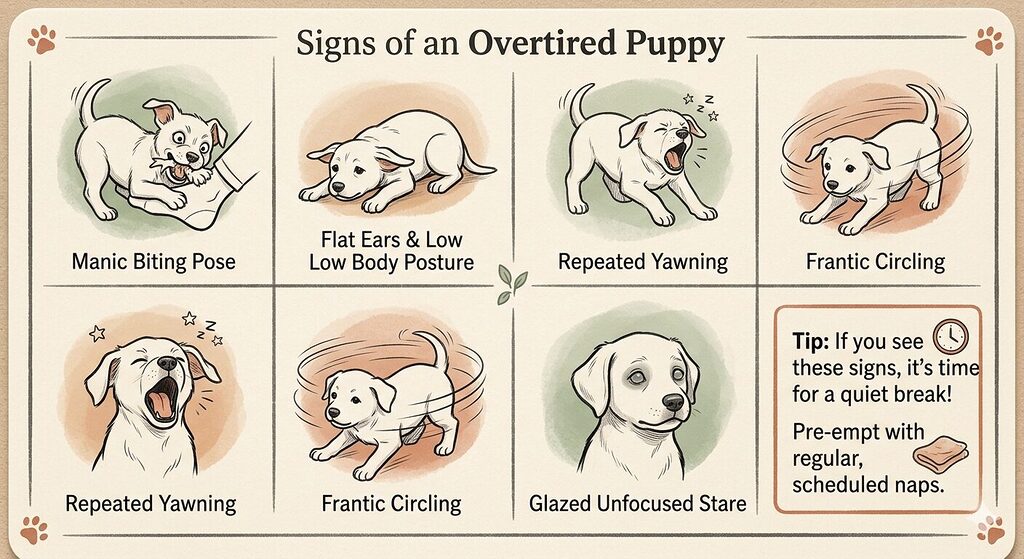
Signs of an overtired puppy
Manic, bitey, or frantic behaviour that escalates rather than resolves
Difficulty settling even when placed in their crate
Yawning repeatedly during what should be an active period
Ears flat or body low despite no obvious threat
Sudden regression in house training or previously learned behaviours
Structuring rest periods
Rest periods need to be protected, not optional. This means using a crate or pen to remove the decision from the puppy — if they are loose in the house, they will follow stimulation rather than rest. The crate should be introduced gradually with positive association (treats thrown in, meals fed inside, door closed only briefly at first), so that being placed in it is experienced as a normal, neutral event rather than a punishment.
Nap periods of one to two hours should follow every significant activity — a walk, a play session, a training session, or a period of social interaction. This is especially important in homes with young children, where the temptation to keep the puppy engaged is constant and the pace of stimulation is high.
Toilet training through routine
Toilet training is not a separate project from routine-building — it is one of its most important outputs. When feeding, exercise, and rest are consistent, toilet timing becomes predictable, and predictability is the entire game.
When puppies need to toilet
Puppies almost always need to toilet at the following moments: immediately on waking (from overnight sleep and from any nap), within fifteen to twenty minutes of eating, during or just after play, and whenever they have been quiet and inactive for more than sixty to ninety minutes (for young puppies). If you build outdoor toilet trips around these triggers, the number of accidents inside falls dramatically within the first two weeks.
What to do outside
Take your puppy to the same area of the garden each time. Stand still and wait. Do not play, do not chat — the goal is for your puppy to learn that this particular trip outdoors has a specific purpose. The moment they toilet, deliver calm, warm praise and a treat. This is the entire method. No scolding for accidents indoors, no rubbing noses in mistakes — neither does anything useful, and the latter actively damages trust.
Night-time and overnight
Very young puppies (8–10 weeks) physically cannot hold their bladder for more than three to four hours overnight. A puppy crying in the night is almost always asking to toilet, not attention-seeking. Setting an alarm to take them out once overnight, then extending the interval by fifteen minutes every few nights as they develop capacity, is a far more effective strategy than hoping they will manage and cleaning up the crate each morning.
Most puppies can reliably sleep through the night (seven to eight hours) by twelve to sixteen weeks if the routine has been consistent. Some will manage it earlier; others, particularly smaller breeds with smaller bladders, take slightly longer.
On accidents
Every indoor accident is information, not a moral failure on your puppy's part. Ask yourself: did I miss a trigger? Was the interval between outdoor trips too long? Was my puppy showing signals I didn't notice? Adjust the routine accordingly. Puppies who toilet indoors are not being defiant — they are physiologically unable to hold on, or they haven't yet learned that inside is not an appropriate place.
Adapting the routine to working life
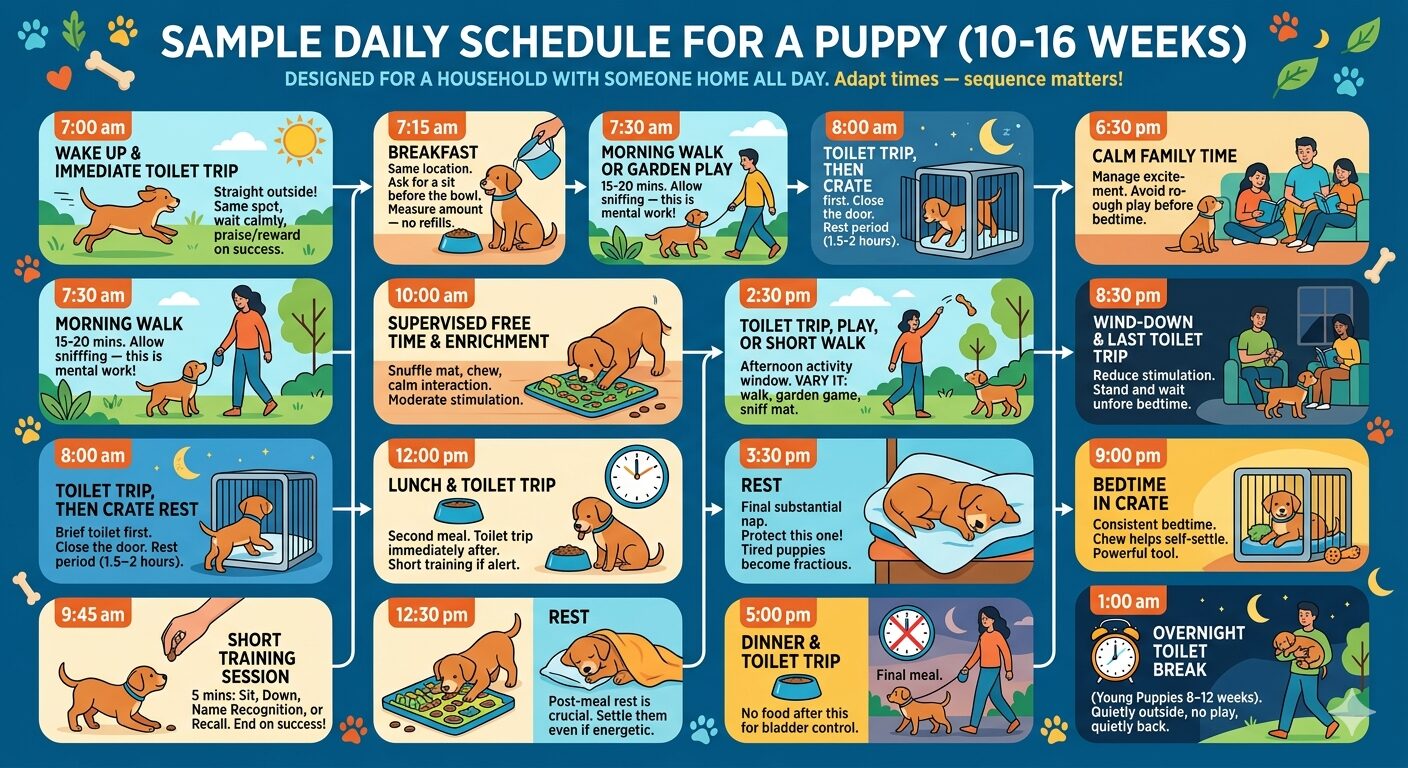
The sample schedule above assumes someone is home throughout the day. The reality for many households is different, and that is entirely manageable — but it requires honest planning rather than wishful thinking.
What puppies actually need when you are out
A puppy under twelve weeks should not be left alone for more than two hours at a time. Between twelve and sixteen weeks, up to three hours is reasonable with a toilet break built in. By six months, most puppies can manage four to five hours, though this should still be the exception rather than the rule during the crucial developmental period.
During any absence, a pen or crate setup gives your puppy a defined, safe space. Do not allow unsupervised free-roaming in the house — not because your puppy is "bad," but because the absence of guidance means the absence of learning, and the presence of opportunity means chewed cables, toilet accidents, and habits that are far easier to prevent than to undo.
Covering the midday gap
A trusted person — a neighbour, friend, family member, professional dog walker, or doggy daycare — for a midday visit during the first few months is not a luxury. It is a genuine welfare requirement. This midday break serves three purposes: toilet opportunity, brief social interaction, and a break from the monotony of confinement. Look for someone who will follow your routine rather than import their own habits.
Morning and evening anchors
When working outside the home, the priority is that the parts of the routine you do control — the morning and evening windows — are absolutely consistent. This means the same wake-up time, the same morning sequence, the same evening walk, the same bedtime, every day including weekends. The urge to "let the puppy sleep in" on Saturday is understandable but counterproductive. Consistency across seven days, not five, is what builds the routine's power.
On separation anxiety
Routine is one of the most effective preventatives for separation anxiety. A puppy who knows the morning sequence and has learned that your departure is followed by rest and then your return has a fundamentally different experience of being alone than one who faces each separation as an unpredictable event. Build independence gradually: start with very short absences from the room, reward calm behaviour, and increase duration slowly over weeks.
Age-by-age routine adjustments
The routine that works for an eight-week-old puppy will need to evolve substantially by the time that puppy reaches twelve months. Here is how to think about each phase.
8–12 weeks
Newborn phase - Three meals, toilet every 60–90 min, four or more naps daily, overnight toilet break required. Max 15 min structured activity at a time.
12–16 weeks
Foundation phase - Three meals or transitioning to two. Toilet intervals lengthening to 2 hours. Sleep still 16+ hrs. Training beginning to stick.
4–6 months
Learning phase - Two meals. Walks lengthening (up to 25 min). Most can sleep through the night. Adolescence approaching — keep structure tight.
6–12 months
Adolescent phase - Hormonal changes make some dogs appear to "forget" training. Don't reduce structure — increase it. Walks can lengthen significantly.
12+ months
Maturing phase - Two meals, two walks. Sleep reduces. More independence. Continue routine — it's now deeply embedded and genuinely effortless to maintain.
Adolescence (roughly six to eighteen months, longer for large breeds) deserves special mention. During this period, hormonal changes affect the prefrontal-equivalent regions of the canine brain, leading to apparently increased impulsivity, selective deafness, and apparent regression in trained behaviours. This is neurologically normal and temporary. The owners who successfully navigate adolescence are almost universally those who maintained their routine rigorously rather than loosening it in frustration.
When the routine breaks down
No routine survives contact with real life entirely intact. Illness (yours or the puppy's), travel, visitors, holidays, changes in work schedule — all of these will occasionally disrupt the pattern. The question is not how to prevent disruption but how to manage it and recover from it.
Short disruptions
A single disrupted day rarely does lasting damage. If you miss a meal time, return to schedule the next day. If a walk is cut short or skipped, compensate with enrichment at home rather than making it up with a longer walk later (this can confuse the pattern). If bedtime is significantly later than usual, maintain the morning wake time the next day and accept one tired day rather than allowing the whole schedule to drift.
Extended disruptions
Holidays or travel require you to approximate the routine in a new environment. Bring the crate, bring the feeding bowl, maintain the same meal times and walk windows as closely as possible. Your puppy will be alert to the new environment regardless — familiar timing cues provide a stabilising scaffold that significantly reduces stress in unfamiliar settings.
Recovery after a disruption
When returning to normal after an extended break, expect one to three days of adjustment. Your puppy may be unsettled, may have a toilet regression, or may be more difficult to settle at night. This is normal. Simply resume the routine without drama or punishment and the pattern will re-establish faster than it was originally built.
Common mistakes and how to fix them
Mistake 1 - inconsistent wake-up times
Weekend lie-ins are one of the most common routine disruptors. A puppy woken at 7am on weekdays and 9am on weekends is not on a routine — they are on a five-day routine. The bladder doesn't understand the calendar. Maintain consistent wake times seven days a week, or accept that house training will take longer than it needs to.
Mistake 2 - too much time with people
It is natural and lovely to want to spend all your time with a new puppy. But a puppy who is never alone — never in a crate, never outside the room you are in, never given a quiet chew without you present — is a puppy who never learns that being alone is safe. Deliberate separation, introduced gradually from week one, is one of the most important investments you can make against separation anxiety.
Mistake 3 - skipping rest because the puppy seems fine
Overtired puppies do not look tired in the way humans do. They often look manic, bitey, and high-energy. If your puppy has been active for more than an hour and is becoming increasingly frantic, that is usually a sign of over-stimulation, not a sign that they need more activity. Put them in the crate. They will almost certainly be asleep within minutes.
Mistake 4 - reacting to vocalisation in the crate
When a crate-trained puppy vocalises, the instinct is to respond — to soothe, to let them out, to sit beside the crate. Unless you believe they need to toilet, waiting for a brief pause in the vocalisation before opening the door (or doing nothing) is far more effective than responding to the noise. Responding to vocalisation reinforces it immediately and powerfully.
Mistake 5 - abandoning the routine during adolescence
When an adolescent dog suddenly seems to have forgotten their training, the understandable response is frustration and a loosening of structure — fewer walks, less training, more free-roaming. This is precisely the wrong response. Adolescent behaviour is temporary; the habits formed during adolescence are not. Maintain the routine with patience and the vast majority of adolescent dogs come out the other side calm and well-mannered.
01 — My puppy seems to ignore the routine and does things on their own schedule. Is this normal?
Completely normal in the first two to three weeks. A routine is something you impose, not something a puppy arrives knowing. Consistency from your side creates the pattern; your puppy catches up. If you are maintaining the same times and sequences every day and still seeing no pattern after three weeks, consider whether the rest periods are long enough — an overtired puppy struggles to settle into predictable cycles.
02 — How long will it take before the routine feels natural to both of us?
Most households find that the routine feels established by four to six weeks of consistent practice. Your puppy will begin anticipating transitions — waking before your alarm, moving toward the door before you pick up the lead — within the first two to three weeks. Your own fluency with the routine usually takes slightly longer, because humans are less attentive to daily patterns than dogs are.
03 — My puppy wakes me up at 5am. How do I push this later?
Do not interact, feed, or let the puppy out (unless they need to toilet) at 5am if your goal time is 7am. Any response — including going in to tell them to be quiet — reinforces the 5am waking. The first morning you successfully wait until 7am before responding is the first repetition of the new pattern. It will take several days of difficult mornings before the new time embeds. Blackout blinds in summer can help significantly.
04 — Do I really need to maintain the same routine at weekends?
Yes, for at least the first six months. After that, a puppy with a deeply embedded routine can tolerate occasional weekend variations (a later walk, a changed meal time) without significant disruption. But during the foundation period, weekend consistency is as important as weekday consistency. Think of it as a short-term investment for a long-term payoff.
05 — My puppy fights the crate. Can I skip crate training and still have a routine?
You can, but it is harder. The crate solves several problems simultaneously: it provides a safe, defined rest space, prevents unsupervised access to the house, and gives you a reliable tool for enforcing rest. Without it, you need an alternative confinement solution (a pen, a puppy-proofed room) that achieves the same purpose. The issue with free-roaming during rest periods is that many puppies will not self-settle without the physical boundary of a crate.
06 — My puppy doesn’t seem tired at naptime. Should I still put them in the crate?
Yes. An overtired puppy rarely looks tired — they look wired. Placing them in the crate even when they seem energetic is appropriate because within a few minutes of reduced stimulation, most puppies will fall asleep. You are not waiting for sleepiness before initiating the rest period — you are creating the conditions in which sleepiness arrives. Trust the routine rather than reading your puppy's energy level as a guide to whether rest is needed.
07 — We have young children at home who want to play with the puppy constantly. How do I manage this?
Children and puppies both need guidance here. Establish clear times when the puppy is available for play and clear times when the puppy is resting and off-limits. Help children understand that a sleeping or resting puppy is not to be disturbed — frame it as the puppy growing their brain rather than being boring. A puppy pen that the puppy can enter but children cannot is enormously useful in households with young children.
08 — How do I handle the routine when my puppy is ill?
Maintain the skeleton of the routine (meal times, toilet trips, rest periods) while adapting the active elements. A puppy with an upset stomach, for instance, needs more frequent toilet trips and possibly temporarily more frequent small meals, but the same crate schedule and the same basic daily rhythm. After illness resolves, return to the full routine within a day or two. Most puppies reorient to their routine quickly after a brief disruption from illness.
09 — My partner and I have completely different schedules. How do we build a consistent routine?
Write it down and agree on it explicitly before you bring the puppy home, or as soon as possible afterward. The most common cause of routine breakdown in two-person households is not ill will but different assumptions about what "around lunchtime" means or who is responsible for the evening walk. A shared schedule — even a simple printed one on the fridge — eliminates this. Both people need to execute the same sequences in the same way, not just the same times.
10 — Is it okay to occasionally use doggy daycare or a dog walker?
Absolutely, and for working owners it is often essential. The key is to brief your dog walker or daycare on your routine so they approximate it as closely as possible during the time they have your puppy. A good dog walker will feed at the right time, respect rest periods, and avoid over-stimulating your puppy. Ask potential dog walkers how they handle rest and what a typical day looks like before committing.
11 — My puppy is completely reliable at home but has accidents at other people’s houses. Why?
Toilet training is location-specific in puppies until it becomes very well generalised. Your puppy has learned that indoors at your house means no toileting. Indoors at a different house is — to their brain — a new and uncategorised environment. Treat visits to other houses exactly as you did the early days at home: immediate outdoor access on arrival, supervised time indoors, frequent toilet trips. After several successful visits, the generalisation develops.
12 — When can I start giving my puppy more freedom and relaxing the strict routine?
Freedom is earned gradually through demonstrated reliability. As a rough guide: unsupervised access to one room at around four to five months when house training is solid; access to two or three rooms at six to eight months; free roaming when alone only when you have had at least thirty consecutive days with no accidents or destructive incidents indoors. Rushing this process is the single most common cause of setbacks. The routine doesn't disappear — it simply becomes the natural rhythm of daily life.
13 — My puppy has started waking earlier and earlier. Have I accidentally trained this?
Almost certainly, yes — and it is extremely common. Every time you responded to early waking (even to feed them or let them out to toilet), you reinforced waking at that time. The pattern drifts earlier incrementally. To reset it, you need to stop responding to early waking entirely, even if it means a difficult week. Alternatively, set a fixed alarm slightly earlier than your puppy is currently waking, go in before they make noise, and then gradually push the alarm later every two to three days.
14 — Does the type of breed change what kind of routine I should build?
Breed affects the content of the routine more than its structure. A working breed (Border Collie, German Shepherd, Malinois) needs significantly more mental enrichment built in than a companion breed (Cavalier, Shih Tzu, Bichon). A scent breed (Beagle, Bloodhound) needs long sniff walks as a core part of their enrichment, not a bonus. A giant breed needs more sleep and less high-impact exercise during the first eighteen months. But all breeds benefit equally from the same principle: predictable, consistent, balanced daily structure.
15 — I feel exhausted and like I’m failing. Is it supposed to be this hard?
Yes, genuinely — early puppyhood is one of the most demanding periods of pet ownership, and the fact that this isn't discussed openly enough leads many new owners to believe they are doing something wrong when everyone else is finding it easier. You are sleep-deprived, your routine has been upended, and you are trying to teach a very young animal the rules of a world they have just entered. The first four to six weeks are the hardest. A solid routine is your most powerful tool for moving through this phase faster. It gets substantially easier, and then — quite suddenly — it becomes the best thing you ever did.
A routine built around your puppy's needs and your real life isn't a sacrifice — it's one of the most efficient investments you can make in a calm, confident, well-behaved dog. The effort concentrated in these early months pays dividends every single day for the next ten to fifteen years.