The word socialisation is used so frequently in the context of puppy raising that it has become, for many people, a vague instruction meaning something like "let your puppy meet other dogs and people." This is not wrong, but it is dramatically incomplete, and the incompleteness matters — because what you don't socialise your puppy to during the critical window is just as consequential as what you do.
Socialisation, properly understood, is the process by which a young animal learns what is normal in the world they inhabit. It is the mechanism through which novelty becomes familiarity, and through which the nervous system learns what to treat as safe background information versus what to treat as a potential threat. A well-socialised puppy is not one who has merely met many dogs and people. It is one whose brain has catalogued a wide range of stimuli — sounds, surfaces, environments, movements, smells, handling experiences, visual events — and filed them under the category of "normal and not requiring a stress response."
This distinction matters enormously in practice. A puppy who has met many friendly people but never experienced the sound of a vacuum cleaner, the sensation of walking on a metal grate, or the sight of someone in a bicycle helmet may develop into a dog who is perfectly confident around people but frightened by a range of everyday stimuli. The goal of socialisation is breadth — the widest possible range of safe, positive exposures to the world as it actually is.
Socialisation is not the same as habituation. Habituation is simply the reduction of a response through repeated, neutral exposure. Socialisation during the sensitive period goes deeper — it shapes the very architecture of how the brain categorises experience. This is why experiences during weeks 8 to 16 have effects that persist for life in a way that experiences at other times simply do not.
The neuroscience of the sensitive period
To understand why the socialisation window matters so profoundly, it helps to know something about what is happening in the puppy brain during this period. The concept of a sensitive period — a developmental window during which the nervous system is unusually plastic and experience has disproportionate and lasting effects — was first documented rigorously in dogs by Scott and Fuller in their landmark 1965 study at Bar Harbor, Maine. Their findings, and the decades of research that followed, have been consistently clear: the period between roughly three and twelve weeks of age is when social and environmental experiences most powerfully shape the adult dog's responses.
During this window, the brain is forming and pruning synaptic connections at an extraordinary rate. Neural pathways that are used repeatedly become strengthened and myelinated — faster, more efficient, more automatic. Pathways that are not used are pruned away. The emotional processing systems, including the amygdala's threat-detection circuitry, are particularly sensitive to experience during this period. An amygdala that has processed a wide range of stimuli without negative outcome during the sensitive period develops a broader definition of "safe." One that has encountered a narrow range of stimuli — or that has had fearful or painful experiences — develops a correspondingly narrower, more reactive threat-detection system.
The practical implication of this neuroscience is stark: you are not simply teaching a puppy during weeks 8 to 16. You are shaping the structure of the brain that will govern their responses for the next ten to fifteen years. Positive, varied, controlled experiences during this window create a dog who is fundamentally easier to live with — not because they have been trained to comply, but because their nervous system has been built with flexibility and confidence as its baseline.
Key research finding
Scott and Fuller identified that puppies not exposed to human contact before the age of fourteen weeks showed persistent fearfulness of humans that could not be fully reversed through later socialisation. The window is not merely important — it is, to a meaningful degree, irreversible.
The socialisation window — a visual breakdown
The sensitive period does not begin at eight weeks and does not end at sixteen. It is a continuum, with a gradient of plasticity that peaks in the middle and fades at both ends. Understanding the full arc helps you make sense of why different weeks demand different priorities.
Socialisation sensitivity across early puppyhood
Weeks 3 to 7 represent the portion of the sensitive period that occurs before most puppies come home. A responsible breeder uses these weeks to expose the litter to household sounds, gentle handling by multiple people, different surfaces, and mild environmental variation. The quality of this early breeder socialisation has a documented effect on outcomes — which is why the choice of breeder matters as much as anything you do after bringing your puppy home.
Weeks 8 to 12 are the prime window. The puppy has just left their litter, their brain is maximally plastic, and new experiences leave the deepest impressions. This is also the most emotionally sensitive period — fear responses are easily triggered and easily imprinted. The art of good socialisation during these weeks is controlled positive exposure: broad in range, gentle in intensity, always allowing the puppy to set the pace.
Weeks 13 to 16 see the window beginning to close. Experiences during this period still matter and still shape the adult dog, but they require more repetition to achieve the same depth of effect. The puppy is also becoming more cautious of novelty — a feature, not a bug, of normal development — which means you need to be more thoughtful about how you introduce new experiences.
Why weeks 8–16 are uniquely critical
The specific weeks between 8 and 16 sit at a uniquely demanding intersection of developmental factors. Understanding each of them helps you manage this period with the care it deserves.
The transition from litter to home
Most puppies come home between 8 and 10 weeks. This transition — leaving the mother, litter, and all familiar smells and sounds — is the most significant stress event of a puppy's life to date. It coincides precisely with peak brain plasticity. The experiences of the first days in a new home are processed with unusual depth and permanence. A puppy who arrives home and immediately encounters warm, calm, consistent handling from multiple people is building a deeply embedded association between humans and safety. A puppy who arrives home to loud environments, rough handling, or isolation is building a different kind of foundation entirely.
Maternally derived immunity and disease risk
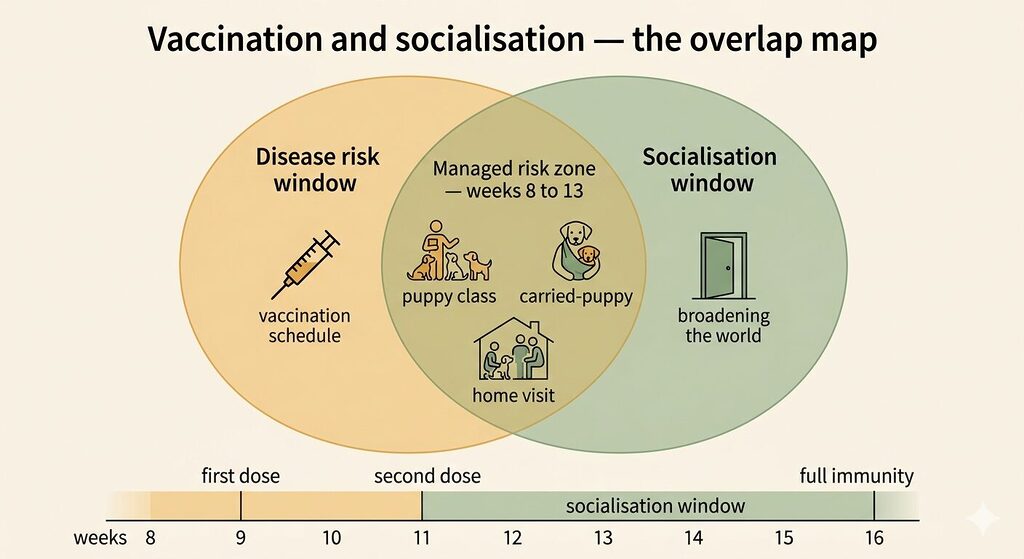
One of the most significant practical challenges of the 8-to-16-week window is the overlap between peak socialisation opportunity and the period before full vaccination. Maternal antibodies begin to wane from around 6 to 8 weeks, leaving a gap — the "immunity window" — before the puppy's own vaccine response is fully established. This has historically led veterinary advice toward keeping unvaccinated puppies away from other dogs and public spaces, which directly conflicts with the socialisation imperative. The emerging consensus among veterinary behaviourists is that the risk of behavioural problems from insufficient socialisation exceeds the disease risk of carefully managed early exposure. This does not mean abandoning vaccination protocols — it means being intelligent about where and how you socialise before full vaccination is complete.
The foundation of bite inhibition
Weeks 8 to 16 are also the primary window for learning bite inhibition — the control of jaw pressure that prevents play bites from becoming damaging bites. Puppies learn this initially from their litter, and it continues to be shaped through interaction with people and other vaccinated, safe dogs during the first weeks at home. The neural circuits governing this skill are among those being most actively formed during this period. A puppy who lacks appropriate interactive contact during these weeks may develop poor bite inhibition that becomes a significant safety issue in adult life.
The fear imprint periods
Within the broader sensitive period, there are two shorter windows during which fear responses are particularly easily formed and particularly resistant to later modification. Understanding these fear imprint periods is essential for preventing the most common and most lasting socialisation injuries.
First fear imprint period
Approximately 8–10 weeks This period coincides almost exactly with the typical homecoming week. The puppy's nervous system is on high alert for threatening information, and a single significant fright during this window can leave a lasting impression that no amount of later positive exposure fully erases. This does not mean you should wrap your puppy in cotton wool during weeks 8 to 10 — avoidance itself creates its own problems. It means you should be especially thoughtful about controlling the intensity of new experiences during these weeks. Loud sudden noises, rough handling, being dropped, being cornered, or frightening encounters with other animals during this period carry disproportionate risk.
Second fear imprint period
Approximately 6–14 months A second, less acute fear period occurs during adolescence. During this phase, experiences that would not have produced lasting fear responses at earlier or later ages can become embedded in a similar (though less intense) way to the early fear imprint. This is one reason why adolescent dogs who suddenly become reactive to things they previously ignored should be handled with patience rather than forced exposure — the fear is real, even if the triggering stimulus seems unremarkable.
The one-event rule
During the first fear imprint period, a single overwhelming or painful experience can override weeks of positive socialisation. This is not an argument for avoidance — it is an argument for control. Keep the intensity low, the pace gentle, and the puppy's agency intact during weeks 8 to 10 in particular.
What to socialise your puppy to
A complete socialisation programme covers far more than people and dogs. The world a domestic dog navigates is extraordinarily complex and varied, and the goal is to expose your puppy to as wide a range of its components as possible during the sensitive window. The categories below are not exhaustive but represent the most important domains.
People
Your puppy needs positive experiences with people of different ages, sizes, appearances, and behaviours. This explicitly includes: men (statistically the most common source of fearfulness in under-socialised dogs), children (whose movements are unpredictable and whose voices are high-pitched), people wearing hats, sunglasses, hoods, or helmets, people with beards, people using walking aids, people in wheelchairs, people in uniforms, people of different ethnicities, and elderly people who may move slowly or unpredictably. Each of these represents a visual category that an under-socialised brain may not recognise as "human" without specific exposure.
Animals
Other dogs are the obvious priority — but the quality of dog-dog meetings matters far more than the quantity. Safe, vaccinated, calm adult dogs are ideal socialisation partners. Avoid dog parks during early puppyhood; the unpredictability and potential for overwhelming or rough experiences outweighs the benefit. Equally important, and frequently overlooked, is exposure to other species your puppy is likely to encounter: cats, livestock if relevant to your location, small animals, birds. A puppy raised in an urban flat who has never seen a horse before adulthood may have a genuinely alarming first encounter.
Environments
Every new environment your puppy enters safely expands their definition of "normal." Priority environments include: busy streets, quiet streets, cafes with outdoor seating, parks, car parks, train stations or bus stops (sound exposure even if you do not travel), vets (positive-only visits before any medical procedure are one of the most valuable investments you can make), groomers, lifts, staircases, bridges, markets, and rural environments if you live in a city — and vice versa. The principle is to introduce variety before your puppy develops a fixed view of what the world looks like.
Surfaces and physical sensations
Dogs frequently develop surface anxiety that is entirely preventable. Walking confidently on different surfaces — grass, gravel, sand, wet pavement, wooden decking, metal grates, tiles, carpet, rubber — is learned, not innate. So is comfort with being handled: having ears, paws, mouth, and tail examined; being lifted; having a collar or harness put on and taken off; being towelled dry; having nails clipped; and being groomed. All of these experiences, introduced gently and with positive reinforcement during the sensitive period, become unremarkable adult experiences. Introduced for the first time in adulthood, they may require significant counter-conditioning work.
Sounds
Sound sensitivity is one of the most common sources of lifelong anxiety in dogs, and it is almost entirely socialisation-related. The list of important sounds to expose your puppy to includes: traffic, sirens, thunder and fireworks (via sound recordings if necessary), vacuum cleaners, washing machines, power tools, children playing, crowds, music, doorbells, alarms, motorbikes, and lorries. Sound desensitisation using recordings is a legitimate and important supplement to real-world exposure — apps and playlists specifically designed for puppy sound socialisation exist and are worth using systematically.
People - All ages, appearances, clothing styles, and mobility aids.
Animals - Dogs, cats, and other species your puppy will encounter.
Environments - Urban, rural, indoor, outdoor, busy, and quiet.
Sounds - Traffic, sirens, appliances, fireworks via recordings.
Handling - Paws, ears, mouth, grooming, collar, vet examinations.
How to socialise without overwhelming
The single greatest error in socialisation is equating exposure with flooding. Flooding — forcing a fearful animal into the presence of a feared stimulus until the fear response extinguishes — is not socialisation. It is a potentially traumatic experience that can deepen fear rather than resolve it, particularly during the sensitive period when neural fear pathways are most easily formed. Good socialisation is the opposite of flooding in almost every way.
The three principles of effective socialisation
1. Positive association. Every new experience should be paired with something the puppy values — food, play, calm praise, or simply the freedom to explore at their own pace. The goal is not to eliminate the puppy's reaction to novelty but to pair novelty reliably with good things, so the puppy's default response to "I don't know what that is" becomes curiosity rather than fear.
2. Puppy-led pace. Your puppy's body language is your guide. A puppy who approaches a new stimulus voluntarily is processing it well. A puppy who freezes, retreats, or shows stress signals (yawning, lip licking, whale eye, tail tucking, flattened ears, trembling) is telling you the intensity is too high. Reduce distance, reduce duration, or change the context. Never push a fearful puppy toward a stimulus — this is the moment at which socialisation tips into the fear imprint territory you are trying to avoid.
3. Graduated exposure. Begin with the mildest version of each new experience and progress gradually. For sounds, start with a low volume recording before encountering the real thing. For unfamiliar people, start with one calm adult before progressing to a group. For busy environments, visit at quiet times before busy ones. The nervous system that is gradually walked toward a stimulus develops a very different response than one that encounters it without preparation.
The socialisation outing framework
Rather than approaching socialisation as a series of isolated events, think of it as a cumulative programme. A useful framework is to aim for at least one intentional socialisation outing per day during weeks 8 to 16. Each outing has a simple structure: choose one or two primary targets (a new environment, a specific type of person, a sound source), keep the outing short (fifteen to twenty minutes is plenty for a young puppy), observe and respond to your puppy's body language throughout, and always end on a positive note before the puppy shows fatigue or stress.
The “three S” test
Before any socialisation experience, ask: is this
Safe (no disease risk, no aggressive animals, no dangerous surfaces)? Is this
Supervised (you are present and attentive throughout)? Is this
Short (brief enough that the puppy ends the experience in a neutral or positive emotional state)?
If all three are yes, proceed. If any is no, modify the plan.
Socialisation and vaccination — navigating the overlap
The tension between socialisation and vaccination is one of the most practically challenging aspects of early puppy care, and it deserves a careful and evidence-based treatment. The risk is real on both sides: parvovirus and distemper are serious and potentially fatal diseases; inadequate socialisation produces behaviour problems that are among the leading causes of dogs being surrendered to shelters or euthanised before old age. Both risks are preventable. Balancing them requires intelligence, not the elimination of one in favour of the other.
What the evidence supports
The American Veterinary Society of Animal Behavior, the British Veterinary Behaviour Association, and most contemporary veterinary and behaviour organisations are aligned on this point: puppies should begin socialisation before the full vaccination course is complete. The key is managing disease risk while not sacrificing the socialisation window. Specifically:
Puppy classes run in clean, well-managed indoor environments using vaccinated puppies are generally considered low-risk and high-value from 7 to 8 days after the first vaccination. These classes offer both socialisation and early training in a controlled setting.
Visits to the homes of vaccinated, healthy dogs allow your puppy to meet calm adult dogs and experience different environments safely. Carrying your puppy into public spaces — shopping areas, markets, cafes — allows sound and visual socialisation with zero ground contact and therefore negligible disease risk. Avoiding high-risk locations — dog parks, pet shops with unknown vaccination histories, ground frequented by unvaccinated dogs — is sensible without preventing all socialisation.
Timing the vaccine course
The standard UK puppy vaccination schedule involves a first vaccination at 8 weeks and a second at 10 to 12 weeks, with full immunity established approximately one to two weeks after the second dose. This means that for most puppies, the primary period of disease vulnerability is weeks 8 to 13 or 14 — precisely the most critical socialisation weeks. Plan around this by maximising ground-free socialisation early, attending puppy class as soon as eligible, and ramping up outdoor socialisation from week 13 or 14 onward.
Talk to your vet
Your vet's specific vaccination schedule and your local disease prevalence both influence the calculus here. Have an explicit conversation about socialisation with your vet, ideally at the first visit. A vet who is familiar with current behavioural science will be able to help you manage both risks intelligently rather than defaulting to blanket restriction.
Socialisation for different breeds
The sensitive period operates in the same developmental windows for all breeds, but what needs to happen within it varies significantly depending on the breed's original function, its sensory strengths, and its adult social environment. A socialisation programme designed for a Labrador Retriever will not adequately serve a livestock guarding breed, a sighthound, or a terrier.
Herding and working breeds
Border Collies, German Shepherds, Belgian Malinois, and related working breeds have particularly sensitive and reactive nervous systems. Their threat-detection is finely tuned, and their capacity for over-stimulation is high. Socialisation for these breeds needs to prioritise calm, controlled exposures rather than quantity, with special attention to preventing fearful incidents that are disproportionately likely to stick. Eye contact, direct approach from strangers, and chaotic environments require very careful introduction.
Guarding breeds
Livestock guardian breeds (Kangal, Anatolian Shepherd, Great Pyrenees) and property-guarding breeds (Rottweiler, Dobermann, Cane Corso) have been selectively bred for suspicion of strangers and independent territorial decision-making. Socialisation for these breeds is not optional — it is a safety requirement. Broad, consistent, ongoing exposure to humans of all types from the earliest possible age is critical to producing an adult dog whose natural guarding instinct is guided by accurate assessment rather than reflexive fear or aggression.
Sighthounds
Greyhounds, Whippets, and Salukis have a strong prey drive that is motion-activated. Socialisation must specifically include small animals, bicycles, joggers, and children moving at speed — not just to prevent chasing (which requires ongoing management regardless) but to reduce the arousal intensity triggered by these stimuli. Sighthounds also tend toward sensitivity and are more easily startled than many other types.
Companion and toy breeds
Small companion breeds (Chihuahua, Shih Tzu, Pomeranian, Maltese) are frequently under-socialised because owners carry them constantly and are reluctant to expose them to environments that feel physically risky for a very small dog. This well-intentioned protectiveness can produce some of the most anxious, reactive small dogs — animals who are simultaneously the most portable and the most poorly exposed to the world. These breeds need the same breadth of socialisation as any other; the method simply needs to account for their size and the genuine physical risks of ground-level exposure in some environments.
Signs your puppy is coping — and signs they are not
Reading canine body language during socialisation outings is a skill that every puppy owner needs to develop quickly. The consequences of missing stress signals — and continuing an exposure that has exceeded your puppy's threshold — range from a missed learning opportunity to a genuine fear imprint. The signals below are not exhaustive but represent the most important ones to recognise.
Signs of positive engagement
Loose, wiggly body posture — the puppy's whole body is relaxed, not stiff
Voluntary approach toward the new stimulus without hesitation
Soft, round eyes — not wide or staring
Tail in a natural, relaxed position or gently wagging
Willingness to take treats in the presence of the new stimulus
Normal play behaviour with you or other dogs after the experience
Early stress signals — reduce intensity immediately
Yawning outside of a waking or resting context
Repeated lip licking when no food is present
Looking or turning away from the stimulus
Refusing food they would normally take enthusiastically
Sniffing the ground excessively in a displacement behaviour pattern
Panting when not hot or recently exercised
High stress signals — end the exposure now
Trembling or shaking
Tail tucked firmly under the body
Ears pinned back flat against the head
Whale eye — the whites of the eyes are visible
Attempted escape or hiding behind your legs
Barking, growling, or snapping at the stimulus
Urination or defecation in a non-toilet context
After a stressful experience
If your puppy shows high-stress signals during a socialisation experience, do not attempt the same exposure again the following day. Give two to three days of calm, low-stimulation experience before reintroducing that stimulus at a significantly reduced intensity — greater distance, shorter duration, or a more controlled version. One step back does not mean failure; pushing forward after a stress response does.
Common socialisation mistakes
Mistake 1. Treating quantity as quality
More exposures are not better if those exposures are neutral or negative. A puppy who visits ten environments in a week but is stressed, overwhelmed, or simply bored during each visit is not building positive associations — they are building a tolerance for anxiety. Fewer, richer, genuinely positive experiences are far more valuable than a checklist of locations visited.
Mistake 2. Using the dog park as a socialisation tool
Dog parks are unpredictable environments where off-lead dogs of unknown temperament and vaccination status interact without supervision or structure. For an 8 to 12-week-old puppy, a single negative experience in a dog park — being bowled over by a large dog, being chased and unable to escape — can produce lasting dog-dog reactivity. The dog park is not a socialisation tool for puppies. It is an exercise space for adult dogs with solid social skills.
Mistake 3. Focusing only on experiences the puppy will enjoy
Socialisation needs to include things that are initially unfamiliar or slightly concerning — not because you want to stress your puppy, but because the goal is confidence in the face of novelty, not just enjoyment of what is already familiar. A puppy who is only exposed to things they clearly enjoy from the outset never develops the neural scaffolding that allows them to approach the unknown with curiosity rather than fear.
Mistake 4. Not socialising to handling
The handling socialisation that occurs — or fails to occur — during weeks 8 to 16 directly determines how safe and manageable the adult dog is during veterinary care, grooming, and first aid situations. A dog who has never had their mouth opened, paws touched, ears examined, or teeth brushed without a struggle by the time they are six months old is significantly more dangerous and more expensive to care for medically throughout their life. Handling socialisation is not optional; it is a welfare issue for the dog and a safety issue for everyone who will care for them.
Mistake 5. Stopping socialisation after the window closes
The sensitive period requires intensive effort precisely because of its brevity and its disproportionate impact. But the window closing does not mean socialisation ends. A dog who receives no new experiences between the age of five months and adulthood will begin to lose confidence with novelty — a process sometimes described as "dehabituation." Ongoing novel, positive experiences throughout adolescence and adult life maintain the flexibility that was built during the sensitive period. Think of the early window as the foundation and everything that follows as the structure built on it.
Catch-up socialisation. What if you missed the window?
Not every puppy arrives in their forever home at eight weeks with an ideal breeder socialisation history behind them. Rescue puppies, late-placed puppies, and puppies from poor breeding backgrounds may arrive with significant socialisation gaps. This is not a reason for despair — but it does require honest assessment and realistic expectations.
The honest truth is this: a dog who missed substantial portions of the sensitive period will almost certainly require more management, more patience, and more professional support than one who was well socialised during those weeks. The nervous system that was not built with broad experience as its baseline is not broken — but it is working from different raw material. Progress is possible; reverting to an "as if well-socialised from puppyhood" baseline is generally not.
For dogs who missed the window, the approach is structured desensitisation and counter-conditioning — the professional equivalent of what good socialisation achieves during the sensitive period, but applied more slowly and with less deep effect to a more mature nervous system. Working with a qualified clinical animal behaviourist rather than attempting this alone is strongly recommended for dogs with significant fearfulness or reactivity. A CCAB (Certificated Clinical Animal Behaviourist) or equivalent credential is the appropriate level of qualification for this kind of work.
On managing expectations
For an under-socialised older puppy or adult dog, "better" is the goal, not "fixed." Many dogs with difficult early histories go on to be happy, well-managed companions whose owners understand their limits and work skillfully within them. That is a success worth pursuing.
Record keeping and socialisation checklists
Given the breadth of the socialisation task and the brevity of the window, maintaining a simple record of what your puppy has been exposed to — and how they responded — is genuinely useful. It serves two purposes: it prevents you from inadvertently neglecting entire categories of experience (handling, for instance, is frequently omitted from otherwise thorough programmes), and it gives you an early warning system for patterns of fearfulness that may benefit from professional attention before they become entrenched.
A good socialisation log records the date, the experience, the puppy's reaction on a simple scale (approached willingly / was neutral / showed mild concern / showed high stress), and any follow-up needed. This does not need to be elaborate — a notebook page or a simple spreadsheet is sufficient. What matters is that it is consistent and honest.
Many puppy classes provide structured socialisation checklists as part of their course materials. The Kennel Club's Puppy Foundation Assessment and equivalent frameworks in other countries provide useful benchmarks for what a well-socialised puppy should be able to do by a given age. These are not pass/fail tests — they are mirrors that show you where the gaps are while there is still time to address them.
The long game, socialisation beyond 16 weeks
By the time your puppy reaches sixteen weeks, the intensive phase of socialisation is behind you — but the work is not finished, and it never truly will be. What comes after the sensitive period is not a second socialisation window but a maintenance and expansion phase in which the foundation built during weeks 8 to 16 is reinforced, tested, and built upon.
The adolescent period — roughly five to eighteen months, extending later in large breeds — brings the second fear imprint phase, the hormonal disruption of puberty, and a neurological reorganisation that can temporarily unravel apparently solid socialisation. Dogs who seemed confident at four months may become tentative or reactive at seven or eight months. This is normal and, with consistent gentle management, temporary. Maintain exposure to varied environments and people, keep training positive and consistent, and do not mistake the adolescent fear period for a permanent change in temperament.
Adult dogs benefit from continued novelty. A dog who has not encountered a new environment, a new surface, or a new type of person for several months may begin to narrow their confidence range. Regular new walks, new dog-friendly spaces, new experiences with different people, and continued training that challenges the dog cognitively and socially all contribute to the kind of flexible, confident adult temperament that good early socialisation makes possible — but that requires maintenance to sustain.
The socialisation window is brief, demanding, and irreplaceable. What you do in these eight weeks does not merely shape the next year — it shapes the entire life of the dog you are raising. Approach it with the seriousness it deserves, and the rewards will compound every single day for the decade or more to come.
Expert’s insights
"In over two decades of working with dogs whose behaviour had become unmanageable — dogs who were surrendered, dogs who had bitten, dogs whose owners were exhausted and out of options — the single most consistent thread in their histories was not cruelty, not neglect in any conventional sense, but a socialisation window that had simply not been used. The owners loved their dogs. They just didn't know that eight weeks of early life would cast such a long shadow."
What the research established decades ago, and what clinical practice confirms every week, is that the sensitive period is not a metaphor or a loose guideline. It is a neurological event. The synaptic architecture being laid down between weeks eight and sixteen is the substrate on which every subsequent emotional response will run. A well-constructed substrate — built through broad, positive, graduated exposure during those weeks — produces a dog whose nervous system has learned, at the deepest biological level, that the world is navigable. That confidence is not something that can be fully installed later. It can be approximated, managed, worked around. But the original build quality matters in ways that no amount of later training entirely overcomes. I would rather spend one hour counselling a new owner on the critical importance of those eight weeks than spend forty hours working with the adult dog whose owner didn't know.
The question I am asked most often by owners in the clinic is some version of: "Is it too late?" And the honest answer is almost always: it is not too late to help, but it was always going to be harder than it needed to be. The dogs who concern me most are not the reactive ones or the fearful ones — those dogs are in the room, they have owners who care, and there is work we can do together. The dogs who concern me most are the ones whose sensitive period is happening right now, in a home where nobody told the owner what was at stake. That is why guides like this one matter. Not because they replace professional support, but because they change what owners know before the window closes — and knowing changes what they do.
01 — My puppy came home at 12 weeks instead of 8. Have I already missed the most important socialisation weeks?
You have missed some of the prime window, but you still have weeks 12 to 16 and the closing phase, which remain significantly more plastic than post-window periods. The most urgent priority is to begin immediately and intensively — every day counts now. Ask the breeder what socialisation they provided between weeks 8 and 12, as a responsible breeder will have been working on this continuously. If the breeder provided little or no structured socialisation during those weeks, factor that in and consider consulting a behaviourist for a structured programme.
02 — My vet told me not to take my puppy anywhere until they are fully vaccinated. What should I do?
This advice reflects a legitimate disease concern but does not reflect current consensus on the relative risks of under-socialisation versus infectious disease. The emerging position of leading veterinary behaviour organisations is that carefully managed early socialisation — carried on vaccinated dogs, in clean indoor settings, or via carrying in public — is appropriate before full vaccination. Have a direct conversation with your vet about socialisation specifically, and if they are not familiar with the current guidance from bodies such as the AVSAB, a second opinion from a veterinary behaviourist is worth seeking.
03 — How do I know if my puppy is being overwhelmed during a socialisation outing?
Watch for the early stress signals: repeated yawning away from sleep contexts, lip licking with no food present, turning the head or body away from a stimulus, refusing treats they would normally take, excessive ground sniffing. These signals appear before the more obvious high-stress behaviours (trembling, hiding, fleeing) and are your cue to reduce intensity immediately. The moment you see these signals and respond by increasing distance or ending the outing, you are socialising well. Ignoring them is when socialisation tips into flooding.
04 — Can I take my puppy to a puppy class before they are fully vaccinated?
Yes, provided the class is run in a clean indoor environment, requires all attending puppies to have had at least their first vaccination, and maintains appropriate hygiene standards. Classes that meet these criteria are considered low-risk for disease and very high-value for socialisation. The benefits — exposure to other puppies, different people, handling experiences, and early training in a structured context — are sufficiently significant that most veterinary behaviour organisations recommend them from 7 to 10 days after the first vaccine. Choose your class carefully: ask about vaccination requirements, class size, and how fearful or overwhelmed puppies are managed.
05 — My puppy was frightened during a socialisation experience. Have I permanently damaged them?
Probably not, unless the experience occurred during the first fear imprint period (weeks 8 to 10) and was severely traumatic. A single mildly frightening experience, followed by calm recovery time and then careful, gradual reintroduction of the same stimulus at lower intensity, is unlikely to cause lasting harm. The key is not to repeat the overwhelming exposure immediately, and not to avoid the stimulus entirely — avoidance prevents the nervous system from learning that the stimulus is safe. Give two to three days of calm recovery and then reintroduce very gently.
06 — My puppy seems to be afraid of men specifically. What should I do?
Fear of men is one of the most common socialisation gaps and is well documented in research. It often develops because the puppy was primarily handled by women during the sensitive period. The approach is systematic desensitisation: begin with men who are calm, non-threatening, and briefed on how to behave — seated, avoiding direct eye contact, offering high-value food without reaching toward the puppy. Progress very gradually from comfortable distance to closer proximity over multiple sessions. Never force interaction; every voluntary approach the puppy makes is a success. This process can take weeks to months and is worth doing with professional support if the fear response is significant.
07 — Is a puppy class enough socialisation on its own?
No. A weekly puppy class is a valuable component of a socialisation programme but represents perhaps one-seventh of the required weekly effort. The socialisation window demands daily intentional exposure across a wide range of categories — people, environments, surfaces, sounds, animals, and handling. A class provides structured exposure in one context, with specific dogs and specific people. It does not replace the breadth of real-world experience that needs to happen every other day of the week.
08 — My puppy is very bold and fearless. Do I still need to worry about socialisation?
Yes. A naturally bold puppy still needs structured socialisation because boldness is not infinite, and the dog you socialise now is the dog you live with for a decade or more. Adolescence regularly reveals fearful responses in puppies who appeared fearless in early weeks. More importantly, a bold puppy who is not given appropriate socialisation — including with children, handling, and complex environments — may develop confidence that shades into inappropriate behaviour: rushing strangers, ignoring recall, or lack of inhibition around other dogs. Socialisation is not only about preventing fear; it is about building appropriate responses across the full range of social situations.
09 — How is socialisation different from training?
Socialisation and training are related but distinct. Socialisation shapes the emotional and perceptual architecture of the dog — what they find threatening, neutral, or comfortable in the world. Training shapes specific behaviours — sit, stay, recall, loose lead. Training is far more effective when done on a well-socialised dog, because a dog who is anxious, reactive, or hyper-vigilant about their environment does not have the cognitive bandwidth to learn new behaviours. Think of socialisation as building the hardware and training as installing the software — the software runs much better on capable hardware.
10 — My puppy was a stray or rescue with an unknown history. Where do I start?
Begin with a period of calm decompression — typically two to four weeks during which you make no demands, keep the environment quiet and predictable, and allow the dog to observe the household from safety. This gives the nervous system time to settle before being asked to process novelty. After decompression, begin introducing new stimuli very gradually, always watching for stress signals and always working at the dog's pace. A professional behavioural assessment at the start of this process is strongly recommended — it gives you an accurate baseline and a structured programme tailored to the specific dog's history and current responses.
11 — Do I need to socialise my puppy with children even if I don’t have children at home?
Yes. Your puppy will encounter children in parks, on streets, at friends' homes, and potentially in many other contexts throughout their life. A dog who has no experience of children — their high-pitched voices, unpredictable movements, and tendency to approach dogs directly and enthusiastically — may find them genuinely alarming. Dog bites to children are disproportionately common in dogs with no child socialisation history. This is one area where the effort of finding appropriate child exposure during the sensitive period carries a direct safety dividend for years to come.
12 — Can I use videos or screens to help socialise my puppy to sights and sounds?
For sounds, yes — sound desensitisation using recordings is a well-validated technique and particularly valuable for fireworks and thunder, which cannot be reliably encountered during a specific developmental window. For visual socialisation, screens are significantly less effective because the visual system processes the depth, movement, and scale of real-world stimuli in ways that a flat screen cannot replicate. Use sound recordings as a genuine tool; use video as a supplement to, not a replacement for, real-world exposure to people, animals, and environments.
13 — My puppy growled at a visitor during the socialisation period. Should I punish this?
No, and this is important. A growl is communication — it is the dog's signal that they are uncomfortable and need the situation to change. Punishing a growl does not remove the discomfort; it removes the warning signal. A dog who has learned that growling produces punishment may stop growling before biting — producing a dog who bites without apparent warning, which is significantly more dangerous than one who growls. Instead of punishing the growl, respond to the message it is communicating: the puppy is uncomfortable, the visitor is too close or too intense, and the situation needs to be managed to reduce the puppy's stress. Then work on the underlying fear with graduated exposure.
14 — At what age can I consider my dog “fully socialised”?
The concept of a finished socialisation state is not entirely accurate — socialisation is better thought of as a lifelong process with a critical early phase. That said, a dog who has been consistently and broadly exposed from 8 to 16 weeks through adolescence and into adulthood, and who responds to novelty with curiosity and confidence rather than fear or aggression, is functioning as a well-socialised adult. The maintenance of this state requires continued exposure, training, and enrichment throughout the dog's life. The window closes; the work never entirely does.
15 — I work full-time and genuinely cannot do daily socialisation outings. What is the minimum effective programme?
The honest answer is that the sensitive period is demanding and there is no fully equivalent shortcut. However, a realistic minimum programme for a working owner includes: attending one puppy class per week, arranging for a trusted person (dog walker, friend, family member) to take the puppy on at least one socialisation outing per day during weeks 8 to 16, using sound recordings during the working day, and maximising the richness of morning and evening exposures on working days. If you can arrange two weeks of leave around the puppy's arrival to invest in the prime window weeks 8 to 10, the return on that investment in terms of the adult dog you will spend the next decade living with is very substantial.