When you bring a new puppy home, one of the most consequential decisions you will make in the weeks that follow is which veterinary practice to register with. Most owners approach this decision the way they might choose a nearby pharmacy — by proximity, by price, or by recommendation from a neighbour. These are not unreasonable starting points, but they miss the variable that matters most. Whether the vet in front of you has the specific knowledge to care well for the specific dog sitting on the examination table.
Veterinary medicine is, in this respect, not unlike human medicine. A general practitioner who sees mostly elderly patients in a suburban practice develops different clinical reflexes to one who works predominantly with athletes or infants. The knowledge base overlaps substantially, but the pattern recognition, the differential diagnoses that come to mind first, and the protocols for routine care differ in ways that directly affect outcomes. The same is true in veterinary practice. A vet who has spent a decade seeing predominantly Boerboels, Afrikaners, and Rhodesian Ridgebacks in a Pretoria suburb is not equally equipped to manage the anaesthetic needs of a brachycephalic French Bulldog, the orthopaedic trajectory of a rapidly growing Great Dane puppy, or the hereditary eye conditions of a Border Collie, and vice versa.
This is not a criticism of general practice veterinarians, who are among the most broadly trained medical professionals in any field. It is an acknowledgement of a structural reality. The range of breeds in modern South African households spans extremes of physiology, temperament, and hereditary disease burden that no single practitioner can hold with equal depth. Knowing the limits of a practice's experience — and knowing how to find a vet who has the right depth of knowledge for your specific breed — is one of the most valuable things you can do for your dog's long-term health and welfare.
The core principle
You are not looking for the best vet in your suburb. You are looking for the best vet for your breed in a reasonable distance from your home. These are often the same person, but knowing the difference changes how you search.
How veterinary training works in South Africa
South Africa has a single veterinary school of global standing, the Faculty of Veterinary Science at the University of Pretoria, located at the Onderstepoort campus north of Pretoria. Onderstepoort is not merely the only veterinary school in South Africa — it is one of the foremost veterinary institutions on the African continent, with a particular strength in large animal medicine, wildlife medicine, and tropical and subtropical diseases. All vets practising in South Africa must be registered with the South African Veterinary Council (SAVC), and the BVSc degree from Onderstepoort, or an equivalent recognised foreign qualification, is the baseline requirement for registration.
The BVSc degree is a five-year programme covering all species and all body systems, with clinical rotations in the teaching hospital that expose students to a wide range of cases. What it does not provide in depth — and cannot, given the breadth of what it must cover — is specialised knowledge in any single species type, breed category, or clinical discipline. The graduate who emerges from Onderstepoort is comprehensively trained in veterinary fundamentals. Breed-specific depth comes afterward, through clinical experience, continuing professional development, and, for those who pursue it, formal postgraduate specialisation.
Postgraduate specialisation in South Africa
Vets who wish to specialise in a particular discipline — internal medicine, surgery, dermatology, oncology, ophthalmology, cardiology, or others — typically complete a residency programme followed by examination by the relevant specialist college. In South Africa, specialist recognition operates through the SAVC and in alignment with international bodies such as the European College of Veterinary Internal Medicine (ECVIM) and the American College of Veterinary Internal Medicine (ACVIM). The number of recognised veterinary specialists in South Africa is relatively small compared to the human specialist pool, and they are concentrated primarily in Johannesburg, Pretoria, Cape Town, and Durban.
For the majority of dog owners, the relevant practitioner is not a specialist but a general practice vet with a particular interest in or experience with companion animal medicine. The important distinction to understand is that "interest" and "qualification" are different things. A vet who has treated many Bulldogs over fifteen years of practice has genuine clinical experience that has value. A vet who attended a weekend CPD course on brachycephalic syndrome last year has awareness but not depth. Both are meaningfully different from a vet who is a recognised specialist in respiratory medicine or small animal surgery. Knowing which category your vet falls into for your breed's specific concerns is the beginning of making a good choice.
The landscape of veterinary practice in South Africa
The South African veterinary landscape is shaped by significant geographic, economic, and demographic variation. Understanding this landscape helps owners in different circumstances know what is realistically available to them and how to navigate the gaps.
Urban practices
In the major metropolitan areas — Johannesburg, Pretoria, Cape Town, Durban, Port Elizabeth, and Bloemfontein — the density of veterinary practices is relatively high, and the range of services and experience available is broad. Most of South Africa's specialist veterinary services are concentrated in these centres, with the largest specialist hospitals in Johannesburg and Pretoria. Urban owners have, in principle, the widest choice of both general practice and specialist care.
The urban market has also seen significant growth in the corporate veterinary model, with chains such as VetCo, Medivet, and others operating multiple-branch networks across metropolitan areas. These practices offer consistency of standards, access to in-house diagnostics, and often extended hours. Their trade-off is sometimes the continuity of care — seeing the same vet at every appointment — that underpins the deepest breed knowledge and the most productive owner-vet relationship.
Suburban and peri-urban practices
The majority of South African dog owners use a suburban general practice — often an owner-operated or partnership practice that has served a particular community for decades. These practices vary enormously in their equipment, their continuing education investment, and their breed experience. A long-established suburban practice in a high-income area where Boxers, Bulldogs, and Dachshunds are common will often have deep practical knowledge of those breeds' specific concerns. A practice in an area where the dog population is predominantly Boerboels, Staffies, and cross-breeds may have less experience with brachycephalic medicine or the orthopaedic conditions of giant breeds.
Rural and farm practices
In rural areas, mixed practices — those treating both large animals and companion animals — are common and often the only available option within a reasonable distance. These practitioners tend to have exceptional training in large animal medicine and surgery, and a pragmatic, solutions-oriented approach to companion animal care. Their depth of experience with breed-specific companion animal conditions may be limited simply by the population of animals they see. For owners of breeds with complex breed-specific health profiles in rural settings, a relationship with both a local generalist and a specialist referral practice in the nearest city is the most practical model.
A South African reality
Geographic distance, load shedding affecting clinic equipment and refrigerated vaccines, and significant variation in the cost and availability of specialist care are all real factors in South African veterinary access. Plan for them rather than discovering them in a crisis.
Breed-specific health concerns
What your vet must know
Breed-specific medicine is a substantial and growing field, driven by the documented health consequences of selective breeding for extreme physical traits, the identification of hereditary diseases through genetic research, and the increasing recognition that standard treatment protocols may need modification for particular breeds. The following categories represent the most clinically significant domains of breed-specific knowledge your vet should be familiar with.
Brachycephalic obstructive airway syndrome (BOAS)
Brachycephalic breeds — French Bulldogs, English Bulldogs, Pugs, Boston Terriers, Shih Tzus, Cavalier King Charles Spaniels, Boxers, and Pekingese among others — are anatomically predisposed to a cluster of upper airway abnormalities collectively described as BOAS. These include stenotic nares (narrowed nostrils), an elongated soft palate, a hypoplastic trachea, and everted laryngeal saccules. The combined effect is a chronic restriction of airflow that in moderate to severe cases significantly impairs the dog's ability to breathe, exercise, sleep, cool itself, and tolerate heat and stress.
In South Africa's climate — with high summer temperatures across much of the country — BOAS is not merely a quality-of-life issue but a genuine emergency risk. A vet managing a brachycephalic patient must understand the grading of BOAS severity, the indications for corrective surgery, the specific anaesthetic risks these breeds carry (including the need for careful pre-oxygenation, appropriate intubation protocols, and extended post-anaesthetic monitoring), and the heat stress management that is essential in a South African summer. A vet who routinely uses standard anaesthetic protocols without BOAS-specific modification is a vet who is not adequately prepared for these breeds.
Orthopaedic conditions in large and giant breeds
Large and giant breeds — Great Danes, Boerboels, German Shepherds, Rottweilers, Labrador Retrievers, Golden Retrievers, St Bernards, and Mastiff-type breeds — carry an elevated risk of orthopaedic conditions including hip and elbow dysplasia, osteochondrosis dissecans (OCD), hypertrophic osteodystrophy (HOD), panosteitis, and wobbler syndrome. In giant breeds particularly, the rate of skeletal growth creates a window of vulnerability during puppyhood and adolescence in which nutritional management, exercise restriction, and early clinical monitoring are critical to long-term joint health.
A vet managing large breed puppies should understand the dietary principles specific to large breed growth — the importance of controlled calcium and phosphorus ratios, the risks of over-supplementation, and the appropriate growth-rate targets for the breed. They should be able to perform and interpret orthopaedic examinations, know when to refer for radiographic screening, and be familiar with the South African and international screening programmes (such as the OFA scheme and the BVA/KC Hip Dysplasia scheme) that responsible breeders use.
Hereditary eye conditions
A significant number of breeds carry hereditary eye conditions that require either pre-purchase genetic testing, periodic ophthalmological screening, or both. Progressive retinal atrophy (PRA), hereditary cataracts, collie eye anomaly (CEA), multifocal retinal dysplasia, persistent pupillary membranes, and primary lens luxation are among the most important. A vet managing these breeds should know which conditions are relevant to the specific breed, what screening is recommended and at what age, and how to advise owners appropriately. Breeds of particular relevance in South Africa include Border Collies, Collies, Shelties, Cocker Spaniels, Labrador Retrievers, Siberian Huskies, and Staffordshire Bull Terriers.
Cardiac conditions
Heritable cardiac disease is present in a significant number of breeds. Dilated cardiomyopathy (DCM) is a primary concern in Dobermanns, Great Danes, Irish Wolfhounds, and Boxers — and in the Dobermann in particular, it is so prevalent that the breed-specific cardiac screening programme (the Dobermann Health Survey protocols) should be considered a standard of care for any vet managing these dogs. Cavalier King Charles Spaniels carry an extraordinarily high lifetime prevalence of mitral valve disease, and the internationally recognised CKCS Mitral Valve Disease Breeding Protocol represents important context for any vet working with this breed. Boxers are additionally predisposed to arrhythmogenic right ventricular cardiomyopathy (ARVC), a condition that can cause sudden death and requires specific investigation protocols.
Dermatological conditions
Skin and coat conditions represent one of the most common reasons for veterinary consultations in companion animals, and several breeds carry significantly elevated dermatological risk. West Highland White Terriers, Labrador Retrievers, Golden Retrievers, Shar-Peis, Bulldogs, Boxers, and German Shepherds all have documented elevated prevalences of atopic dermatitis. Shar-Peis carry a unique hereditary condition — Shar-Pei fever (also called familial Shar-Pei fever or FSF) — that has no parallel in other breeds. Skin fold dermatitis is an inevitable risk in any breed with pronounced facial or body folds. A vet in South Africa also needs to be alert to the interaction between breed predisposition and local environmental allergens — the grass pollen, dust mite, and plant allergen profiles of the Highveld, the Western Cape fynbos biome, and the KwaZulu-Natal coast differ meaningfully and interact with genetic susceptibility in ways that affect presentation and management.
Drug sensitivities and breed-specific pharmacology
Perhaps the most immediately life-critical domain of breed-specific medicine is drug sensitivity. The MDR1 (ABCB1) gene mutation, present in herding breeds including Collies, Shelties, Australian Shepherds, Border Collies, and several others, causes sensitivity to a range of common veterinary drugs — most critically ivermectin (a widely used antiparasitic), loperamide, and several chemotherapy agents — at doses that are safe in other breeds. Administering ivermectin-based antiparasitic products to an MDR1-affected dog can be fatal. A vet managing herding breeds who does not know about this mutation, who does not test for it, or who does not adjust drug protocols accordingly is presenting a genuine and avoidable risk to those animals.
Additionally, Greyhounds and related sighthound breeds have significantly reduced body fat, atypical plasma protein profiles, and different liver enzyme activity compared to other breeds, which results in altered pharmacokinetics for many common anaesthetic agents, particularly barbiturates and propofol. Standard anaesthetic induction doses used routinely in other breeds can cause dangerously prolonged recovery in sighthounds. This is well documented and entirely manageable — but only by a vet who knows it.
South Africa’s most popular breeds and their key health priorities
The following breed cards summarise the health domains that any vet caring for these breeds in South Africa should be familiar with. This is not a complete clinical reference — it is a guide to the conversations you should have with any prospective vet about the specific dog you own.
Questions to ask before you register
The first appointment at a new veterinary practice — ideally a wellness visit scheduled in the first week after bringing your puppy home — is an excellent opportunity to assess the practice, just as much as it is for the vet to assess your puppy.
In South Africa, veterinarians are highly qualified professionals who take great pride in their expertise. When asking questions, it is essential to approach the conversation with extreme caution, respect, and diplomacy. Frame your questions politely and collaboratively rather than interrogatively. A good vet and or his/her staff will welcome thoughtful, informed questions and see them as a sign of a responsible pet owner.
Conversely, if a veterinarian becomes dismissive or defensive when asked about their experience with your specific breed, this can be an important red flag. Pay close attention to how they respond — it often reveals more about the practice than the answers themselves.
The questions below are not designed to be asked in a rapid-fire sequence. Select those most relevant to your breed, and introduce them naturally as part of the consultation conversation.
On breed experience
"How many [breed] patients do you currently see in this practice? What are the most common health issues you manage in them?"
On brachycephalic breeds
"What anaesthetic protocol does the practice use for brachycephalic patients? Do you grade BOAS severity, and at what point do you recommend corrective surgery?"
On drug sensitivity (herding breeds)
"Do you routinely test for the MDR1/ABCB1 mutation in herding breeds before prescribing antiparasitic or other affected drugs? Which antiparasitic products does this practice use?"
On large breed nutrition
"What nutritional guidance do you give for large and giant breed puppies? What are your views on calcium supplementation and growth rate management?"
On cardiac screening
"Does this practice perform auscultation at every wellness visit? At what age do you recommend Holter monitoring for Dobermanns, and do you refer for echocardiography when indicated?"
On specialist referral
"Which specialist practices does this practice refer to in [city], and what is your policy on referral — do you refer proactively when a case is outside your experience, or do you prefer to manage in-house?"
On continuing education
"Does the practice invest in CPD specific to [your breed type]? Are there any vets in the team who have a particular interest in or additional training in [orthopaedics / cardiology / dermatology] relevant to my breed?"
On genetic screening
"Which genetic health tests do you recommend for [breed] before or shortly after purchase, and do you use — or refer to — Embark, Wisdom Panel, or a South African genetic testing service?"
What good breed-aware care looks like in practice
Knowing what to ask is one thing. Knowing what good looks like when you hear it is another. The following markers indicate a practice and a vet who are bringing genuine breed awareness to your dog's care.
At the first puppy visit
A breed-aware vet will, without prompting, raise the specific health concerns associated with your breed. For a French Bulldog, they should mention BOAS assessment and heat management before you ask. For a Dobermann puppy, they should mention the cardiac screening programme. For a Border Collie, they should raise MDR1 testing. The fact that these conversations happen proactively — rather than reactively when something goes wrong — is the single clearest indicator of breed-specific preparedness.
They should perform a thorough physical examination that includes auscultation of the heart and lungs, assessment of conformation relevant to breed-specific conditions (nares, palate, and airway in brachycephalic breeds; joint range of motion in large breeds), and discussion of an appropriate screening schedule. They should ask about the breeder, the breeding parents' health tests, and whether any genetic screening has been performed.
At routine wellness visits
Breed-aware care at annual or biannual wellness visits includes a structured approach to the conditions of concern for that breed — not merely the standard checklist applied to every dog regardless of type. For a Labrador, this means body condition scoring with explicit obesity discussion at every visit. For a Cavalier King Charles Spaniel, it means careful auscultation with reference to the MVD breeding protocol thresholds. For a Dachshund, it means a spinal assessment and conversation about weight, exercise, and the early signs of disc disease.
A good vet keeps notes that track breed-specific markers over time — murmur grade progression in a Cavalier, body condition score trajectory in a Labrador, orthopaedic findings in a growing Boerboel — and refers to them in the context of the consultation rather than approaching each visit as if it were the first.
At the point of prescribing
Drug prescribing is where breed-specific knowledge has its most immediate and potentially most consequential expression. A vet who prescribes ivermectin-based antiparasitic products to a Border Collie without first confirming MDR1 status is not operating at the standard of care that breed requires. A vet who uses a standard barbiturate induction protocol in a Greyhound without sighthound-appropriate dose adjustments is applying a protocol that is inappropriate for the patient's physiology. Good prescribing practice in a breed-aware context means checking the breed before selecting the drug, adjusting doses where evidence indicates this is necessary, and flagging drug sensitivity risks proactively to owners.
Specialist referral
When your GP vet is not enough
One of the most valuable qualities a general practice vet can have is the confidence to say "this is outside my depth, and I am going to refer you." The willingness to refer is not an admission of inadequacy — it is a mark of professional integrity, and it is the single most important protection your dog has against being managed with insufficient expertise for a complex condition.
When to expect referral
There are clinical thresholds at which referral is the standard of care, not an optional extra. These include, surgical management of moderate to severe BOAS in brachycephalic breeds; orthopaedic surgery for hip dysplasia, cruciate ligament rupture, or complex fractures; neurological investigation and management of suspected disc disease (IVDD) or degenerative myelopathy; cardiac management beyond initial auscultation in breeds with known DCM or ARVC; ophthalmological assessment for hereditary eye conditions; oncology management; and advanced imaging (MRI, CT) for any condition requiring cross-sectional imaging that your general practice cannot provide in-house.
Major specialist centres in South Africa
South Africa has a small but growing specialist veterinary sector. The most significant specialist referral centres, predominantly in Gauteng and the Western Cape, include veterinary teaching hospitals associated with Onderstepoort and a number of private specialist practices. Specialist services available include small animal internal medicine, surgery (orthopaedic and soft tissue), cardiology, dermatology, ophthalmology, neurology, oncology, and diagnostic imaging. Wait times for specialist appointments can be significant — weeks rather than days in some disciplines — which reinforces the importance of proactive management and early referral rather than waiting for a crisis.
In Cape Town, Durban, and other major centres, a smaller but functional specialist referral network exists. For owners in secondary cities or rural areas, the practical reality is that specialist referral typically requires travel to the nearest major centre, which has cost and logistical implications that are worth planning for rather than discovering urgently.
Ask about the referral relationship
When registering with a new practice, ask which specialist practices they work with and how they manage the referral process — whether they send clinical notes and imaging, whether they communicate with the specialist in advance, and whether they remain involved in ongoing management after referral. A practice with established specialist relationships handles referrals far more smoothly than one that simply hands you a phone number.
Veterinary costs and medical aid in South Africa
Veterinary care in South Africa operates entirely without the subsidy structures that partially buffer costs in some public health systems — it is a private market, and the costs reflect this. Breed-specific care adds additional financial dimensions that owners of particular breeds should factor into their planning from the moment they bring a puppy home.
The cost profile of breed-specific conditions
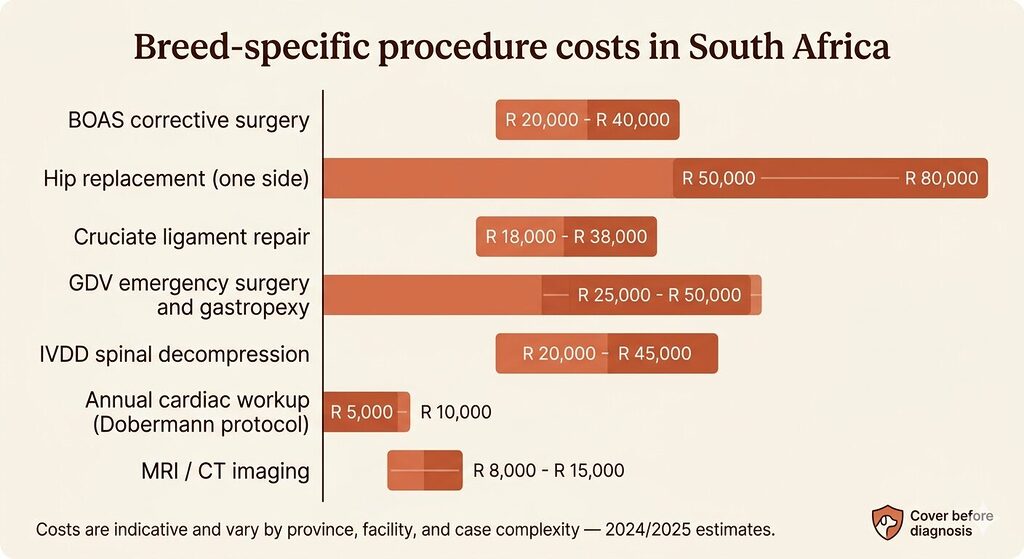
BOAS corrective surgery for a brachycephalic breed typically ranges from R15,000 to R35,000 at a competent facility, depending on the complexity of the procedure and the province in which it is performed. Orthopaedic procedures — hip replacement, triple pelvic osteotomy (TPO) for hip dysplasia in young dogs, cruciate repair — range from R20,000 to R60,000 or more for complex bilateral cases. Cardiac management including echocardiography and Holter monitoring, required annually in Dobermanns following established protocols, adds ongoing costs of R3,000 to R8,000 per year in diagnostic fees alone, before any medication. Neurological investigation including MRI for IVDD or Wobbler syndrome typically costs R10,000 to R20,000 for imaging alone.
These figures are not presented to alarm but to contextualise the importance of pet medical aid. An owner who has budgeted for routine care but not for the breed-specific procedures their dog is statistically likely to need is an owner who will face an impossible financial choice when that need arises.
Pet medical aid in South Africa
South Africa has a well-developed pet medical aid market, with a number of established providers including Dotsure, MediPet, PetSure, Oneplan, and others. These products vary significantly in what they cover, the waiting periods they impose, whether they exclude pre-existing conditions and congenital conditions, and how they handle breed-specific hereditary conditions. Reading the fine print on exclusions is critical — a policy that excludes hereditary conditions for your breed is of very limited value precisely when your breed is most likely to need it.
The time to take out pet medical aid is before any condition is diagnosed, not after. Once a condition such as hip dysplasia, BOAS, or cardiac disease has been identified in your dog, it becomes a pre-existing condition and will be excluded from future coverage. Enrolling your puppy in a comprehensive plan during the first weeks of ownership — before any health issues are formally diagnosed — is the financially responsible approach for owners of any breed with a significant hereditary disease burden.
Key questions for pet insurers
Before taking out pet medical aid, ask explicitly. Does this policy cover hereditary and congenital conditions? Is BOAS / hip dysplasia / DCM (as relevant to your breed) covered? What is the waiting period before claims can be made? Is there a lifetime limit per condition, and what is it? Understanding these terms before you sign is significantly easier than disputing them after a claim.
Rural and peri-urban access to veterinary care
For South African dog owners outside the major metropolitan areas, the challenge is not choosing between good vets — it is often finding any vet within a manageable distance. The distribution of veterinary practices in South Africa is heavily skewed toward urban centres, and the ratio of vets to dog-owning households in rural and peri-urban areas is significantly lower than in cities.
In these contexts, the practical model for owners of breeds with significant health complexity is a two-tier system, a trusted local generalist for routine care, vaccinations, parasite management, and minor illness, and an established relationship with a specialist or experienced small animal practice in the nearest city for breed-specific screening, complex diagnosis, and any surgical or specialist management that arises. Building the city relationship before you need it — registering, completing baseline health screening for your breed, introducing yourself to the specialist team — means that when a crisis occurs, you are not making calls to unknown practices while your dog is in distress.
The growth of teleconsultation in South African veterinary practice is also worth noting. Several platforms now offer remote consultations with experienced veterinarians who can review clinical notes, imaging, and video of clinical signs and provide advice on management or referral urgency. For rural owners managing the decision of whether a condition warrants a four-hour drive to a specialist, this kind of remote second opinion has genuine practical value.
Red flags
Signs you need a different vet
The relationship between an owner and a vet should be one of mutual respect and open professional communication. When that relationship is not working — or when the clinical care your dog is receiving is genuinely inadequate — the responsible action is to seek a second opinion or to change practice. The following are clear signals that action may be warranted.
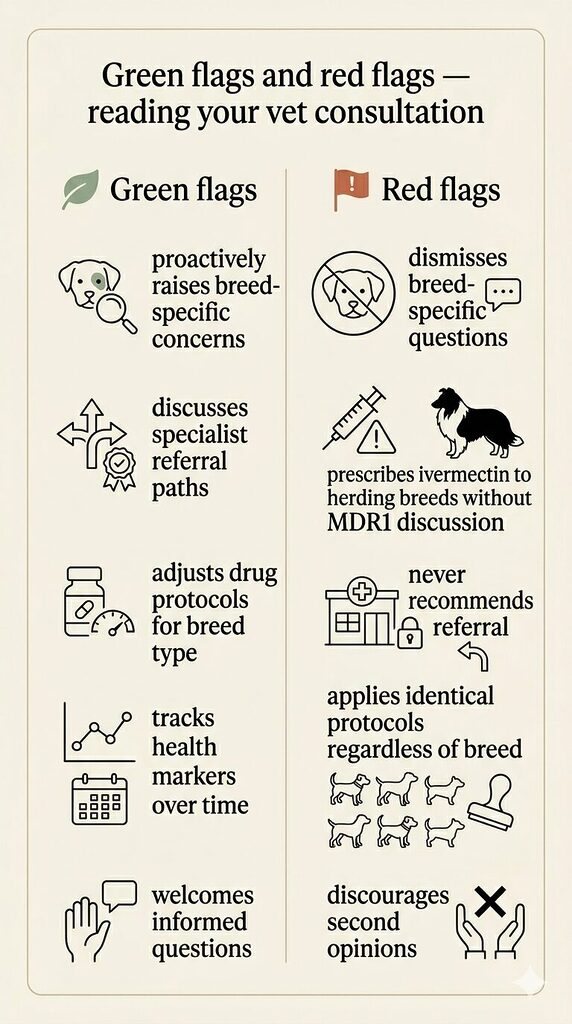
Your vet dismisses questions about breed-specific health conditions with generalisations ("all dogs are the same underneath") or apparent unfamiliarity with conditions that are well-documented in your breed.
Ivermectin or ivermectin-containing products are prescribed or dispensed for a herding breed patient without any discussion of MDR1 status — this is a clinical safety failure.
Standard anaesthetic protocols are used without modification for a brachycephalic breed, or a sighthound is given barbiturate induction without sighthound-specific dosing adjustments.
Your vet never recommends specialist referral, even for complex conditions that clearly exceed general practice scope. Reluctance to refer is not a sign of confidence — it is a sign of poor professional boundary awareness.
Breed-specific screening (cardiac auscultation in Cavaliers, body condition scoring in Labradors, spinal assessment in Dachshunds) is never discussed or initiated proactively.
You are made to feel that asking informed questions is unwelcome or inappropriate. A professional who is threatened by an informed owner is not a professional who will provide the best care for your dog.
The practice has no capacity for basic diagnostics — in-house blood work, urinalysis, basic imaging — and cannot explain clearly how these will be accessed when needed.
On second opinions
Seeking a second opinion is your right as a client and in your dog's best interest when you have genuine uncertainty about a diagnosis or treatment plan. A good vet will not be offended by this — they will either have their view confirmed, which is reassuring, or learn something from the process. A vet who actively discourages second opinions is one worth looking at more carefully.
Building a long-term relationship with your vet
The most productive veterinary relationships are longitudinal — built over years of consistent contact, honest communication, and mutual investment in the animal's wellbeing. A vet who has known your dog since puppyhood, who has seen their body condition evolve, who has tracked their cardiac murmur grade over six consecutive annual visits, and who knows your circumstances, your concerns, and your level of engagement is providing care that is categorically different from a vet seeing a patient for the first time on a busy afternoon.
Achieving this kind of relationship requires effort from both sides. From the owner, it requires registering with a practice rather than simply attending the nearest available clinic for each visit, seeing the same vet where possible, keeping vaccination and health records in order, attending wellness visits on schedule rather than only presenting when something is wrong, and communicating openly about concerns, observations, and changes in your dog's behaviour or condition.
It also requires advocating for your dog when you need to. If your vet's approach to a breed-specific issue does not align with current guidance, say so — calmly, specifically, and with reference to whatever source informs your concern. Most vets will engage with this in good faith. The few who do not are, again, providing you with useful information about the quality of the professional relationship you are in.
Emergency veterinary care in South Africa
Emergency veterinary care in South Africa is unevenly distributed, with 24-hour facilities concentrated almost entirely in metropolitan areas. In a country where heat stress emergencies in brachycephalic breeds, GDV in giant breeds, and spinal emergencies in Dachshunds can develop from zero to life-threatening in under an hour, knowing where the nearest 24-hour facility is — and how to get there — is not optional preparation. It is essential.
Most major metropolitan areas have at least one 24-hour emergency veterinary hospital. In Johannesburg and Pretoria, several compete for the specialist emergency market. In Cape Town, Durban, and Port Elizabeth, the options are fewer but exist. Identifying the nearest 24-hour facility, saving their number in your phone, and knowing your route there before an emergency arises is one of the most straightforward and most frequently overlooked aspects of responsible pet ownership.
Breed-specific emergency awareness is equally important. Owners of brachycephalic breeds should know the early signs of heat stress and respiratory distress, how to perform initial cooling, and why these animals should be prioritised as emergencies on presentation. Owners of Great Danes and other deep-chested breeds should know the signs of GDV — unproductive retching, a distended abdomen, restlessness and distress — and understand that this condition requires emergency surgical intervention, not a wait-and-see approach. Owners of Dachshunds should know that sudden hindlimb weakness or paralysis is a spinal emergency in which the window for successful decompression surgery is measured in hours.
Prepare now, not then
Save the number of your nearest 24-hour veterinary emergency facility in your phone today. Write down the address and the fastest route. Tell everyone in your household where this information is. The two minutes this takes will matter more than almost anything else if you ever need them at 2am.
The role of the South African Veterinary Council
The South African Veterinary Council (SAVC) is the statutory body that regulates the veterinary profession in South Africa under the Veterinary and Para-Veterinary Professions Act (Act 19 of 1982). All veterinarians practising in South Africa must be registered with the SAVC, which maintains a public register of registered professionals that any member of the public can consult. The SAVC sets standards for veterinary education, handles complaints against registered practitioners, and has the authority to investigate and discipline vets found to be in breach of professional standards.
If you have a substantive concern about the standard of veterinary care your dog has received — particularly if that concern relates to a potentially avoidable adverse outcome — the SAVC is the appropriate body to approach. Their complaints process is formal and requires documented evidence, but it exists precisely for situations in which the professional relationship has broken down beyond what a direct conversation can resolve.
The SAVC also recognises and registers veterinary specialists, and their public register indicates which vets hold specialist recognition in specific disciplines. This register is publicly accessible and is a useful verification tool when assessing whether a vet who presents as a specialist actually holds recognised specialist status, or whether they are using the term informally to describe a particular clinical interest.
Choosing a vet is not a bureaucratic task to be completed once and forgotten. It is an ongoing act of advocacy for the animal in your care. The best vet for your dog is the one who knows your breed, asks the right questions, says the hard things when they need to be said, and treats you as a partner in your dog's health rather than an obstacle to efficient throughput. That vet exists in South Africa. Finding them is worth the effort.
Specialist in small animal internal medicine, Johannesburg · 18 years in South African practice
"The cases that stay with me are not the difficult ones — the difficult ones are expected in a specialist practice. The cases that stay with me are the ones that arrived late. The Dobermann whose DCM was at end-stage when the owner finally pushed for a Holter because their previous vet had said the heart 'sounded fine for years.' The Border Collie who came in paralysed after receiving a routine ivermectin injection at a practice that simply didn't know. The Frenchie who had been managed for 'noisy breathing' for three years before anyone graded her BOAS and recognised that she had been in chronic respiratory distress since puppyhood. These are not cases of bad vets in any simple sense. They are cases where the specific knowledge gap between the vet in front of the animal and the animal's actual clinical needs had real and lasting consequences. That gap is closeable — but only if owners know it exists and know how to assess it."
What makes breed-specific medicine in South Africa particularly interesting — and particularly demanding — is the interaction between the breeds South African owners have chosen to keep and the environment those breeds are kept in. We have one of the highest per-capita populations of brachycephalic breeds on the African continent, and we have summer temperatures that expose the limits of those dogs' physiology in ways that a damp British summer simply does not. We have giant breeds in households without the insurance penetration to support the interventions those breeds' statistical health profiles will almost certainly require. We have herding breeds on farms where the temptation to reach for the nearest antiparasitic is understandable and potentially lethal. The South African vet treating companion animals is, in this respect, managing a more demanding intersection of breed, climate, economics, and geography than most. The vets doing this well are doing something genuinely skilled. Finding them is the owner's most important job.
My advice to any owner registering a new puppy in South Africa is this. Be the owner who reads before they arrive. Know your breed's top three health risks. Know whether your breed has drug sensitivities. Know what screening is recommended and when. Not because you are trying to replace your vet, but because the consultation you have with an informed owner who knows what questions to ask is a categorically better consultation for the animal than one where neither party has thought about these things in advance. The best vets I know are energised by that conversation, not threatened by it. And if the vet in front of you is threatened by it — that, too, is information worth having.
01 — Do I need a specialist vet for my breed, or will a general practice vet do?
For routine care — vaccinations, parasite management, annual wellness visits, minor illness — a general practice vet is entirely appropriate. For breed-specific health conditions that are complex, progressive, or require specialist intervention, a GP vet who knows your breed well and has clear specialist referral pathways is the right base, not a specialist as your primary vet. Think of it as a general practitioner model. Your GP manages most things, but refers when the situation warrants it. The key is that your GP vet knows your breed well enough to recognise when that threshold has been reached.
02 — How do I find out if a vet has experience with my specific breed in South Africa?
The most direct method is to ask — by phone before booking, or in the first consultation. Ask how many patients of your breed the practice currently manages, what conditions they commonly see in that breed, and whether any vet in the practice has a particular interest or additional training relevant to your breed's health profile. Breed clubs and communities are also useful sources. The relevant breed club affiliated with the Kennel Union of Southern Africa (KUSA) often maintains informal lists of vets with established experience in their breed. Facebook groups and online communities for specific breeds in South Africa frequently contain practitioner recommendations from experienced owners in your area.
03 — What is the SAVC and how do I check if my vet is registered?
The South African Veterinary Council (SAVC) is the statutory regulatory body for all veterinary professionals in South Africa. All vets practising legally must be registered with the SAVC. You can verify a vet's registration through the SAVC's public register, accessible via their website at savc.org.za. The register confirms registration status and indicates whether a vet holds any recognised specialist qualification. Registration is annual, so a vet whose registration has lapsed should not be practising.
04 — My French Bulldog needs surgery. Should I use my local vet or go to a specialist?
For BOAS corrective surgery specifically — which involves the nares, soft palate, and potentially the laryngeal saccules — the outcomes data strongly favour a surgeon who performs this procedure regularly and in meaningful volume. This is a procedure where surgical experience and case volume directly correlate with outcome quality and complication rates. If your general practice vet does not perform BOAS surgery regularly, a specialist surgical referral is appropriate and should be proactively offered by your vet. In South Africa, look for a board-certified veterinary surgeon or a practice with documented BOAS surgical experience and post-operative monitoring protocols appropriate for brachycephalic patients.
05 — What antiparasitic products are safe for my Border Collie or Collie?
The MDR1/ABCB1 mutation in herding breeds causes sensitivity to ivermectin, milbemycin oxime, moxidectin, and several other drugs. This means that ivermectin-based antiparasitic products — including many common injectable, oral, and topical products widely used in South Africa — can cause toxicity at doses that are safe in other breeds. Before your herding breed receives any antiparasitic product, confirm with your vet that the product does not contain ivermectin or another affected drug, or that your dog has been tested for the MDR1 mutation and is confirmed clear. Products containing sarolaner, afoxolaner, fluralaner, or spinosad are generally considered safe in MDR1-affected dogs. An MDR1 gene test through Embark, Wisdom Panel, or an accredited genetic testing laboratory is strongly recommended before any antiparasitic prescription for herding breeds.
06 — Is pet medical aid worth it for a healthy puppy in South Africa?
For breeds with significant hereditary disease burden — brachycephalic breeds, giant breeds, Dobermanns, Cavalier King Charles Spaniels, Dachshunds, and others — pet medical aid is not optional risk management; it is financially rational. The probability that one of the major breed-specific conditions will require veterinary intervention is high enough, and the cost of that intervention significant enough, that the expected value of comprehensive cover is positive. The critical qualifier is "comprehensive cover with hereditary condition inclusion" — a policy that excludes hereditary conditions for your specific breed is of substantially reduced value. Take out cover as a puppy, before any conditions are diagnosed, to avoid exclusion of pre-existing conditions.
07 — My Dobermann puppy just came home. When should cardiac screening begin?
For Dobermanns, cardiac auscultation should begin at every wellness visit from puppyhood onward. The European Dobermann Health Survey protocol recommends annual Holter monitoring (24-hour ECG) and annual echocardiography from the age of two years in all Dobermanns, regardless of apparent health. This is because DCM in Dobermanns can present with electrical abnormalities (detectable on Holter) before any structural changes are visible on echocardiography, and the window for effective medical management is significantly wider when the condition is detected early. A vet who manages Dobermanns should be familiar with this protocol; if they are not, it is a substantive concern about their breed-specific knowledge for this particular dog.
08 — I live in a rural area of South Africa. How do I access specialist care for my breed?
The practical model for rural owners of breeds with complex health profiles is a two-tier system. Identify and register with the best available local generalist for routine care. Separately, identify the nearest specialist practice in your closest major city — Johannesburg, Pretoria, Cape Town, Durban, or Bloemfontein depending on your location — and make contact before you need them. Establish your dog's records with that practice, complete any baseline screening for your breed, and save their details for when specialist care is required. Additionally, explore teleconsultation options. Several South African platforms now offer remote veterinary second opinions that can help you assess whether a condition warrants the drive before committing to it.
09 — What genetic tests should I do for my new puppy in South Africa?
The relevant genetic tests depend entirely on the breed, and a responsible breeder should have already performed those appropriate to the breeding pair before the litter was born. For the puppy owner, the most immediately actionable tests are those that affect veterinary management — MDR1/ABCB1 status in herding breeds (because it determines which drugs are safe), and where available, tests for conditions with high breed prevalence such as DCM gene markers in Dobermanns, DM (degenerative myelopathy) in German Shepherds, EIC in Labradors, and L2-HGA in Staffordshire Bull Terriers. Services available in South Africa include Embark (US-based but accessible), Wisdom Panel, and direct submission to accredited overseas genetic laboratories. Your vet and your breed club are the best sources of guidance on which specific tests add the most value for your breed.
10 — What is KUSA and does it affect my choice of vet?
The Kennel Union of Southern Africa (KUSA) is the South African national canine authority and breed registry, affiliated with the Fédération Cynologique Internationale (FCI). KUSA registers purebred dogs, recognises breed standards, and governs conformation showing and working trials. KUSA does not directly regulate veterinary practice, but it is relevant to health in several ways. KUSA's affiliated breed clubs maintain health registers, promote health testing, and in some cases run breed-specific health schemes. KUSA is also your first point of contact for pedigree documentation that a vet may need when assessing breeding line health histories. Registering your KUSA-registered dog with your vet with their pedigree documentation is a useful step that provides the vet with additional context about the dog's lineage and any hereditary conditions in the breeding line.
11 — My vet recommended against corrective BOAS surgery for my Bulldog. Should I get a second opinion?
If your Bulldog is showing moderate to severe respiratory compromise — loud breathing at rest, poor exercise tolerance, heat sensitivity, sleep disturbance, or graded as BOAS grade 2 or 3 on clinical assessment — and surgery has been advised against without a clear clinical rationale, then yes, a second opinion from a vet with specific BOAS surgical experience or a specialist surgeon is reasonable and appropriate. There are genuine cases where the risk-benefit calculation for surgery is unfavourable — very old dogs, dogs with severe concurrent disease, or dogs with particular anaesthetic risk factors — but in a young or middle-aged Bulldog with symptomatic BOAS, conservative management is generally the inferior option when corrective surgery is available.
12 — Are there breed-specific vaccination schedules I should know about?
The core vaccination schedule — distemper, parvovirus, adenovirus, and rabies — is broadly consistent across breeds, and rabies vaccination is a legal requirement in South Africa. There are, however, breed-specific nuances worth knowing. Rottweilers and Dobermanns have documented reduced immune responses to parvovirus vaccination compared to other breeds, and the recommendation for these breeds is to extend the puppy vaccination series to a final dose at 16 to 18 weeks rather than the standard 12 weeks, with some protocols recommending a booster at 20 weeks. A vet who is unaware of this Rottweiler and Dobermann parvovirus vaccination exception is missing an important breed-specific protocol that has direct consequences for protection during the puppy vulnerability period.
13 — How do I manage South Africa's heat for my brachycephalic breed?
South Africa's climate — with sustained high temperatures across the Highveld summer, the humid heat of KwaZulu-Natal and Mpumalanga, and hot dry conditions in the Northern Cape and parts of the Western Cape — presents a genuine management challenge for brachycephalic breeds. The practical guidelines are, walk only in the early morning or late evening during summer months; never leave the dog in a car or unventilated space; keep the home cool (air conditioning or fans) on hot days; have access to cool water at all times; recognise the early signs of heat stress (excessive panting beyond normal for the breed, distress, extended neck breathing, pale or bluish gum colour) and act immediately by moving to a cool environment, applying cool (not ice cold) water to the paw pads and groin, and transporting to a veterinary emergency facility without delay. BOAS corrective surgery significantly improves heat tolerance — this is one of the most compelling quality-of-life arguments for early surgical intervention in symptomatic brachycephalic dogs in a South African climate.
14 — My vet has recommended gastropexy for my Great Dane puppy. What is this and is it necessary?
Prophylactic gastropexy is a surgical procedure in which the stomach is permanently attached to the abdominal wall, preventing it from rotating — the rotation being the life-threatening component of gastric dilatation-volvulus (GDV), the bloat condition to which deep-chested giant breeds, particularly Great Danes, are highly predisposed. GDV has a reported lifetime risk of approximately 42% in male Great Danes and 37% in females — making it the single most likely life-threatening surgical emergency your Great Dane will face. Prophylactic gastropexy, performed electively at the time of desexing or as a standalone procedure, effectively eliminates the risk of stomach rotation while not preventing gas accumulation. The consensus among veterinary surgeons and internal medicine specialists who manage Great Danes is that prophylactic gastropexy is a strongly recommended standard of care for the breed. If your vet has recommended it, this is a sign of breed-aware practice, not unnecessary intervention.
15 — How do I lodge a formal complaint about a vet in South Africa?
Formal complaints about veterinary practitioners in South Africa are handled by the South African Veterinary Council (SAVC). The complaint must be submitted in writing to the SAVC's registrar, with supporting documentation including clinical records, invoices, correspondence, and any independent veterinary opinion you have obtained. The SAVC's Professional Conduct Committee reviews complaints and can impose sanctions ranging from a reprimand to suspension or removal from the register. Before proceeding to a formal complaint, it is worth attempting direct communication with the practice principal — many issues can be resolved at that level, and the SAVC process is formal, slow, and resource-intensive for all parties. If direct communication fails or the issue involves patient safety that others may be exposed to, a formal complaint is the appropriate mechanism.