Why puppy nutrition is more complicated than it looks
Walk into any pet shop and the wall of puppy food options is, on first encounter, overwhelming. Dozens of brands in brightly designed bags making claims that range from the modest to the near-miraculous "brain development," "immune support," "optimal bone growth," "ancestral diet." Every product appears to be premium. Every product appears to be science-backed. Every product appears to be the best possible choice for your puppy. This is, of course, by design — and it is one of the most successful confusions in modern consumer marketing.
The difficulty is that puppy nutrition genuinely does matter, a great deal and in specific ways, and the gap between a good diet and a poor one in the first year has consequences that can be traced in the adult dog's joint health, coat condition, immune function, and body composition for years afterward. But the information that would help an owner make a well-reasoned decision is almost entirely absent from the front of the bag. It lives, partially obscured, in the small print of the ingredients list and the guaranteed analysis panel — and only becomes intelligible with some knowledge of how that information is structured, what it is required to contain, and, critically, what it is not required to say.
This guide decodes all of it. Not to turn you into a pet nutritionist, but to give you the specific knowledge that converts a wall of competing claims into a manageable decision — and to identify the handful of feeding practices in the first year that account for the majority of avoidable nutritional problems in adult dogs.
How pet food labelling actually works
Pet food labelling is regulated differently in different parts of the world, but shares a common structure across most major markets. In the UK and EU, pet food is governed by FEDIAF guidelines and EU regulations. In the US, the Association of American Feed Control Officials (AAFCO) sets the framework. In South Africa, regulations are governed by Act 36 of 1947 (the Fertilizers, Farm Feeds, Agricultural Remedies and Stock Remedies Act), with additional guidelines from SACOTA (the South African Compound Animal Feed Manufacturers Association). In all cases, the regulatory framework establishes minimum requirements — what must be stated — but says relatively little about what cannot be implied.
The mandatory elements on a pet food label include the product name, the species for which it is intended, the net weight, the name and address of the manufacturer, and either a guaranteed analysis panel or a typical analysis panel. In most markets, an ingredients list in descending order of weight before processing is also required. What the label does not have to include, in most jurisdictions, is the actual percentage of each ingredient, the source of any fat or protein described generically, the processing method used, or the origin of raw materials.
The naming rules — and how they mislead
In AAFCO-governed markets (the US and, by informal adoption, many others), the naming conventions for pet food contain important signals that most owners never learn. The "100% rule" means a product named "Chicken for Puppies" must contain nothing but chicken (plus water, preservatives, and vitamins/minerals). The "95% rule" means a product named "Chicken Puppy Food" must contain at least 95% chicken by weight excluding water. The "25% rule" (sometimes called the "dinner rule") means a product named "Chicken Dinner," "Chicken Entrée," or "Chicken Formula" need only contain 25 to 95% chicken. The "with" rule means "Puppy Food with Chicken" need only contain 3% chicken. And the "flavour" rule means "Chicken Flavour Puppy Food" need contain no chicken at all — only a sufficient amount of chicken digest or flavour to be detectable.
These rules are not loopholes — they are the actual regulatory framework. A bag labelled "Salmon & Potato Dinner" contains between a quarter and just under all salmon and potato combined. A bag labelled "with real chicken" contains a minimum of 3% chicken. Reading the product name with this framework in mind converts a marketing-driven front panel into a rough ingredient-proportion indicator.
The front panel is marketing
Every claim on the front of a pet food bag — "premium," "natural," "grain-free," "ancestral," "holistic," "veterinary formula" — is marketing language, not a regulated term with defined meaning in most jurisdictions. Turn the bag around. The ingredients list and guaranteed analysis panel are where the actual information lives.
Decoding the ingredients list
The ingredients list is printed in descending order of weight before processing. This sounds straightforward, but it contains several features that reward careful reading and several that actively obscure what you are paying for.
Ingredient splitting
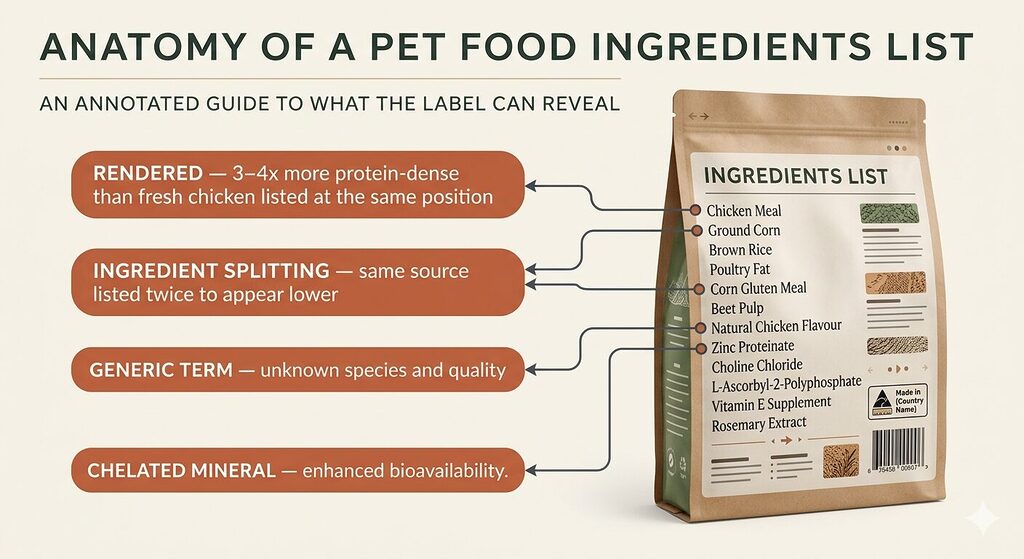
The most significant manipulation technique in ingredients lists is ingredient splitting. Because ingredients are listed by pre-processing weight, a manufacturer can take a single ingredient — say, corn — and list it as "corn," "corn gluten meal," and "corn flour" separately. Each appears lower on the list than it would if listed as a combined total, creating the impression that corn is a minor ingredient when it may in fact represent the largest single component of the food by weight. This technique is widespread and entirely legal. To detect it, look for the same base ingredient appearing in multiple forms — "chicken," "chicken meal," and "chicken digest" are three forms of the same animal protein source; "brown rice," "white rice," and "rice flour" are three forms of the same grain.
Named versus generic ingredients
The specificity of ingredient naming carries quality implications. "Chicken" is a named, specific protein source. "Poultry" is a generic term that could include any bird, including by-products from multiple species. "Meat and animal derivatives" is the most generic category in EU labelling, and can include any part of any farmed animal — which is not necessarily harmful, but provides no information about what you are actually feeding. Premium foods tend to name ingredients specifically, "deboned salmon," "fresh chicken thigh," "turkey meal." Foods that rely heavily on generic terms are telling you something about the ingredient sourcing — not that it is bad, but that the manufacturer either does not know or is not disclosing the specific origin.
Meals versus fresh ingredients
A "meal" — as in "chicken meal" or "salmon meal" — is an ingredient that has been rendered, the moisture has been removed and the product concentrated. This means chicken meal contains roughly three to four times as much protein by weight as fresh chicken listed at the same position on an ingredients list, because fresh chicken is roughly 70% water. A food whose first ingredient is "chicken meal" may actually contain more chicken protein than a food whose first ingredient is "fresh chicken" — the meal is simply more concentrated. Neither is inherently better or worse; understanding the distinction prevents misreading of the ingredients list.
Ingredients list decoder — terms to know
Named meal (e.g. chicken meal)
Rendered, moisture-removed protein concentrate. Higher protein density than fresh equivalents listed at the same position.
By-products / derivatives
Organ meats, bone, and non-muscle tissue. Not inherently poor quality — liver and kidney are highly nutritious — but non-specific by-product terms reveal nothing about quality or source.
Digest
Chemically or enzymatically hydrolysed animal tissue. Used primarily as a palatability enhancer. Nutritionally minimal but not harmful.
Preserved with mixed tocopherols
Natural vitamin E preservation. Shorter shelf life than artificial preservatives but generally preferred. Look for this over BHA, BHT, or ethoxyquin. BHA / BHT / ethoxyquin
Synthetic antioxidant preservatives. BHA and BHT are approved in most markets. Ethoxyquin is restricted or banned in several countries but still present in some fish-based foods as a residual from fish meal processing.
Chelated minerals
Minerals bonded to amino acids for enhanced absorption (e.g. zinc proteinate, iron glycinate). Generally a quality marker indicating higher investment in mineral bioavailability.
Carrageenan
A seaweed-derived thickener common in wet foods. Subject to ongoing debate about gastrointestinal effects; some owners choose to avoid it, though current evidence in dogs is limited.
Understanding the guaranteed analysis panel
The guaranteed analysis panel is the section of the pet food label that lists the minimum or maximum percentages of key nutrients. In most markets, the mandated figures are minimum crude protein, minimum crude fat, maximum crude fibre, and maximum moisture. Some manufacturers voluntarily add further figures — omega fatty acids, calcium, phosphorus, sodium — but are not required to.
The "crude" problem
"Crude protein" does not mean protein from crude or poor-quality sources. It means total nitrogen-containing compounds measured by a standard chemical method (the Kjeldahl method). The problem is that this method measures all nitrogen, whether from genuinely digestible and bioavailable protein or from non-protein nitrogen sources such as urea, melamine, or poorly digestible feather meal. A food can have a high crude protein figure and low actual digestible protein. The crude protein percentage tells you how much protein-equivalent nitrogen is present; it tells you nothing about whether that protein is absorbed and used by the puppy's body.
A better question — one the label does not answer — is digestibility, sometimes expressed as a digestibility coefficient. Digestibility data is not required on pet food labels in most markets, though some premium manufacturers publish it voluntarily or on request. Foods with AAFCO or FEDIAF feeding trials behind them (rather than just nutrient profile formulation) have implicitly demonstrated a higher standard of nutritional adequacy.
Comparing foods on a dry matter basis
Comparing the guaranteed analysis figures of a dry food and a wet food directly is meaningless because wet food contains 70 to 80% water while dry food contains 8 to 12%. To compare them fairly, you must convert both to a dry matter basis by removing the moisture contribution. The calculation is, dry matter % = (nutrient % ÷ (100 − moisture %)) × 100. A wet food showing 10% crude protein on the label at 78% moisture has a dry matter protein of (10 ÷ 22) × 100 = 45.5% — significantly higher than a dry food showing 28% crude protein at 10% moisture, which has a dry matter protein of (28 ÷ 90) × 100 = 31.1%. This calculation is rarely performed by owners and rarely explained by retailers, which is why the comparison between food types is so persistently confusing.
The feeding trial distinction
Some labels state "formulated to meet nutritional levels established by AAFCO nutrient profiles." Others state "animal feeding tests using AAFCO procedures substantiate that [product] provides complete and balanced nutrition." The second statement is meaningfully stronger — it means the food has been fed to real animals and demonstrated adequate nutritional outcomes. The first means only that the nutrient levels on paper meet minimum requirements.
The AAFCO and FEDIAF standards — what “complete and balanced” means
"Complete and balanced" is one of the most important phrases in pet food labelling and one of the most misunderstood. It does not mean "nutritionally optimal" or "the best possible diet." It means the food meets the minimum nutrient profile for the stated life stage as defined by AAFCO (in North America and many other markets) or FEDIAF (in Europe and markets that follow European standards). These profiles specify minimum levels for approximately forty nutrients including protein, fat, essential amino acids, fatty acids, vitamins, and minerals, with maximum levels for nutrients where excess is harmful.
The life stage designation on a "complete and balanced" label is critical. A food labelled "for adult maintenance" has not been formulated to meet the elevated requirements of growth and is not appropriate as the primary diet for a growing puppy. A food labelled "for all life stages" has been formulated to meet the most demanding nutritional profile — that of growth and reproduction — and is appropriate for puppies. A food labelled "for puppies" is specifically formulated for the growth life stage. These distinctions matter because the nutrient requirements for a growing puppy differ significantly from those of an adult dog — particularly in terms of protein quality, calcium and phosphorus ratios, and caloric density.
The large breed puppy exception
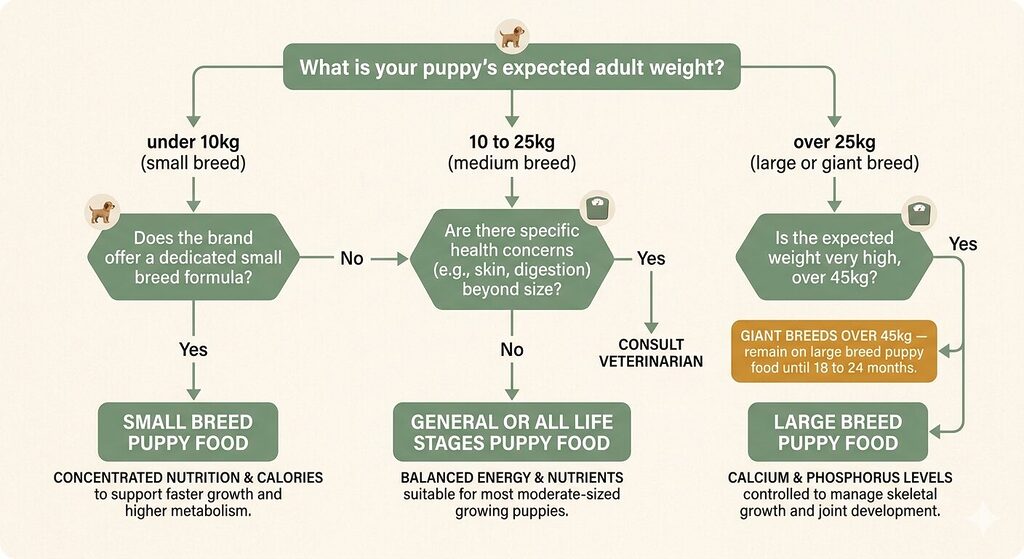
Within the puppy category, there is a critical subdivision that affects a significant proportion of dog owners. The large breed puppy designation. AAFCO and FEDIAF both define a separate nutritional profile for puppies of breeds expected to exceed 25kg (55lb) at adult weight. The key difference is in calcium content. Large breed puppies require a lower calcium range than small breed puppies — specifically, AAFCO guidelines set a calcium maximum of 1.8% for large breed puppy foods, whereas the general puppy profile allows up to 2.5%. Excess calcium in large breed puppies during the rapid growth phase is associated with developmental orthopaedic disease — conditions including osteochondrosis, hypertrophic osteodystrophy, and angular limb deformities that can have lifelong consequences. This is not a minor nutritional nuance; it is one of the most significant dietary decisions in a large breed puppy's first year.
Dry, wet, raw, and fresh
The food format debate The format debate in pet food — dry kibble versus wet food versus raw (BARF) versus fresh-cooked — is one of the most strongly held controversies among dog owners, and one of the areas in which strongly held opinions frequently outrun the available evidence. A fair assessment of each format follows.
Dry kibble
Extruded dry kibble remains the most widely used puppy food format for practical reasons. It is calorie-dense, has a long shelf life, is easy to portion, and the major brands have the largest evidence base for nutritional adequacy. The manufacturing process (high-temperature extrusion) does reduce some heat-sensitive nutrients, which manufacturers compensate for by fortifying the product. Kibble's primary nutritional weaknesses are its relatively high carbohydrate content (necessary for the extrusion process) and the fact that it is a heavily processed product whose digestibility varies significantly between manufacturers. It is also worth noting that many kibbles use synthetic vitamin and mineral premixes that are bioavailable but less complex than those found in whole foods.
Wet food
Wet food typically has a higher moisture content, a higher meat content (by dry matter comparison), and is often more palatable than kibble. It is also more expensive per calorie, has a shorter open shelf life, and contributes to dental plaque more readily than dry food. For puppies, wet food can be a useful palatability tool during the transition from mother's milk, and high-quality wet food provides excellent nutrition. Complete wet food for puppies (as opposed to a "complementary" product, which should not be fed as a sole diet) is nutritionally adequate when the "complete and balanced" designation applies.
Raw (BARF) diets
Biologically Appropriate Raw Food (BARF) diets consist of raw meat, raw meaty bones, organ meat, and sometimes vegetables and other additions. They have a passionate following and are claimed to produce superior coat condition, reduced stool volume, better dental health, and improved energy. The evidence base for these claims is limited and mixed. The concerns that are well-documented include, bacterial contamination (Salmonella, Listeria, Campylobacter, and E. coli have all been found in raw pet foods at rates that present real zoonotic risks, particularly in households with immunocompromised members, young children, or elderly people); nutritional imbalance in home-prepared raw diets (deficiencies in calcium, phosphorus, zinc, vitamin D, and iodine have all been reported in raw diets without careful formulation); and the risk of bone-related injuries including tooth fracture, oesophageal obstruction, and intestinal perforation from raw bone feeding. Commercial raw food that meets AAFCO or FEDIAF complete and balanced standards and has been high-pressure pasteurised (HPP) addresses several but not all of these concerns. Raw feeding for puppies in particular carries more risk than for adult dogs because puppies' immune systems are still developing.
Fresh and gently cooked diets
The fastest-growing segment of the pet food market is fresh or gently cooked food — whole food ingredients cooked at lower temperatures than extrusion and delivered refrigerated or frozen. The nutritional profile of high-quality fresh diets can be excellent, the digestibility tends to be higher than equivalent kibble, and the ingredient quality is typically more transparent. The constraints are cost (fresh diets are significantly more expensive per day than kibble), shelf life management, and the need to ensure the specific product carries a "complete and balanced" designation rather than being a complementary or supplementary product. Several subscription-based fresh food services have emerged that address these constraints with varying degrees of nutritional rigour.
The format is less important than the standard
The single most important question about any puppy food, regardless of format, is, does this product carry a "complete and balanced" designation for the growth life stage (or all life stages) from a recognised regulatory body? A premium raw food that does not meet this standard is nutritionally inferior to a modest kibble that does. Format preferences are secondary to this baseline.
Large breed versus small breed puppy food — why it matters
The large breed versus small breed distinction in puppy food is one of the most practically significant choices an owner makes, and it is one that many get wrong — typically by either using an adult food for a large breed puppy (calorie density too low, nutrient profile wrong for growth) or by using a general puppy food for a large breed puppy (calcium level potentially too high).
The defining threshold varies slightly by jurisdiction and manufacturer, but the working rule is, if your puppy's expected adult weight is 25kg or more, they should be on a food specifically formulated for large breed puppies, not a general "all puppies" or "all life stages" formula. Giant breeds — those expected to exceed 45kg at adult weight — benefit most from this distinction and are at the highest risk from inappropriate calcium levels during the growth phase.
Small breed puppies (expected adult weight under 10kg) have different requirements in the opposite direction, they have higher metabolic rates per unit of body weight, smaller stomachs, and higher caloric needs per gram of body weight than large breeds. Small breed puppy foods are formulated with higher caloric density and smaller kibble sizes. A Chihuahua puppy eating a large breed formula may be genuinely under-nourished even when apparently consuming adequate volume, because the food was not formulated for their metabolic profile.
Medium breeds (expected adult weight 10 to 25kg) can generally be well-served by a general puppy formula or an all life stages formula, provided the calcium levels are within an appropriate range. They sit in the middle ground where neither the large breed calcium concern nor the small breed caloric density concern applies with the same force.
Portion sizes, feeding guides, and why the bag is wrong
Every bag of dog food carries a feeding guide — typically a chart correlating body weight to recommended daily portion. These guides are almost universally problematic as a sole guide to portion sizing, for several reasons that are worth understanding in detail.
Why feeding guides overestimate
Feeding guides are calculated by manufacturers based on average energy requirements for a population of dogs of the relevant weight and life stage. They tend to be set conservatively toward the higher end of the range, because the consequence of underfeeding (a thin dog) is more immediately visible to the owner than the consequence of overfeeding (a gradually fattening dog), and because a manufacturer whose guide results in visibly underfed dogs receives complaints. The practical result is that most feeding guides overestimate the appropriate portion for any given individual by somewhere between 20 and 40%.
Individual variation
Dogs vary enormously in their resting metabolic rate, their activity level, their neuter status, and their efficiency of energy extraction from food. A neutered, sedentary indoor Labrador and an entire, working-farm Border Collie of the same body weight have caloric requirements that may differ by 50% or more. A feeding guide that does not account for these variables — and no bag guide does, because it cannot know your individual dog — can only ever be a starting point, not a prescription.
The guide is for the entire day
A feeding guide specifies the total daily portion. Every treat, training reward, food topper, dental chew, and scrap from the table is food. In households where a puppy receives ten to fifteen small training treats over the course of a day — entirely normal and appropriate for a puppy in active training — those treats may represent 10 to 20% of total daily caloric intake. If the main meal portion is not reduced accordingly, the puppy is being overfed by that proportion every day. The compounding of this over the first year is one of the primary drivers of the puppy-to-adult obesity transition that veterinary practices see commonly.
The measuring cup problem
The volume of a "cup" or "scoop" varies enormously depending on how full it is, how compressed the kibble is, and how large the pieces are. Weighing food on a digital kitchen scale in grams is more accurate than volumetric measuring by a significant margin. If the bag guide gives weights and volumes, use the weight. If it gives only volumes, convert — most kibbles have a grams-per-cup figure available from the manufacturer.
The body condition score
Your real portion guide The body condition score (BCS) is the single most reliable tool for assessing whether your puppy is receiving the right amount of food, and it is entirely independent of the bag guide. The BCS is a numerical assessment of body fat and muscle coverage assessed by sight and palpation — the most commonly used scale runs from 1 (emaciated) to 9 (obese), with 4 to 5 representing ideal condition.
The key assessment points in puppies and dogs are, the ribs should be easily felt under gentle pressure with the flat of the hand, with a thin layer of fat covering them (like feeling knuckles through a thin glove) but not visible or prominently protruding; the waist should be visible when viewed from above (a gentle hourglass); the abdomen should have a slight tuck when viewed from the side. If you cannot feel the ribs without significant pressure, the puppy is above ideal weight. If the ribs are visible to the eye without palpation, the puppy is below ideal weight.
For large breed puppies, there is an important nuance. The ideal BCS during the growth phase is on the lean side of the range — a 4 to 4.5 rather than a 5 — because carrying excess body weight during skeletal development places additional load on developing joints and growth plates. A lean large breed puppy is not an underfed one. Breeders and vets familiar with giant breeds routinely advise keeping young dogs at the leanest end of the healthy range precisely to protect joint development.
Assess your puppy's BCS at least weekly during the first six months, and every two weeks from six to twelve months. Adjust the daily portion by 10% in the direction indicated — up if the BCS is below 4, down if above 5 — and reassess after two weeks. This feedback loop is more reliable and more individualised than any bag guide.
Feeding schedules across the first year
The frequency of meals matters as much as the total daily amount, and both change significantly across the first twelve months. The following timeline represents established nutritional practice for companion dog puppies.
8–12 weeks - Four meals per day
Small stomach capacity and high metabolic rate require frequent, small meals. Spreading the daily portion across four meals reduces the risk of hypoglycaemia (particularly in toy breeds) and supports digestion. Meals at approximately 7am, 11am, 3pm, and 6pm work well for most households. No food after 6–7pm to support overnight bladder control.
12–16 weeks - Transitioning to three meals
Most puppies can move to three meals per day by 12 weeks, though toy and small breeds may benefit from remaining on four meals until 16 weeks. Three meals per day — morning, midday, and early evening — remains the standard. Maintain the no-food-after-6pm rule.
4–6 months - Three meals or transitioning to two
Larger breeds begin transitioning to two meals from around four months. Small breeds are often better on three meals until six months. The transition should be gradual — move one of the three meals into the remaining two over one to two weeks rather than dropping it suddenly.
6–12 months -Two meals per day
By six months, most puppies are on two meals — morning and evening, spaced roughly twelve hours apart. This schedule continues into adult life for the majority of dogs. Total daily amount should be recalculated as growth rate slows, typically requiring a modest reduction from the peak growth-phase portions.
10–18 months - Transitioning to adult food
The transition from puppy food to adult food happens at breed-appropriate maturity — small breeds at 10–12 months, medium breeds at 12 months, large breeds at 12–18 months, giant breeds at 18–24 months. Transitioning before skeletal maturity removes the growth-phase nutrients before they are no longer needed; transitioning too late maintains the higher caloric density of puppy food beyond the period of rapid growth, contributing to weight gain.
Treats
The hidden calorie problem Treats are the single most overlooked source of caloric excess in puppies and young dogs. They are given with good intentions — for training, for bonding, for comfort — and individually each treat is small enough that it does not register as a significant feeding event. Cumulatively, across a day of active training and casual reward-giving, they frequently represent a substantial proportion of total daily energy intake.
The 10% rule
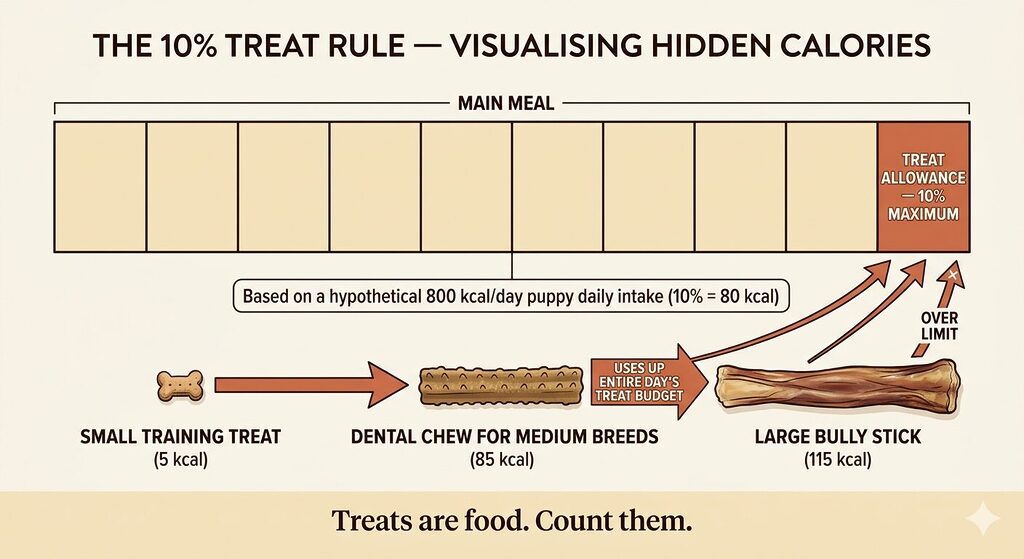
The widely cited guideline is that treats should constitute no more than 10% of total daily caloric intake. For a 10kg puppy consuming 800 calories per day, that is 80 calories from treats — roughly equivalent to eight standard training treats or one medium dental chew. Most owners significantly underestimate the caloric content of the treats they give, and significantly overestimate how much 10% actually is in practice. Looking up the caloric content of your chosen treats and calculating how many that 10% buys is a worthwhile exercise that almost always produces a number smaller than expected.
Training treats
Training treats for puppies in active learning phases should be as small as possible — pea-sized or smaller — as high-value as necessary for the specific training context, and as low-calorie as practical. Small pieces of cooked chicken breast, plain cooked fish, carrot, blueberry, or commercial soft training treats in small sizes are all appropriate. Hard biscuit-style treats, which are relatively calorie-dense and take time to consume, are less suited to rapid-repetition training. The palatability of the treat should match the difficulty of what is being asked. Routine sit-and-reward can use lower-value treats; recall training in a high-distraction environment warrants the highest-value treats you have.
Dental chews, bully sticks, and long-lasting chews
Long-lasting chews — bully sticks, raw hides, pigs' ears, dental chews — are frequently given outside the context of the daily meal plan entirely, as if they exist in a separate nutritional category. They do not. A single large bully stick can contain 90 to 130 calories. A standard dental chew for a medium breed may contain 70 to 100 calories. A large pig's ear contains 150 to 200 calories. These are significant additions to the daily caloric total that, if not accounted for in the main meal portion reduction, contribute directly to weight gain over time. Dental chews that carry the VOHC (Veterinary Oral Health Council) seal have demonstrated efficacy for plaque or tartar control and represent the best evidence-based choice for dental health maintenance in this category.
Human food and table scraps
Human food given to puppies — even the "healthy" versions, even small amounts — creates two problems beyond the caloric one. First, many human foods are genuinely toxic to dogs (covered in the next section). Second, puppies who receive human food develop reliable expectations for it, which drives food-seeking behaviour at the table and increases the probability that they will opportunistically consume something harmful when it becomes available. The cleanest policy — human food never, without exception, in the first year — is more manageable than a "sometimes and only safe foods" policy, because it does not require the puppy to make a distinction they are not equipped to make.
Foods that are toxic to dogs
The following foods are documented as toxic to dogs and should never be within reach of a puppy, in any amount. Some of these are well known; others are significantly underappreciated.
Grapes and raisins - Can cause acute kidney failure. No established safe dose — even small amounts in some dogs cause severe renal injury. Mechanism not yet fully understood.
Xylitol (birch sugar) - Found in sugar-free gum, some peanut butters, baked goods, and dental products. Causes rapid insulin release and potentially fatal hypoglycaemia and liver failure. Extremely dangerous.
Onions, garlic, leeks, chives - All Allium family plants damage red blood cells, causing haemolytic anaemia. Toxic in raw, cooked, and powdered forms. Garlic powder is particularly concentrated.
Chocolate - Contains theobromine and caffeine. Dark chocolate and baking chocolate are most dangerous. Can cause vomiting, seizures, and cardiac arrhythmia. Dose-dependent toxicity.
Macadamia nuts - Cause weakness, vomiting, tremors, and hyperthermia. Mechanism unknown. All parts of the macadamia plant are toxic.
Alcohol - Dogs metabolise alcohol far less efficiently than humans. Even small amounts of beer, wine, or spirits can cause vomiting, CNS depression, respiratory failure, and death.
Cooked bones - Cooking makes bones brittle and prone to splintering. Splinters can lacerate the mouth, oesophagus, stomach, and intestine. Raw bones carry separate risks of bacterial contamination and tooth fracture.
Avocado - Contains persin, which can cause vomiting, diarrhoea, and myocardial damage. The flesh is least toxic, but the skin, pip, and leaves carry higher persin concentrations.
Caffeine - Found in coffee, tea, energy drinks, and some medications. Causes hyperactivity, tremors, seizures, and cardiac arrhythmia. Similar mechanism to chocolate toxicity.
Nutmeg - Contains myristicin. In large amounts causes disorientation, elevated heart rate, abdominal pain, and seizures. Commonly overlooked as a kitchen hazard.
Raw bread dough - Yeast continues to rise in the warm stomach environment, causing bloat. The fermentation also produces ethanol, effectively causing alcohol toxicity internally.
Salt / salty snacks - Large amounts cause sodium ion poisoning. Vomiting, diarrhoea, tremors, seizures, and death. Crisps, pretzels, and salted nuts are common sources of accidental excess.
If ingestion is suspected
If you suspect your puppy has eaten any toxic food, do not wait for symptoms. Contact your vet or an animal poison control service immediately. Timing is critical — interventions such as induced vomiting are only effective within a narrow window after ingestion.
Supplements
Wat's necessary and what's marketing The supplement market for dogs is large, growing rapidly, and almost entirely unregulated compared to human supplements in most jurisdictions. Products range from those with a solid evidence base to those with no plausible mechanism of action, and distinguishing between them requires more effort than most owners — or, frankly, most retailers — are willing to invest.
What a puppy eating a complete and balanced diet does not need
If your puppy is eating a food that is genuinely "complete and balanced" for the growth life stage, they do not need additional vitamins, minerals, calcium, or protein supplementation. Adding these is not merely unnecessary — it is potentially harmful. Calcium supplementation of a puppy already eating a complete diet has been directly linked to developmental orthopaedic disease. Vitamin A excess causes bone abnormalities. Vitamin D excess causes soft tissue mineralisation. The margin between supplementation and toxicity is narrow for fat-soluble vitamins, and a puppy whose base diet already meets requirements has no buffer for additional intake.
Supplements with a genuine evidence base in puppies
Omega-3 fatty acids — specifically EPA and DHA from marine sources (fish oil, algal oil) — have the strongest evidence base of any supplement for dogs. They support brain development, coat health, joint health, and immune function. Many puppy foods include omega-3s, but the levels are often lower than those shown to be beneficial in research. A fish oil supplement at a dose of 50 to 100mg EPA+DHA per kg of body weight per day is a reasonable addition for puppies, with the caveat that fish oil is calorie-containing and should be counted in the daily caloric total.
Probiotics have a growing evidence base for specific clinical applications — antibiotic-associated diarrhoea, certain gastrointestinal conditions, and potentially immune modulation — but the evidence for routine prophylactic use in healthy puppies is less robust. Strain specificity matters significantly in probiotic efficacy; a broad claim of "supports gut health" does not substitute for evidence that a specific strain at a specific dose produces a specific outcome. If your puppy has a period of digestive disruption — food transition, stress, antibiotic treatment — a probiotic from a veterinary brand with documented strain research is a reasonable short-term addition.
Joint supplements
Glucosamine and chondroitin supplements are widely marketed for joint support in large and giant breed puppies. The evidence that they prevent joint disease in growing dogs is not established. They have a reasonable evidence base for slowing the progression of existing osteoarthritis in adult and older dogs, which is a meaningfully different claim. Starting a growing puppy on joint supplements is not supported by current evidence; managing weight, controlling growth rate through appropriate nutrition, and limiting high-impact exercise during the growth phase are all better-evidenced interventions for joint health in large breeds.
Transitioning foods safely
The digestive microbiome of a puppy is adapted to the specific food they have been eating. An abrupt change in diet — even from a lower-quality to a higher-quality food — frequently causes gastrointestinal upset, soft stools, diarrhoea, vomiting, and flatulence. This does not mean the new food is wrong. It means the microbiome needs time to adapt, and abrupt transitions do not give it that time.
The standard transition protocol is a seven to ten day gradual blend, days 1 to 3, approximately 75% old food and 25% new food; days 4 to 6, 50/50; days 7 to 9, 25% old food and 75% new food; day 10 onwards, 100% new food. Puppies with sensitive digestion may benefit from a fourteen-day transition. During the transition, any significant worsening of gastrointestinal signs — not just soft stools but bloody diarrhoea, repeated vomiting, lethargy, or abdominal pain — warrants veterinary attention.
Food transitions occur at several predictable points in the first year, on arriving home from the breeder (continuing the breeder's food initially is strongly recommended), when switching to an age-appropriate formula, when transitioning from puppy to adult food at breed-appropriate maturity, and any time a medical reason requires a dietary change. Each of these transitions should follow the gradual blending protocol.
Common feeding mistakes in the first year
Mistake 1 - Changing the breeder's food immediately on arrival
The first days in a new home are already maximally stressful for a puppy. Adding a food change to that stress reliably produces gastrointestinal upset, which is often misattributed to the new food being "wrong" rather than to the timing of the change. Continue the breeder's food for a minimum of two weeks before any transition, regardless of whether you intend to change it eventually.
Mistake 2 - Supplementing a complete diet
Adding calcium, vitamins, or mineral supplements to a food that is already complete and balanced is one of the most common routes to nutritional harm in puppies, particularly large breed puppies. The impulse is understandable — more must be better — but for nutrients with tight optimal ranges, this logic is demonstrably wrong. If the food is complete and balanced, it does not need supplementation.
Mistake 3 - Free feeding
Leaving food available at all times removes the owner's ability to monitor intake, eliminates the regulatory function of meal timing, makes house training significantly harder (because food in equals waste out, and the timing is uncontrollable), and removes food as a training reward. Scheduled meals are better for the puppy's health, better for house training, and better for training in almost every respect.
Mistake 4 - Using adult food for a large breed puppy
Adult maintenance foods are not formulated to support the elevated protein, specific calcium range, and caloric requirements of a growing large breed puppy. This is one of the most consequential nutritional errors in early puppyhood, with direct links to skeletal developmental disease. Large breed puppies need large breed puppy food until breed-appropriate skeletal maturity.
Mistake 5 - Not adjusting for treats in the daily total
Treats are food. They contain calories. Every calorie from a treat that is not subtracted from the main meal portion is an extra calorie. Over weeks and months, this imbalance produces gradual weight gain that is rarely noticed until it has become a significant health issue. Weigh your puppy monthly, assess BCS fortnightly, and adjust the total daily intake — including treats — accordingly.
Mistake 6 - Continuing puppy food too long for large breeds
Large breed puppy foods are calorie-dense. A Labrador who continues on puppy food until two years of age — past the point where their growth has effectively ceased — is consuming a higher-calorie food than their maintenance requirements warrant, and will gain weight accordingly. Transition large breeds to adult food at twelve to eighteen months, in consultation with your vet.
Mistake 7 - Trusting marketing language over label content
The most expensively marketed puppy food is not necessarily the best. "Grain-free," "ancestral diet," "raw-inspired," "holistic" — none of these terms is regulated, none describes nutritional adequacy, and some (grain-free in particular) have been associated with a pattern of investigation into potential links to dilated cardiomyopathy in dogs, though the research remains ongoing. The regulated information — the life stage designation, the guaranteed analysis, and whether the product has been validated by feeding trial — is a more reliable guide than any front-panel claim.
What you feed your puppy in the first year is not merely a consumer preference. It is the biological substrate on which their adult health is built. The difference between informed and uninformed choices in this domain does not show up immediately — it shows up in the adult dog's joints, body composition, coat, and organ function years later. This guide exists to close that gap.
Consultant in companion animal nutrition · 16 years in clinical and research practice
"The conversation I have most often in clinic is not about the exotic case — the dog with a rare metabolic condition, the puppy with a documented hereditary disorder. It is about the healthy dog who has been gradually, invisibly, unintentionally undone by the accumulation of well-meaning but misinformed feeding decisions in the first year. Calcium supplementation on top of a complete large breed puppy food. A whole year on a general puppy formula for a Great Dane. Treats that account for a quarter of the daily caloric total, never subtracted from the meal. These are not negligent choices. They are the entirely predictable outcome of an owner navigating a market that is architecturally designed to create confusion and fill the void with appealing packaging. The information that would prevent these outcomes is available — it is simply buried in a regulatory framework that most owners have no reason to know exists."
What I would most want every new puppy owner to carry away from any conversation about nutrition is a single, reorienting principle. The front of the bag is not where the information is. The marketing language — premium, ancestral, holistic, grain-free, natural — occupies the space where the useful information is not. The ingredients list, the guaranteed analysis, the life stage designation, the presence or absence of a feeding trial statement. These are where the actual nutritional content of the product is described, imperfectly and partially, in a framework that rewards the owner who knows how to read it. Teaching that reading skill to owners before they bring a puppy home would prevent more diet-related disease than almost any clinical intervention I could offer afterward.
The second thing I would want owners to understand is that body condition is a feedback signal, not a fixed state. The bag guide is an average; your dog is an individual. The body condition score is the most reliable, most accessible, most individualised nutritional assessment tool available to any owner — it requires no equipment, no calculation, and no specialist training beyond learning to use your hands. A puppy who is assessed fortnightly, whose BCS is tracked over time, and whose portion is adjusted by 10% in response to BCS drift will almost always be adequately fed and appropriately weighted at the end of the first year. That is a better outcome than the one produced by following the bag guide exactly and never questioning it — which, in a significant proportion of cases, leads to the overweight one-year-old who is already on a trajectory toward joint disease, diabetes, and a shortened life.
01 — My breeder feeds raw. Should I continue this when my puppy comes home?
Continue whatever the breeder has been feeding for at least the first two weeks to avoid digestive disruption during an already stressful transition. After that, the decision to continue or switch is yours to make with your vet's input. If you continue with raw, ensure the specific product carries a "complete and balanced" designation for the growth life stage, follows high-pressure pasteurisation (HPP) protocols, and is formulated by a qualified veterinary nutritionist. Home-prepared raw diets without professional formulation are a significant nutritional risk for growing puppies. If you switch from raw to kibble, follow a gradual ten-day transition.
02 — Is grain-free food better for my puppy?
There is no nutritional evidence that grain-free diets offer benefits to healthy puppies without a diagnosed grain intolerance or allergy. True grain allergies in dogs are uncommon — protein sources (particularly beef and chicken) are significantly more frequent allergy triggers than grains. The grain-free trend is primarily marketing-driven. More significantly, the FDA in the United States launched an investigation in 2018 into a potential association between grain-free diets high in legumes, pulses, and potatoes (used as grain substitutes) and dilated cardiomyopathy in dog breeds not typically predisposed to the condition. The research is ongoing and causality has not been definitively established, but the precautionary principle — especially in puppies — suggests there is no compelling reason to choose grain-free over a conventional complete and balanced puppy food unless medically indicated.
03 — My puppy seems hungry all the time. Am I underfeeding?
Puppies — particularly Labradors, Beagles, and other food-motivated breeds — will reliably behave as if they are starving regardless of how much they have eaten. This is a breed-specific behavioural trait, not a nutritional signal. The correct assessment tool is the body condition score, not the puppy's enthusiasm for more food. If BCS is 4 to 5 and the puppy has appropriate energy levels, normal growth, and good coat condition, they are not underfed. If BCS is 3 or below, or the puppy is lethargic and failing to thrive, consult your vet. Do not use the puppy's hunger behaviour as a portion guide.
04 — Can I feed my puppy a vegetarian or vegan diet?
Dogs are omnivores who can, in principle, meet their nutritional needs from plant-based sources if the diet is carefully formulated to provide all essential amino acids, fatty acids, vitamins, and minerals. In practice, this is nutritionally challenging and requires professional formulation. If you choose to feed a plant-based diet, it must carry a "complete and balanced" designation for the growth life stage from a manufacturer who uses a board-certified veterinary nutritionist in formulation, and ideally has feeding trial data to support the claim. The nutritional risks of a poorly formulated vegetarian or vegan diet for a growing puppy — deficiencies in taurine, L-carnitine, vitamin D3, zinc, and essential fatty acids — are real and potentially serious. This is not an area for home experimentation without professional support.
05 — How do I know if my puppy has a food allergy or intolerance?
True food allergies in dogs present primarily as chronic gastrointestinal signs (vomiting, diarrhoea, flatulence) and/or dermatological signs (itchy skin, recurrent ear infections, paw licking, face rubbing). Food intolerance typically presents as digestive upset without an immune component. The gold standard diagnostic for food allergy is an elimination diet trial — eight to twelve weeks on a novel protein source or hydrolysed protein diet that the dog has never encountered before, with strict exclusion of all previous food and treats. Blood tests and skin prick tests for food allergy have poor diagnostic accuracy in dogs. If you suspect food allergy, consult your vet rather than self-diagnosing and rotating foods randomly — rotation makes the elimination trial more difficult to interpret.
06 — Is it safe to give my puppy peanut butter?
Plain peanut butter made from peanuts only is not toxic to dogs and is frequently used as a high-value treat or Kong stuffing. The critical caveat is xylitol, some commercial peanut butter brands use xylitol as a sugar substitute, and xylitol is severely toxic to dogs. Always check the ingredients before giving any peanut butter product to your dog. Brands that contain xylitol include some low-sugar or "natural" varieties. Additionally, peanut butter is calorie-dense — a tablespoon contains approximately 90 to 100 calories — and should be counted in the daily caloric total accordingly.
07 — Should I be adding anything to my puppy's food — eggs, vegetables, olive oil?
If the food is complete and balanced for the growth life stage, additions are not nutritionally necessary. Small additions of safe whole foods — a little plain cooked egg, plain cooked carrot, plain blueberries — are unlikely to cause harm in small amounts, and some owners value them as variety or as a palatability tool. The practical rules are, additions should not exceed 10% of the total daily caloric intake, should never include anything on the toxic foods list, should be accounted for in the daily total, and should not include added fats (olive oil, butter) in any significant quantity, as fat-soluble vitamin toxicity risk and caloric excess are both relevant concerns for growing puppies.
08 — My vet recommended a veterinary diet. Is it worth the cost?
Veterinary prescription diets are formulated for specific clinical conditions — gastrointestinal disease, kidney disease, food allergy (hydrolysed protein diets), urinary conditions, and others — and have a rigorous evidence base behind them. If your vet has recommended a veterinary diet for a diagnosed condition, the recommendation is clinically grounded and worth following. Veterinary diets for healthy puppies without a clinical indication are not necessary; a high-quality commercial puppy food that is complete and balanced for the growth life stage achieves the same nutritional outcome at significantly lower cost. The cost premium of veterinary diets is justified by the clinical formulation for disease management, not by general nutritional superiority.
09 — My puppy keeps eating grass. Should I be worried?
Grass eating in dogs is common and the cause is not definitively established. Proposed explanations include dietary fibre supplementation behaviour, a response to gastrointestinal discomfort, boredom, or simply an opportunistic behaviour with no particular function. Occasional grass eating without subsequent vomiting and with no other signs of gastrointestinal distress is generally not a cause for concern. Frequent grass eating with repeated vomiting, lethargy, or other signs may indicate underlying gastrointestinal disease and warrants a veterinary assessment. Ensure the grass your puppy accesses has not been treated with herbicides or pesticides.
10 — How many calories does my puppy actually need per day?
Daily caloric requirements for growing puppies are calculated from the resting energy requirement (RER) multiplied by a growth factor. The RER formula is 70 × (body weight in kg)^0.75. For growing puppies, this is typically multiplied by a factor of 2.0 to 3.0 depending on age and breed size — younger puppies and small breeds at the higher end. A 10kg puppy, for example, has an RER of approximately 70 × 10^0.75 = 70 × 5.62 = 394 kcal, multiplied by a growth factor of 2.0 to 2.5 gives a daily requirement of approximately 788 to 985 kcal. This is a calculated starting point; the BCS feedback loop is what tells you whether the actual amount is right for your individual puppy.
11 — The bag says to feed two cups per day but my puppy seems to be gaining weight rapidly. What do I do?
Reduce the daily portion by 10 to 15% and reassess BCS after two weeks. If BCS improves toward the ideal range, you have found a more appropriate portion. Bag guides are averages that frequently overestimate individual requirements. Additionally, check whether treats, chews, and any additions to the bowl are being counted in the daily total — these are frequently the unaccounted source of excess calories. For large breed puppies particularly, erring on the lean side of ideal BCS is nutritionally appropriate and protective of joint development.
12 — Can my puppy eat cat food occasionally?
Cat food is not toxic to dogs, but it is not nutritionally appropriate as a regular or supplementary food. Cat food is formulated for a different set of nutritional requirements — significantly higher protein and fat, higher taurine, and a different mineral profile — and feeding it to a puppy regularly can disrupt the nutritional balance of their diet. An occasional accidental exposure to cat food is not a veterinary emergency. Regular feeding is not appropriate and will contribute to caloric excess given cat food's higher fat content.
13 — What is the difference between "complete" and "complementary" pet food?
"Complete" pet food is formulated to meet all nutritional requirements as a sole diet. "Complementary" pet food — which includes many mixer biscuits, toppers, broths, and some wet foods — is designed to be fed alongside other foods and does not provide complete nutrition on its own. Feeding a complementary food as a sole diet will result in nutritional deficiency over time. Check the label, if the product does not explicitly state "complete and balanced" for the relevant life stage, it is complementary and cannot be fed as the only food.
14 — When should I transition my large breed puppy to adult food?
Large breed puppies (expected adult weight 25 to 45kg) should transition to adult food at approximately 12 to 18 months, when skeletal maturity is largely achieved. Giant breed puppies (expected adult weight over 45kg) should remain on large breed puppy food until 18 to 24 months. Transitioning too early removes growth-phase nutrients before they are no longer needed; transitioning too late maintains the higher caloric density of puppy food beyond the growth phase, contributing to weight gain. Your vet can confirm appropriate timing based on your puppy's growth trajectory. The transition itself should follow the standard gradual ten-day blending protocol.
15 — There are so many puppy food brands. How do I narrow it down?
Apply a four-stage filter. First, does the product carry a "complete and balanced" designation for the growth life stage (or all life stages) from a recognised regulatory body? If not, eliminate it. Second, is the designation supported by feeding trial data rather than nutrient profile formulation alone? The label will state this if so. Third, is the ingredient list specific — named protein sources, named ingredients — rather than generic? Fourth, is the caloric density appropriate for your breed size, with large breed foods having a calcium content in the appropriate range? The majority of products that pass these four filters will provide adequate nutrition for a healthy puppy. Within that qualified group, the differences between products are smaller than the marketing would suggest. Price above a reasonable threshold does not reliably correlate with nutritional superiority.