1. Ensure scene safety (e.g., disconnect power, remove from hazard). 2. Call your vet or emergency clinic immediately (have numbers saved). 3. Assess ABC. Airway, Breathing, Circulation. 4. Control severe bleeding or begin cooling/CPR as appropriate. 5. Gather history (what, when, how much) and transport safely.
The difference between a good outcome and a poor one in a puppy emergency is rarely about the sophistication of the intervention. More often, it comes down to three things,
how quickly the owner recognises that something is wrong,
how calmly they respond in the first two minutes, and
whether they have done enough preparation in advance to act without having to think about the basics under pressure.
Panic is the enemy of effective first aid. A puppy in distress is already frightened. An owner who is visibly panicked compounds that fear, increases the animal's stress response, and degrades their own decision-making capacity simultaneously. The goal in the first moments of any emergency is not to fix the problem — it is to slow your own response enough to assess what is actually happening before taking action. The ten seconds you spend looking at the puppy before touching them is not wasted time. It is the time in which you establish what kind of emergency you are dealing with, which determines everything that follows.
The good news is that the calm, fast, informed response is trainable. Owners who have read this guide, assembled a first aid kit, saved their emergency vet's number, and mentally rehearsed the scenarios below will respond better than those who have not — not because they are braver, but because they have already made the important decisions before the emergency arrived.
Before anything goes wrong
Every emergency preparedness authority, human and veterinary, identifies the same truth. The most effective emergency response happens before the emergency. Preparation is not pessimism — it is the act of caring for your puppy's future self in advance of need.
The numbers you must save today
Your primary vet's number — daytime and after-hours if different
The nearest 24-hour emergency veterinary hospital — address and number
A secondary 24-hour facility if you live in an area with only one option
Animal Poison Control. ASPCA Animal Poison Control Center +1-888-426-4435 (US, fee may apply), or your country's equivalent service
In South Africa, the SPCA Animal Poison Helpline and your nearest 24-hour facility — Onderstepoort Veterinary Academic Hospital +27 12 529 8000 handles referrals and poison queries
Save all of these numbers in your phone under a group labelled "Puppy Emergency" so they are accessible in one tap under stress. Write them on a card that lives in your first aid kit, and share them with every adult in your household and with anyone who cares for your puppy in your absence.
Know the route
Drive or map the route to your nearest 24-hour emergency veterinary facility before you need it. Identify any complications — road works, after-hours gate procedures, parking constraints — and solve them in advance. An owner who has never driven to the emergency facility will take longer, make wrong turns, and arrive more distressed than one who has been there before.
Know your puppy's baseline
Record your puppy's normal vital signs — resting heart rate, respiratory rate, and rectal temperature — when they are calm and well. These figures are the baseline against which you will assess any future change. A puppy whose normal resting heart rate you do not know cannot be accurately assessed for tachycardia. The next section covers how to measure these values.
Puppy-proof your home proactively
The majority of puppy emergencies are preventable. Toxic foods and household chemicals out of reach, electrical cables managed, unsecured garden fences checked, swimming pools fenced or covered, sharp objects and small swallowable items removed from accessible areas, medications stored in locked cupboards — the preparedness conversation is as much about hazard elimination as it is about response capability.
The two-minute rule
Spend two minutes right now — before reading further — saving your emergency vet's number in your phone and writing it on a card for your first aid kit. Everything in this guide is more valuable if that number is accessible the moment you need it.
Common Puppy Hazards by Room (Prevention Checklist)
Kitchen
Secure bins, store chocolate, grapes/raisins, onions, xylitol-containing foods (sugar-free gum, some peanut butters), cleaning products, and medications in locked cupboards.
Bathroom/Laundry
Keep detergents, bleach, and human medications out of reach.
Living Areas
Manage electrical cords, small toys/parts, houseplants (some are toxic), and secure furniture.
Garden/Outdoor
Check for snakes, toxic plants (e.g., oleander, sago palm), pesticides, and secure pools/fences.
Garage
Antifreeze, paints, and sharp tools are major risks.
Your puppy first aid kit
A dedicated puppy first aid kit — assembled before it is needed, stored in a single accessible location that every household member knows — is one of the most practical investments in your puppy's safety. The kit should be checked every six months for expired items and restocked after any use.
Sterile gauze pads
Multiple sizes. For wound covering, pressure application, and eye protection.
Conforming bandage
Self-adhesive (vet wrap / cohesive bandage). For securing dressings without adhering to fur.
Blunt-tipped scissors
For cutting bandage and carefully trimming fur around wounds without skin risk.
Digital rectal thermometer
A dedicated thermometer for puppy use only, with petroleum jelly for lubrication.
Sterile saline solution
For flushing wounds and irrigating eyes. 0.9% sodium chloride only — never tap water for eye injuries.
3% hydrogen peroxide
For inducing vomiting only on direct veterinary instruction. Never use proactively.
Latex-free disposable gloves
Protect you and the wound from cross-contamination. Multiple pairs.
Sterile syringes (no needle)
5ml and 10ml sizes. For administering fluids orally and flushing wounds.
Sterile eye wash
Commercial veterinary or ophthalmic sterile wash for chemical or debris eye injuries.
Digital pulse oximeter
Optional but valuable. Clip-on type adapted for dog ear or tongue if the puppy permits.
Emergency contacts card
Laminated card with vet, emergency vet, poison control numbers, and puppy's weight and microchip number.
Clean cloths and towels
For padding, warmth, immobilisation, and muzzle improvisation. Several clean cloths in a sealed bag.
What not to include
Do not include ibuprofen, paracetamol (acetaminophen), aspirin, or any other human pain medication. All are toxic to dogs. Do not include antiseptic creams containing tea tree oil or zinc — both are toxic if licked. Do not include hydrogen peroxide for wound cleaning — it damages healing tissue. Its only veterinary application is emesis induction on direct veterinary instruction.
Expanded Kit Recommendations (Additions)
In addition to the core items listed above, consider including:
Fine-tipped tweezers or a dedicated tick remover tool.
Pet-safe antiseptic solution or wipes (e.g., chlorhexidine-based, diluted as directed).
Styptic powder or pencil for minor nail bleeds.
An improvised muzzle or materials to make one (soft bandage or tie).
A copy of your puppy’s vaccination/medical records and a recent photo.
A small notebook and pen for noting times, symptoms, and treatments given.
Emergency blanket or reflective mylar sheet for temperature regulation.
Check expiration dates every six months and after use. Store the kit in a clearly labelled, waterproof container in an easily accessible location known to all household members.
Reading vital signs in a puppy
Assessing vital signs is the foundation of all first aid triage. Before you can communicate usefully with a vet on the phone, before you can determine the severity of what you are observing, you need to know what is normal for your puppy and how to measure the four key parameters,
heart rate,
respiratory rate,
temperature, and
mucous membrane colour.
Heart rate
A puppy's normal resting heart rate is significantly higher than an adult dog's. In the first weeks of life, rates of 160 to 200 beats per minute are normal. By eight to twelve weeks, the rate settles toward 120 to 180 bpm. By six months, 80 to 160 bpm is typical depending on size and breed — smaller breeds consistently run faster than larger ones. To measure, place your fingers in the armpit (axilla) or on the inner thigh where the femoral artery runs, count beats for 15 seconds and multiply by four. Any rate below 60 or above 220 bpm in a puppy under six months warrants immediate veterinary attention.
Respiratory rate
Normal resting respiratory rate in puppies is 15 to 40 breaths per minute. Count the rise and fall of the chest for 30 seconds and multiply by two. Observe from a slight distance — your presence close to a distressed puppy may alter the rate. Any rate below 10 or above 60 breaths per minute at rest, laboured breathing, open-mouth breathing in a non-brachycephalic breed, or audible respiratory noise requires immediate veterinary contact.
Temperature
Normal rectal temperature in puppies over four weeks of age is 38.0 to 39.2°C (100.4 to 102.6°F). Newborns run slightly lower — 35.0 to 37.8°C — and require a warm environment to maintain body heat. To measure, lubricate the thermometer with petroleum jelly, insert gently 2cm into the rectum, and hold for 60 seconds or until the digital thermometer signals. Below 37.5°C (99.5°F) indicates hypothermia. Above 39.5°C (103.1°F) indicates fever or hyperthermia requiring veterinary assessment. Above 41°C (105.8°F) is a medical emergency.
Mucous membrane colour and capillary refill time
Gum colour and capillary refill time (CRT) provide rapid assessment of circulatory adequacy. Normal gum colour is pink — not pale, not white, not blue, not brick-red. To assess CRT, press your finger firmly on the gum for two seconds, then release. The blanched white spot should return to pink within two seconds. CRT longer than two seconds suggests poor perfusion and is a serious sign.
Gum colours and their implications:
Pale pink — normal
White or very pale — shock, severe anaemia, severe blood loss. Emergency.
Blue or grey (cyanosis) — oxygen deprivation. Critical emergency.
Lavender — carbon monoxide or severe oxygen depletion. Critical.
Yellow (jaundice) — liver disease or red cell destruction. Urgent.
Bright red — heat stroke, early toxin exposure, or CO poisoning. Emergency.
Choking and airway obstruction
Choking in puppies is a genuine and rapidly fatal emergency. Puppies explore the world with their mouths and have no concept of the hazard posed by small balls, toy fragments, rawhide pieces, or food items that approximate the diameter of their trachea. Recognising choking quickly and acting within seconds can be the difference between life and death.
Signs of choking
Sudden onset of distress while eating or playing
Pawing at the mouth or face
Gagging, retching, or exaggerated swallowing with no productive vomiting
Extended neck, open mouth, frantic appearance
Audible wheezing, gasping, or absence of breath sounds
Progressive cyanosis — gums turning blue
What to do
1. Call your vet immediately while you act
Do not delay action while you call, but have someone else dial if possible. Every second matters.
2. Open the mouth and look
Hold the upper jaw with one hand, the lower with the other. Open wide and look for a visible object. Use a torch if available. If you can clearly see the object and reach it safely, remove it with your fingers or blunt tweezers. Do not perform a blind finger sweep — you may push the object deeper.
3. Back blows — small puppies
For small puppies, hold the puppy face-down along your forearm, head lower than body. Deliver four to five firm blows between the shoulder blades with the heel of your hand. Check the mouth after each sequence for a dislodged object.
4. Modified Heimlich — larger puppies
For larger puppies who cannot be held on your forearm, position the puppy with their back against your chest. Place your fist just below the ribcage and deliver four to five inward and upward thrusts. Check the mouth after each sequence.
5. If the puppy loses consciousness
Lay them on their side, check for an object in the mouth, and begin CPR (see next section) while someone else drives you to the emergency vet.
Important
If the puppy is coughing productively, do not intervene physically. A coughing animal can still move air and may dislodge the obstruction themselves. Only intervene if breathing has stopped or is clearly and severely compromised.
Cardiopulmonary resuscitation (CPR)
CPR in puppies follows the same ABC framework as in humans — Airway, Breathing, Circulation — modified for canine anatomy and size. It is a bridge to professional care, not a cure. The goal is to maintain minimum circulation and oxygenation until veterinary intervention is available. CPR is indicated when the puppy is unresponsive and not breathing.
1. Confirm unresponsiveness
Call the puppy's name. Tap the paw. If no response, lay them on their right side on a firm flat surface.
2. Check and open the airway
Gently extend the neck to create a straight airway. Open the mouth, pull the tongue forward, and look for any obstruction. Remove any visible foreign material.
3. Check for breathing
Watch for chest movement for 10 seconds. Feel for breath against your cheek. If no breathing is present, begin rescue breaths immediately.
4. Rescue breaths
For large puppies, close the mouth and breathe into the nose only, watching for chest rise. For small puppies, cover both nose and mouth with your mouth and breathe gently. Give two initial breaths, each over one second. If no chest rise, recheck the airway position. Do not over-inflate — use only enough air to see the chest rise gently.
5. Check for a pulse
Feel for the femoral pulse on the inner thigh for 10 seconds. If no pulse is detected, begin chest compressions immediately.
6. Chest compressions
For medium to large puppies, place both hands (one on top of the other) over the widest part of the chest. Compress one-third to one-half the depth of the chest at a rate of 100 to 120 compressions per minute — the same rate as "Stayin' Alive" by the Bee Gees. For small puppies, use one or two fingers on the chest, or encircle the chest with both hands and compress with both thumbs. Allow full chest recoil between compressions.
7. Compression to breath ratio
30 compressions followed by 2 rescue breaths. If you have two people, one can manage compressions and one rescue breaths without pausing. Reassess for pulse and breathing every 2 minutes. Continue until the puppy recovers spontaneous circulation, you reach the vet, or you have been performing CPR for 20 minutes without any response.
Learn before you need it
Reading about CPR is significantly less effective than a hands-on practice session. A pet first aid course — offered in most countries by organisations including the Red Cross, local veterinary schools, and private providers — gives you the muscle memory that reading cannot. Consider booking one in the first weeks of bringing your puppy home.
Note on Current Best Practices
These techniques align with core principles of the RECOVER Initiative’s 2024 updated guidelines for veterinary CPR in dogs and cats. Emphasis is placed on high-quality chest compressions with full recoil, early ventilation support, and minimising interruptions. Hands-on training using a pet CPR mannequin is strongly recommended.
Bleeding and wound management
Wounds in puppies range from minor abrasions that require only cleaning to severe lacerations and puncture wounds that require urgent veterinary care. The immediate management principle across all categories is the same, control bleeding first, assess the wound second, transport to professional care third when indicated.
Controlling bleeding
1. Apply direct pressure
Cover the wound with clean gauze or a clean cloth and apply firm, continuous pressure with your hand. Do not lift the dressing to check — every time you lift it, you disturb clot formation. Add further gauze on top if blood soaks through the first layer. Maintain pressure for a minimum of 5 minutes by the clock before assessing.
2. Elevate if possible
If the bleeding wound is on a limb and no fracture is suspected, elevate the limb above the level of the heart while maintaining pressure.
3. Bandage once bleeding is controlled
Once bleeding slows significantly, apply a light conforming bandage over the gauze. Do not apply a tourniquet unless bleeding is truly life-threatening and uncontrollable by pressure — tourniquet complications (tissue death, nerve damage) are severe. If you must use a tourniquet, record the exact time of application and report it immediately to the vet.
Wound cleaning for minor wounds
For minor abrasions and small lacerations that have stopped bleeding, flush thoroughly with sterile saline solution for at least two to three minutes. Remove any visible debris gently. Do not use hydrogen peroxide, iodine, or alcohol directly in wounds — all damage healing tissue. Cover with a clean non-adhesive dressing if possible. All but the most minor wounds should be assessed by a vet — even small puncture wounds (from bites, thorns, or nails) can be deceptively deep and carry significant infection risk.
When to go immediately
Bleeding that does not slow after 10 minutes of firm direct pressure
Spurting blood (arterial bleeding)
Any wound on the chest, abdomen, or neck
Wounds exposing underlying tissue, fat, or bone
Any bite wound from another animal, however small — bite wounds are always deeper than they appear and carry high infection risk
Any wound with significant swelling, heat, or discharge
Poisoning is one of the most common puppy emergencies and one of the most time-sensitive. The range of toxic substances accessible to a puppy in a typical household is wide, and the margin between a non-toxic and a toxic dose is narrow for many compounds.
Signs of poisoning
Vomiting or diarrhoea, especially if sudden and severe
Excessive drooling or foaming at the mouth
Tremors, muscle twitching, or seizures
Collapse, weakness, or sudden inability to stand
Pale, blue, or yellow gums
Difficulty breathing
Dilated or constricted pupils
Disorientation or apparent blindness
Immediate actions
1. Call poison control or your vet immediately
Do this before anything else. Have on hand, what was ingested (bring the packaging), the estimated quantity, and the time of ingestion. This information determines whether inducing vomiting is appropriate — it is not always the right response.
2. Do not induce vomiting unless instructed
Inducing vomiting is contraindicated for caustic substances (bleach, batteries, oven cleaners), sharp objects, petroleum products, and certain medications. It can cause more harm than the original ingestion in these cases. Only induce vomiting on direct instruction from your vet or poison control.
3. If instructed to induce vomiting
The standard method in dogs is 3% hydrogen peroxide at 1ml per kg body weight (maximum 45ml), administered orally by syringe. This works within 10 to 15 minutes. Do not repeat more than once without veterinary instruction.
4. Remove from the source
Move the puppy away from the toxic substance. If the skin or coat is contaminated (with pesticide, for example), rinse thoroughly with large amounts of lukewarm water — use gloves to protect yourself. Do not allow the puppy to lick their coat before rinsing.
5. Transport immediately
Most toxic ingestions require veterinary treatment that cannot be provided at home. Do not wait for symptoms to develop — with many toxins, waiting for clinical signs means the window for effective treatment has narrowed or closed.
Bring the packaging
When transporting to the vet after a toxic ingestion, bring the original packaging of whatever was consumed. The active ingredient list, concentration, and manufacturer's information can significantly accelerate treatment decisions.
Common Toxic Substances for Puppies (Especially Relevant in South Africa)
Foods
Chocolate (theobromine), grapes/raisins/sultanas (kidney failure), onions/garlic/chives (anaemia), xylitol (sugar-free products — causes severe hypoglycaemia and liver failure), macadamia nuts, avocado (in large amounts), alcohol, raw bread dough (expands and ferments), coffee/tea/caffeine.
Other Common Hazards
Human medications (NSAIDs, paracetamol), household cleaners, antifreeze (sweet taste), pesticides/herbicides, certain houseplants (lilies, philodendron), and illegally used baits like aldicarb (“Two-step”).
Always bring packaging or a photo/sample of the suspected toxin to the vet.
Local South Africa Resources
In addition to the ASPCA number, contact your nearest emergency veterinary facility or Onderstepoort Veterinary Academic Hospital (+27 12 529 8000) immediately. Report suspected malicious poisoning to the local SAPS as it is a criminal offence.
Heat stroke and hyperthermia
Heat stroke is a rapidly progressive and frequently fatal condition that can develop in a healthy puppy within minutes of exposure to high temperatures. It is particularly dangerous in brachycephalic breeds (French Bulldogs, Pugs, Bulldogs), overweight puppies, and puppies exercised during the hottest part of the day. The car is the most common site — on a 25°C day, the interior of a parked car reaches 47°C within 60 minutes. No amount of window opening adequately prevents this.
Signs of heat stroke
Excessive, frantic panting — more intense than normal exercise panting
Bright red or brick-red gum colour
Thick, ropy, or absent saliva
Disorientation, staggering, or collapse
Vomiting or diarrhoea, potentially with blood
Loss of consciousness — late and critical sign
Immediate treatment — every minute matters
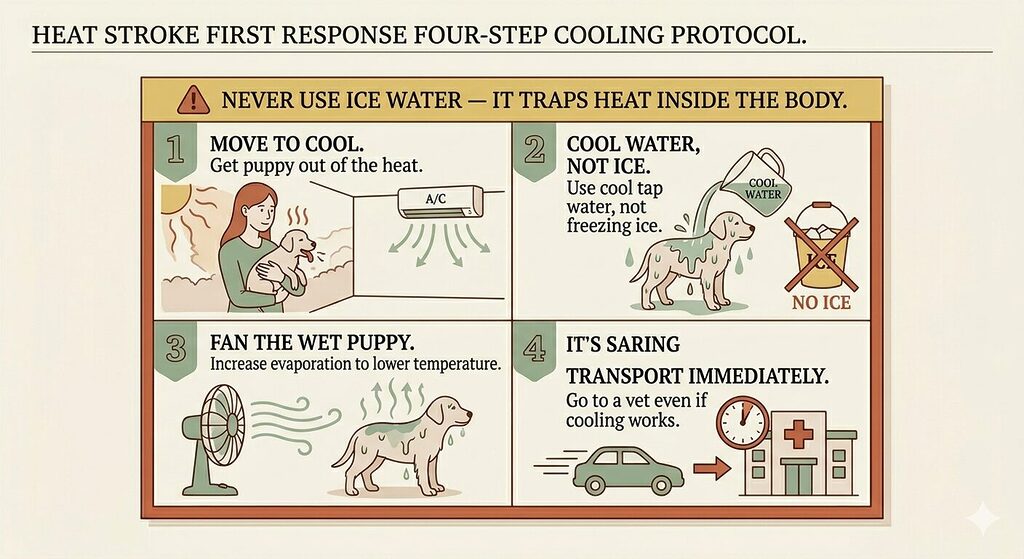
1. Move to a cool environment immediately
Into air conditioning or shade. This is the single most important first action.
2. Apply cool water — not ice
Wet the coat thoroughly with cool (not iced) water. Ice water causes peripheral vasoconstriction that traps heat inside the body — the opposite of what you want. Focus on the paws, groin, armpits, and neck where blood vessels are close to the surface.
3. Fan the wet puppy
Use a fan, air conditioning vent, or manual fanning to increase evaporative cooling. Moving air over wet skin is highly effective.
4. Offer water if conscious
Allow the puppy to drink cool water if they are alert enough to do so safely. Do not force water into an unconscious animal's mouth — aspiration risk.
5. Take the temperature and monitor
If you have a thermometer, take the rectal temperature. Once it reaches 39.4°C (103°F), stop active cooling to prevent overcorrection (hypothermia).
6. Transport to the vet immediately
Even if the puppy appears to recover, internal damage — to the kidneys, brain, clotting system, and gut — may have occurred and requires assessment. Continue cooling during transport with wet towels and air conditioning.
Hypothermia and cold exposure
Young puppies are unable to regulate their own body temperature effectively. Neonates and puppies under four weeks are entirely dependent on their mother and the nest environment for warmth. Even older puppies — particularly small breeds, short-coated breeds, and thin puppies — are vulnerable to hypothermia in cold conditions, during veterinary procedures, after immersion in water, or if left in cold environments for extended periods.
Signs of hypothermia
Shivering — early and active response
Muscle stiffness, slowness, or apparent weakness
Pale or blue gums
Lethargy progressing to unresponsiveness
Slowed, shallow breathing
Temperature below 37.5°C (99.5°F)
Rewarming
1. Move to a warm, dry environment
Remove any wet bedding, towels, or clothing. Dry the puppy thoroughly if wet.
2. Wrap in warm towels
Pre-warm towels in a tumble dryer or on a radiator. Wrap the puppy but leave the face exposed. Place warm (not hot) water bottles wrapped in a cloth next to the puppy — never in direct contact with skin, which burns readily.
3. Body heat
Holding the puppy against your body is an effective and safe rewarming method for mild cases. Your body temperature provides a controlled, appropriate warmth source.
4. Monitor temperature
Take rectal temperature every 10 minutes. Once normal temperature is restored and the puppy is alert and responsive, veterinary assessment is still recommended to evaluate for underlying causes and any organ effects.
Do not do this
Do not use a hairdryer, electric blanket directly on skin, or hot water bottles in direct contact. Burn injuries occur readily when an animal cannot move away from a heat source. Do not rewarm too rapidly — gradual rewarming is safer for the cardiovascular system.
Seizures and convulsions
Witnessing a puppy have a seizure is one of the most frightening experiences for a new owner. The involuntary, violent muscle movements, the loss of consciousness, and the apparent distress of the animal create intense alarm — but the most important thing to understand is that the animal is not conscious and not in pain during the seizure itself. Your role during the seizure is to protect, not to intervene.
During the seizure
1. Do not put anything in the mouth
Dogs do not swallow their tongues during seizures. Putting your hand or any object in a seizing dog's mouth risks a severe bite injury and provides no benefit to the animal.
2. Protect from injury
Clear the area around the puppy of hard objects. If on an elevated surface, lower them to the floor. Place a cushion or folded towel gently under the head if possible.
3. Time the seizure
Note the exact start time. Any seizure lasting longer than 5 minutes (status epilepticus) is a critical emergency requiring immediate veterinary intervention — prolonged seizures cause brain damage.
4. Minimise stimulation
Dim lights if possible. Keep noise to a minimum. The sensory environment can influence the duration and severity of some seizure types.
5. Record if possible
A brief video of the seizure, however distressing this feels, provides invaluable diagnostic information for your vet that a verbal description cannot replicate.
After the seizure
The post-ictal phase — the period after the seizure ends — is characterised by confusion, disorientation, temporary blindness, excessive thirst, and apparent exhaustion. This phase can last from minutes to hours. Keep the puppy in a calm, confined, safe space during this period. Do not offer food until fully alert. Contact your vet regardless of duration — all first seizures require investigation, and any seizure in a puppy under six months requires urgent assessment.
Hypoglycemia (Low Blood Sugar) — Common in Toy Breeds
Tiny puppies (especially under 12 weeks) can develop dangerously low blood sugar quickly if not eating, after vomiting/diarrhea, or during illness.
Signs;
weakness,
tremors,
disorientation,
seizures,
collapse.
Rub honey or corn syrup on gums (if conscious) and seek immediate veterinary care.
Prevention - frequent small meals in young/small puppies.
Drowning and near-drowning
Swimming pools, garden ponds, water features, and even buckets of water are drowning hazards for puppies. Young puppies cannot swim, have limited stamina, and may be unable to find a pool exit even if they can paddle briefly. Near-drowning — survival after water submersion — is a genuine emergency because secondary drowning (fluid in the lungs causing respiratory failure hours after the incident) can develop with no warning even in a puppy who initially appears well.
1. Remove from the water
Support the body. Do not pull by the legs alone as injury may result.
2. Position head down
For small puppies, hold them gently with the head lower than the body for 15 to 20 seconds to allow water to drain from the airway by gravity. Do not swing vigorously.
3. Clear the airway
Open the mouth, pull the tongue forward, and remove any visible debris. Check for breathing.
4. Begin CPR if not breathing
Follow the CPR protocol from Section 6. Rescue breaths are particularly important in near-drowning as the primary problem is oxygen deprivation.
5. Keep warm and transport urgently
Wet puppies lose heat rapidly. Dry and wrap in warm towels immediately. Transport to the vet even if the puppy appears to recover — secondary drowning requires monitoring and potentially treatment that cannot be provided at home.
Fractures and musculoskeletal injury
Puppies are surprisingly resilient, but their developing bones are more susceptible to certain fracture types than adult bones. Falls from heights, entrapment in doors or furniture, road traffic accidents, and being stepped on are common causes. Any sudden inability to bear weight, obvious deformity of a limb, or significant swelling after a traumatic event should be treated as a potential fracture until proven otherwise.
What to do
1. Restrict movement
Prevent the puppy from running, jumping, or weight-bearing on the affected limb. Confine to a small, flat space. Any movement of an unstabilised fracture causes additional tissue damage and significant pain.
2. Do not attempt to splint unless trained
Improper splinting of a fracture can convert a closed fracture to an open one, compress blood vessels, and cause additional pain. Unless you have training in fracture stabilisation, the most effective intervention is careful restriction of movement and rapid transport.
3. Manage any open wound
If the bone is protruding through the skin (open fracture), cover the site with a clean moist dressing — do not attempt to push the bone back in. This wound requires urgent surgical management.
4. Support for transport
Transport on a rigid flat surface if possible — a board, a tray, or a stiff folder. Support the whole body, not just the limb. See Section 22 for transport guidance.
Do not give pain medication
Do not give ibuprofen, paracetamol, aspirin, or any other human pain medication. All are toxic to dogs and several cause fatal outcomes at human doses. Contact your vet for guidance on appropriate pain management.
Eye injuries
Eye injuries in puppies range from minor conjunctival irritation to globe prolapse — a true emergency in which the eyeball is displaced from the socket, most commonly seen in brachycephalic breeds. All eye injuries should be treated with urgency, because the eye is irreparably damaged more quickly than almost any other organ.
Chemical or irritant exposure
If the eye has been exposed to a chemical, detergent, or irritant, flush immediately and continuously with sterile saline solution (not tap water, which is not sterile) for a minimum of five minutes. Hold the eyelid open gently and direct the flow across the eye from the inner corner outward. Do not rub. Transport to the vet after flushing.
Scratches and debris
Visible debris on the surface of the eye can be gently flushed with sterile saline. Do not attempt to remove embedded material with a finger or instrument. Any corneal scratch (indicated by squinting, pawing at the eye, tearing, or visible cloudiness) requires urgent veterinary assessment — corneal injuries deteriorate rapidly.
Globe prolapse
In brachycephalic breeds particularly, trauma to the head can cause the eyeball to prolapse from the socket. This looks catastrophic and is extremely distressing to see. Do not attempt to push the eye back in. Moisten a clean cloth or sterile gauze with saline and lay it gently over the eye to keep it moist. Transport immediately — this is a surgical emergency in which time directly determines whether the eye can be saved. Keep the puppy as calm as possible to prevent straining, which worsens the prolapse.
Burns and scalds
Burns in puppies occur most commonly from hot liquids (scalds from beverages and cooking spills), contact with hot surfaces (barbecue grills, radiators, oven doors), and chemical exposure. The initial appearance of a burn often underestimates its true severity — full assessment of depth and extent may only be possible 48 to 72 hours later as the wound evolves.
1. Cool the burn immediately
Apply cool (not ice cold) running water to the burned area for a minimum of 10 minutes. This is the single most important first aid measure and is effective up to 3 hours after the burn. Do not use ice, butter, toothpaste, or any other household substance — all impede healing or cause additional injury.
2. Cover loosely
After cooling, cover with a clean non-adhesive dressing or cling film (do not wrap tightly — burns swell). Do not burst any blisters — they are protective.
3. Keep warm otherwise
Burns cause significant heat loss from the body. Keep the rest of the puppy warm while the burned area is being cooled.
4. Transport to the vet
All burns beyond minor superficial singeing require professional assessment. Chemical burns, burns on the face or paws, burns covering more than a small area, and any deep burn are urgent.
Bee and wasp stings in puppies cause localised pain, swelling, and redness. Most resolve without treatment. Multiple stings, stings in or around the mouth or throat (which can cause airway swelling), and stings in a puppy with a known or suspected allergy are all emergencies requiring immediate veterinary care. A bee stinger embedded in the skin should be scraped out sideways with a credit card edge — do not squeeze it with tweezers, as this injects more venom. Monitor for signs of anaphylaxis (Section 19).
Snake bites — South African context
South Africa has a significant population of venomous snakes, including puff adders, Cape cobras, Mozambique spitting cobras, black mambas, boomslang, and rinkhals. Snake bites in puppies, who are curious and close to the ground, are a genuine and common emergency, particularly in suburban gardens backing onto bush or in rural areas.
1. Keep the puppy still and calm
Movement accelerates venom circulation. Carry the puppy if at all possible — do not allow them to walk to the car.
2. Do not cut, suck, or tourniquet the wound
All of these are ineffective and cause harm. Do not apply a tourniquet — it concentrates the venom locally and causes tissue death.
3. Identify the snake if safe to do so
Photograph it from a safe distance or describe its appearance. This information can determine the appropriate antivenom. Do not approach a snake to capture or kill it — this creates a second emergency victim.
4. Transport immediately
All suspected snake bites require emergency veterinary care regardless of initial symptoms. Envenomation from cytotoxic species (puff adder) can cause severe localised tissue destruction within hours. Neurotoxic species (mamba, cobra) can cause respiratory failure.
Gastric dilatation-volvulus (bloat) — the silent emergency
Gastric dilatation-volvulus (GDV), commonly called bloat, occurs when the stomach fills with gas and rotates on its axis, cutting off blood supply to the stomach and spleen. Without emergency surgical intervention, GDV is fatal — typically within four to six hours. It is primarily a condition of large and giant deep-chested breeds, Great Danes, German Shepherds, Irish Wolfhounds, Standard Poodles, Weimaraners, St Bernards, and Dobermanns are among the highest-risk breeds. GDV can occur in dogs as young as six months.
Signs of GDV
Unproductive retching — attempting to vomit but bringing nothing up, or bringing up only frothy saliva
Rapidly distending abdomen — the belly appears swollen and feels taut like a drum
Restlessness, inability to settle, pacing
Distress, groaning, or hunched posture
Pale gums and rapid weak pulse — signs of shock
Collapse — very late sign
No wait and see — ever
GDV is one of the few veterinary conditions where the phrase "let's see how they are in the morning" represents a fatal management error. If you observe unproductive retching with abdominal distension in a large or giant breed puppy or dog at any hour of the day or night, transport to the nearest emergency facility immediately. Do not call ahead and wait for a call-back — drive now and call on the way. Every minute of stomach torsion without surgical intervention reduces the probability of survival.
Allergic reactions and anaphylaxis
Anaphylaxis is a severe, systemic allergic reaction that can be triggered by insect stings, vaccination reactions, certain foods, and medications. It develops rapidly — often within minutes of exposure — and can be fatal without immediate treatment. Anaphylaxis is not the same as a local allergic reaction (swelling, hives, itching) which, while requiring veterinary attention, is not immediately life-threatening.
Vomiting and diarrhoea within minutes of exposure to a trigger
Collapse, profound weakness
Loss of consciousness
There is no home treatment for anaphylaxis that is adequate without veterinary intervention. The only first aid is to transport immediately while keeping the puppy as calm and still as possible. If the puppy is not breathing, begin CPR. Epinephrine (adrenaline) administered by a vet is the definitive treatment and must be given within minutes for the best chance of survival.
Spinal and neurological emergencies
Neurological emergencies in puppies present as sudden weakness, paralysis, incoordination (ataxia), changes in consciousness, or sudden blindness. The most common cause in puppies is intervertebral disc disease (IVDD) — particularly in chondrodystrophic breeds including Dachshunds, Basset Hounds, Shih Tzus, and French Bulldogs. Road traffic accidents, falls, and traumatic spinal injuries are also causes in any breed.
Sudden hindlimb weakness or paralysis in a Dachshund, French Bulldog, or other chondrodystrophic breed is a spinal emergency in which the window for successful decompressive surgery is measured in hours, not days. A puppy that cannot walk or is dragging its hindlimbs should reach emergency surgical care within four to six hours of symptom onset for the best neurological prognosis.
1. Restrict movement absolutely
Any movement of the spine in an acute spinal injury can convert an incomplete injury to a complete one. Carry the puppy on a rigid flat surface. Do not allow any running, jumping, or stair use.
2. Support the spine during transport
Lay the puppy on a rigid surface — a board, a tray, or a folded-open hardcover book — with minimal spinal flexion. Support the head, neck, and hindquarters in alignment.
3. Transport immediately
Call ahead to the emergency facility so they can prepare. This is one of the most time-critical conditions in veterinary emergency medicine.
Electric shock
Electric shock from chewed power cables is a genuine risk in puppies who have not yet learned to avoid electrical items. The severity depends on the current, the voltage, and the duration of contact. Effects range from minor burns at the contact site to cardiac arrhythmia, pulmonary oedema (fluid in the lungs), and death.
1. Disconnect the power source first
Do not touch the puppy until the power is off. Turn off at the mains switch if the cable cannot be safely unplugged. Use a wooden or plastic object to move the cable away if necessary — never use a metal object or your bare hands.
2. Assess the puppy
Once the power is disconnected, check for consciousness, breathing, and pulse. Begin CPR if indicated.
3. Transport immediately
All electric shock incidents require veterinary assessment even if the puppy appears well. Pulmonary oedema from electric shock can develop hours after the initial injury. Cardiac monitoring is required.
Transporting an injured puppy safely
Incorrect handling and transport is a common source of secondary injury in emergency situations. The way you move an injured puppy from the scene to the vehicle, and from the vehicle to the vet, can either protect a marginal patient or convert a survivable injury into a fatal one.
General principles
Support the whole body — head, neck, thorax, abdomen, and hindquarters — when lifting. Never lift by the legs alone or swing the body.
For suspected spinal injuries, move only on a rigid flat surface to maintain spinal alignment. Improvise with a board, a tray, or a removed drawer.
For unconscious animals, position on the right side to reduce pressure on the heart and allow airway drainage.
Keep the puppy warm during transport — cover with a blanket and manage the vehicle temperature.
Drive smoothly — hard braking and sharp cornering jar an injured animal.
If possible, have someone other than the driver hold the puppy during transport for monitoring and reassurance.
Improvised muzzling
An injured puppy in pain may bite — even the most gentle, well-socialised dog can bite when frightened and in pain. This is not aggression; it is a pain response. A simple improvised muzzle from a strip of bandage or a tie — looped around the muzzle, tied under the chin, and then behind the ears — protects you during handling without harming the puppy. Do not muzzle any puppy with breathing difficulty, a suspected facial injury, or who is vomiting.
After the emergency
The emergency itself occupies a brief, intense window. What follows — the recovery period, the follow-up care, and the processing of what happened — occupies a much longer one, and how it is managed significantly influences the outcome.
Medical follow-up
Always attend scheduled follow-up appointments after an emergency admission. Many conditions — heat stroke, near-drowning, electric shock, poisoning, severe burns — produce delayed complications that do not appear until days after the initial event. Kidney injury after heat stroke, secondary drowning after near-drowning, and coagulopathy after certain envenomations are all examples of delayed processes that require monitoring. A puppy who "seems fine" after an emergency may have silent ongoing organ injury.
Home monitoring in recovery
Observe appetite, water intake, urination, defecation, activity level, and behaviour. Note any deviation from the pre-emergency baseline and report it promptly. Maintain the activity restrictions prescribed — a puppy convalescing from a fracture, spinal surgery, or major wound is at genuine risk from over-activity during recovery. The energy of puppyhood works against compliance here, and management of the environment (pen rest, lead walks only) is the owner's responsibility.
Your own wellbeing
Witnessing a serious emergency in an animal you love is a genuinely traumatic experience. The adrenaline that carries you through the crisis recedes, and the anxiety, guilt, and replaying of events that follows is a normal human response. Give yourself the same consideration you would offer a friend who had been through the same experience. Talking to your vet about what happened — including understanding what caused it and what, if anything, could be done differently — is often more useful than trying to process it alone.
Every minute of preparation you invest before an emergency happens is worth an hour of response capability when it does. The owner who knows what to do is not lucky — they are prepared. Be prepared.
Emergency and critical care specialist · 19 years in veterinary emergency medicine
"After nearly two decades in emergency and critical care, the variable that predicts outcome better than almost anything else — better than the severity of the initial injury, better than how quickly I can stabilise the patient once they arrive — is the window between when something went wrong and when they reached me. That window is owned entirely by the owner. What they do in it, or fail to do, is the first chapter of the case I receive. The owners who arrive with a puppy who is alive and treatable are, disproportionately, the owners who knew something was wrong and moved immediately. The owners who arrive with a puppy who is in shock, or in irreversible respiratory failure, or whose torsion has been rotating for six hours — they are not bad owners. They are owners who did not know the urgency, and the system failed them by not teaching it."
The conditions that kill puppies in the emergency setting are not, for the most part, exotic or unforeseeable. They are heat stroke in brachycephalic breeds on a hot afternoon. They are GDV in a two-year-old Great Dane whose retching was misread as an upset stomach. They are snake bites that were given a wait-and-see in the hope that the swelling would settle by morning. They are electric shocks from chewed cables in a house where the cables had not been managed. They are, in almost every case, events that had antecedents — warning signs, risk factors, and hazard exposures — that were present before the emergency and that a prepared owner might have prevented or responded to faster.
What I want every owner of a new puppy to understand, and to feel in their bones rather than merely read in a guide, is that the emergency room exists to catch what preparation misses — not to substitute for preparation. My job, and the job of every emergency colleague I know, becomes more possible and more effective every time an owner arrives having already cooled a heat-stroke puppy with cool water, having already called ahead, having already noted the time and substance of a toxin ingestion. The few minutes of clear-headed action that a prepared owner takes before they reach me are minutes that can mean the difference between a patient I can save and one I cannot. Read this guide. Take the numbers. Assemble the kit. Drive the route. And then — I genuinely hope — never need any of it.
01 — My puppy ate something off the floor and I don't know what it was. Should I be worried?
It depends on what is accessible on your floor and what signs, if any, your puppy is showing. If your puppy is behaving normally, eating normally, and showing no signs of gastrointestinal distress, respiratory difficulty, or neurological change, monitor closely for the next 24 hours. If you have any concern about what may have been ingested — particularly if the area is not thoroughly puppy-proofed — call your vet or animal poison control. Erring on the side of a phone call is always appropriate. If your puppy vomits, develops diarrhoea, becomes lethargic, starts trembling, or shows any behavioural change, contact the vet immediately regardless of how minor the initial concern seemed.
02 — How do I know if my puppy is in shock?
Shock in a puppy presents as a cluster of signs reflecting inadequate tissue perfusion. Pale, white, or grey gum colour; CRT (capillary refill time) longer than two seconds; rapid and weak pulse; cold extremities (paws, ears); rapid shallow breathing; and progressive weakness or collapse. Puppies in shock are often very quiet — the absence of distress is not reassurance when these other signs are present. Any combination of pale gums, rapid weak pulse, and progressive weakness after trauma, severe blood loss, anaphylaxis, or serious illness is a shock presentation and requires immediate emergency veterinary care. Keep the puppy warm and quiet during transport.
03 — My puppy was stung by a bee. How do I know if it's an emergency?
A single sting with localised swelling, redness, and pain — particularly on a paw or the body — is likely a routine reaction that resolves within a few hours. Monitor for 20 to 30 minutes for signs of systemic reaction. Emergency signs that require immediate veterinary care are swelling of the face, lips, throat, or around the eyes; difficulty breathing or swallowing; vomiting within minutes of the sting; collapse or extreme weakness; pale or white gums. These indicate anaphylaxis. Multiple stings anywhere on the body are also an emergency because of cumulative venom load. Remove any embedded bee stinger by scraping sideways — do not squeeze.
04 — My puppy had a seizure but seems fine now. Do I still need to go to the vet?
Yes, absolutely. All first seizures in puppies require veterinary investigation regardless of duration or apparent recovery. The causes of puppy seizures range from hypoglycaemia (low blood sugar) and toxin ingestion to structural brain abnormalities, liver disease, and primary epilepsy — all of which require different management. The seizure you witnessed may have been short and resolved, but the underlying cause may be progressive, recurrent, or treatable if identified early. Contact your vet the same day. If the seizure lasted more than five minutes, if your puppy has not fully returned to normal within 30 minutes of the seizure ending, or if a second seizure occurs, treat as an emergency.
05 — Can I give my puppy a human antihistamine after an allergic reaction?
Some human antihistamines — specifically cetirizine (Zyrtec) and diphenhydramine (Benadryl) — are used in dogs at veterinary-prescribed doses for mild allergic reactions and are not toxic at appropriate doses. However, giving any human medication without specific veterinary guidance on dose and formulation carries risk. Many antihistamine formulations contain xylitol (fatally toxic to dogs), decongestants, or alcohol. The correct response to any apparent allergic reaction is to call your vet for guidance on whether and what dose to administer, rather than independently reaching for the medicine cabinet. For any signs of anaphylaxis, antihistamines are inadequate — epinephrine is the required treatment, and transport should not be delayed for antihistamine administration.
06 — My puppy was hit by a car. They seem to be walking. Is it still an emergency?
Yes. A puppy who appears to be walking after a road traffic accident may have internal injuries — ruptured spleen, diaphragmatic hernia, pneumothorax, internal haemorrhage — that are not apparent externally and that can cause death from shock over the hours following the collision. Adrenaline masks pain in the immediate aftermath of trauma. Any puppy involved in a road traffic accident requires emergency veterinary assessment even if they appear to be walking. Internal bleeding and organ rupture are silent in their early stages, and the window for effective surgical intervention is finite. Transport calmly and carefully and contact the emergency vet en route.
07 — How do I safely take my puppy's temperature at home?
Use a digital rectal thermometer designated for puppy use only. Lubricate the tip with petroleum jelly (Vaseline). Have someone gently restrain the puppy — standing is easier than lying for most puppies. Lift the tail and insert the thermometer gently 2 to 3 cm into the rectum. Hold it in place for 60 seconds or until the thermometer beeps. Normal range for a puppy over four weeks is 38.0 to 39.2°C (100.4 to 102.6°F). Clean with rubbing alcohol after use. Take the temperature when your puppy is calm and rested — exercise or excitement will elevate it temporarily. Ear thermometers designed for dogs exist and are less invasive, but rectal measurement remains the most accurate method.
08 — What is the most common puppy emergency I should prepare for?
The most statistically common puppy emergencies are toxic ingestion (particularly household chemicals, medications, and human foods), trauma from falls and road accidents, gastrointestinal foreign body ingestion (swallowing toys or parts of toys), and heat-related illness. The emergency with the narrowest survival window relative to owner response time is GDV in at-risk breeds. The emergency that kills most preventably through owner inaction is heat stroke — particularly in brachycephalic breeds in hot climates. For South African owners, snake bite adds a significant additional risk category that owners in other countries do not face with the same frequency. Preparing for all of these with the emergency kit, the phone numbers, and the knowledge in this guide covers the overwhelming majority of realistic first aid scenarios.
09 — My puppy has been limping since yesterday but isn't crying. Should I wait or go now?
A limping puppy who is eating, drinking, and otherwise behaving normally, and who can bear at least partial weight on the limb, is generally not an immediate emergency but warrants a same-day or next-day veterinary assessment. A limping puppy who is non-weight-bearing, who cries when the limb is touched, who has visible swelling or deformity, or who is lethargic and off food should be seen the same day. Any limping that follows a traumatic event — a fall, a rough play incident, a road accident — requires same-day assessment regardless of apparent severity, as the initial visible symptoms may underrepresent the underlying injury. Pain masking is common in young animals immediately after injury.
10 — Is it safe to muzzle a puppy who might be in pain?
Yes, when done correctly, and often advisable when handling a puppy in significant pain. An improvised muzzle from a strip of soft fabric (a bandage, a tie, a pair of tights) can be applied by looping it around the muzzle, crossing under the chin, and tying behind the ears. It should be snug but not tight — a finger should fit under the loop comfortably. Never muzzle a puppy who is vomiting, having difficulty breathing, is unconscious, or has a facial injury. A muzzle is a protective measure for both you and the puppy — it prevents a fear-driven bite response during handling and allows you to provide care without hesitation.
11 — What should I do if I suspect my puppy has swallowed a foreign body — a toy, a sock, a stone?
If you witnessed the ingestion and the puppy is not showing immediate signs of distress, call your vet immediately. Depending on the size, shape, and nature of the object and the size of the puppy, your vet may advise inducing vomiting, waiting and monitoring (for objects likely to pass), or attending immediately for imaging. Do not induce vomiting for sharp objects (needles, bones, nails), objects that have been down for more than an hour or two, or if the puppy is showing signs of obstruction. Signs that a swallowed foreign body has caused an obstruction — persistent vomiting, complete refusal of food and water, abdominal pain and distension, progressive lethargy — require emergency imaging and potentially surgery. Time matters, the longer an obstruction is present, the greater the risk of intestinal necrosis.
12 — My puppy's gums look pale — what does this mean and what should I do?
Pale gums in a puppy indicate reduced perfusion — blood is not reaching the peripheral tissues in adequate volume. The causes include significant blood loss (internal or external), severe anaemia, shock from any cause, and late-stage heart failure. Any degree of pallor beyond the lightest pink is cause for concern. White or grey gums, or gums with a bluish tinge, are critical emergency signs requiring immediate veterinary care. While waiting to be seen or during transport, keep the puppy warm, restrict movement, and monitor breathing and consciousness. Do not give anything by mouth unless specifically instructed by your vet. Pale gums are never a wait-and-see finding.
13 — How do I perform a Heimlich manoeuvre on a small puppy?
For a very small puppy, the back-blow method is preferred over the Heimlich as it carries less risk of internal injury. Hold the puppy face-down along your forearm with the head lower than the body. Support the head and jaw gently with the same hand. Using the heel of your other hand, deliver four to five firm blows between the shoulder blades. After each series of blows, check the mouth for a dislodged object. If the back-blow method fails and the puppy is losing consciousness, the modified Heimlich can be attempted. Hold the puppy against your body with its back to your chest, place a fist below the last rib, and deliver four to five inward and upward compressions. These techniques are most effective when practised in advance — consider a pet first aid course that includes hands-on practice.
14 — My puppy was attacked by another dog. The wounds look small. Do I still need the vet?
Yes. Dog bite wounds are notoriously deceptive in their visible severity. The small skin puncture at the surface is the entry point — beneath it, the crushing and tearing forces of a bite can cause extensive damage to muscle, fascia, and underlying organs that is invisible externally. This is particularly true for small puppies bitten by large dogs, where the size differential means forces sufficient to fracture ribs, puncture the chest or abdomen, or crush the skull or spine may have been applied regardless of the wound size externally. All bite wounds in puppies require same-day veterinary assessment, imaging in significant attacks, and antibiotic prophylaxis given the extremely high bacterial contamination of bite wounds. Do not attempt to assess depth or severity yourself.
15 — How do I know when something is a true emergency versus something that can wait until morning?
When in doubt, call. Most veterinary practices have an after-hours line, and most emergency facilities will advise over the phone. The true cannot-wait categories are, any difficulty breathing or airway obstruction; uncontrolled or severe bleeding; suspected poisoning; suspected GDV or unproductive retching in a large breed dog; any loss of consciousness; blue, white, or very pale gums; seizures lasting more than five minutes or back-to-back seizures; suspected heat stroke; sudden paralysis or complete inability to use limbs; road traffic accidents; any bite by a potentially venomous snake; and any incident in which your instinct is telling you something is seriously wrong. The cost of an unnecessary emergency visit is financial. The cost of deferring a true emergency is potentially the life of your puppy. When the two uncertainties are in play, always resolve them in the direction of action.
16 — What are the most common toxic foods in South African households?
Chocolate, grapes/raisins, onions/garlic, xylitol products, and human medications top the list. Even small amounts can be fatal in puppies. Keep all human food and meds secured.
17 — Are there good apps or resources for South African puppy owners?
Look for snake identification apps, local vet finder apps, and first aid apps endorsed by veterinary associations. Save contacts for your provincial SPCA and emergency clinics.