Pember Diamonds – A Member Of KUSA, Registration Number 1031350
Why Corgis Thrive on Purpose and Work
There is a particular frustration familiar to many Corgi owners in South Africa: a dog that seems perpetually restless, prone to nipping at heels, and difficult to settle — despite regular walks and a warm home. The problem is rarely the owner. It is, more often, a mismatch between what the Corgi was designed to do and what it is currently being asked to do.
This article is written for South African Corgi owners and prospective buyers who sense their dog has more energy and drive than they know what to do with — and who want to understand the breed deeply enough to give it a fulfilling life, not just manage its behaviour. Understanding the Corgi's working dog traits is not an academic exercise. It is the most practical thing an owner can do.
A Corgi that is given purpose does not need to be corrected into calmness. It earns that calmness by spending its energy on something that satisfies its instincts. This article explains the science, the history, and the daily practice behind that principle.
What Are the Key Corgi Working Dog Traits Every Owner Should Know?
Corgis are herding dogs bred over centuries for sustained physical effort, independent problem-solving, and vocal communication. Their corgi working dog traits — strong herding instinct, high intelligence, and intense drive — remain fully intact in the modern pet dog. These characteristics require structured outlets. Without them, the same traits that make Corgis exceptional working dogs produce frustration, noise, and behavioural problems at home.
The Working Ancestry That Shapes Every Corgi Today
The Pembroke Welsh Corgi and the Cardigan Welsh Corgi share a working lineage that predates formal breed registration by centuries. Archaeological and historical evidence places herding dogs resembling the Corgi in Wales as far back as 1000 CE, with the Cardigan considered the older of the two varieties. These dogs were not companions in the modern sense — they were agricultural tools, expected to move cattle across rough Welsh terrain, nip at hooves to direct movement, and sustain hours of physical effort daily. What makes this heritage relevant to a Corgi owner in Pretoria or Cape Town today is that selective breeding over centuries does not dissolve in two or three generations of domestic life. The traits that made the Corgi an effective cattle dog — persistence, vocal assertiveness, physical stamina relative to body size, and a strong instinct to control moving objects — are heritable characteristics, not habits. They are present in every Corgi, regardless of whether that dog has ever seen a farm.
Breed origin.Wales, with Cardigan Welsh Corgi records dating to approximately the 10th century CE
Original function. Cattle herding — specifically using a heeling technique to drive livestock by nipping at rear hooves
Key ancestral selection pressures. Sustained stamina, low profile to avoid kicks, vocal communication, independent decision-making in the field
Understanding that a Corgi is a working dog wearing a compact body is the starting point for everything else in this article.
Core Corgi Working Dog Traits
What the Breed Was Built to Do
No two Corgis are identical, but the working traits bred into the type are remarkably consistent. Recognising them — not as problems to suppress, but as design features to redirect — changes how an owner approaches the entire relationship.
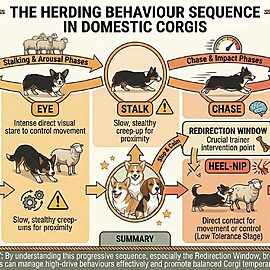
Herding instinct is the most visible corgi working dog trait in domestic settings. It presents as an impulse to circle, chase, and control movement. In the field, this was precise and purposeful. In a living room, it becomes heel-nipping at children, chasing bicycles, and an obsessive fixation on moving objects such as balls and small pets.
Drive and persistence are equally embedded. A herding dog that gave up when a cow ran was useless. Corgis were selected for the capacity to sustain effort and retry a task under pressure. Owners encounter this as stubbornness, but it is more accurately understood as low frustration threshold in the context of incomplete tasks.
Vocal communication was a working function. Herding dogs bark and vocalise to communicate with the livestock and the handler. This is not noise. It is language the dog was bred to use. Suppressing it without redirection creates anxiety rather than silence.
Independent problem-solving distinguishes herding dogs from guarding dogs. A herding dog must read the situation and make decisions without waiting for a command every ten seconds. This produces the sometimes-maddening Corgi quality of doing things its own way — not defiance, but initiative.
How Herding Instincts Manifest in Domestic Life
Herding instinct does not disappear because the dog lives in a suburb. It finds targets. For most domestic Corgis, those targets are children running, small pets, joggers passing the fence, and the family car reversing out of the driveway. Understanding that this behaviour is instinct-driven rather than aggression-driven is essential — it changes both the owner's emotional response and the appropriate intervention strategy.
Research on herding breed behaviour published across canine cognition studies consistently shows that breeds selected for independent herding work score significantly higher on problem-solving persistence and lower on social deference than non-herding breeds. In practical terms, this means a Corgi will keep trying to solve a problem the way it has decided to solve it, even when the owner signals disapproval. Punishment-based correction is particularly ineffective with herding breeds for this reason — it addresses the symptom, not the drive.
Common herding expressions in the domestic Corgi:
Heel-nipping. The dog's original technique for moving cattle. Almost universally present in Corgis interacting with running children or fast-moving pets. Redirection to a toy or a structured chase game is significantly more effective than correction alone.
Eye-stalking. A fixed, low-intensity stare at a moving object before the chase begins. This is the dog reading and preparing — the same visual scan used in the field. Circling behaviour: Corralling movement into a contained path. Corgis will circle family members during walks, attempting to keep the group together as a unit. Fence-running: A response to movement outside the dog's perceived territory. The dog is attempting to control movement it cannot reach.
None of these behaviours are pathological in origin. All of them benefit from structured redirection rather than pure suppression.
Corgi Intelligence and Training
What “Smart” Actually Demands
The Corgi consistently ranks among the top fifteen breeds in canine intelligence assessments based on working and obedience criteria — Stanley Coren's widely referenced work places the Pembroke Welsh Corgi at rank 11 out of 138 breeds evaluated. This is a meaningful figure, but it requires context. High intelligence in a working dog breed does not mean easy compliance. It means the dog processes information quickly, forms expectations, and notices inconsistency.
A Corgi that understands a command after fewer than five repetitions (a threshold Corgis typically meet) is also a Corgi that notices when the rule was not enforced yesterday. Corgi intelligence and training are inseparable precisely because training a Corgi is less about teaching behaviours and more about establishing a consistent, logical framework the dog can work within.
What effective Corgi training actually requires:
Consistency over frequency. - A Corgi does not need hour-long daily training sessions. It needs the same rules applied the same way every time. Inconsistency is the single most common source of frustration in Corgi obedience training.
Structured challenge.Repetitive tasks bore an intelligent dog quickly. Rotating exercises, adding duration, distance, and distraction progressively, and introducing new skill variations keeps engagement high.
Positive reinforcement as the primary methodology.Reward-based training works with the Corgi's intelligence and drive rather than against its independence. Corgis trained primarily through positive reinforcement show significantly higher task persistence and fewer displacement behaviours than those trained through aversive methods.
Clear handler authority.This is not dominance in the outdated sense. It is the dog understanding that the human makes the decisions about when work begins and ends. Without this clarity, a Corgi will often self-assign tasks — which is where herding instinct goes unproductive.
Corgi Mental Stimulation Needs
The Science of a Busy Brain
Physical exercise addresses the Corgi's body. It does not address its brain. This distinction is the most consistently overlooked aspect of Corgi care, and it is the reason a Corgi that has completed a forty-five-minute walk can still destroy furniture an hour later.
Canine cognitive research has established that mental fatigue and physical fatigue activate different physiological pathways and produce different behavioural outcomes. A herding breed that has been physically exercised without cognitive engagement has used its body but not its decision-making capacity. That unused cognitive resource does not disappear — it is redirected into whatever the dog can find: chewing, vocalising, following the owner from room to room, or self-stimulating behaviours.
Corgi mental stimulation needs should be addressed daily, not as a supplement to physical exercise, but as an independent requirement. The practical minimum for a healthy adult Corgi is approximately 15–20 minutes of dedicated cognitive engagement per day, separate from physical exercise.
Effective mental stimulation activities for Corgis:
Scent work and nose games. Hiding treats or articles in a defined search area. Scent-based tasks are among the most cognitively exhausting activities for dogs, activating the same neural pathways used in sustained tracking work. Ten minutes of structured nose work produces measurable calm in most high-drive breeds.
Food puzzle toys. Lick mats, snuffle mats, and tiered puzzle feeders extend feeding time and require problem-solving. These are not passive enrichment — they engage the same persistence drive the Corgi uses in herding contexts.
Trick training and command chaining. Teaching the dog to complete a sequence of behaviours (sit → down → spin → heel) before receiving a reward engages working memory and sustained attention.
Controlled herding games. Using a ball on a rope or a flirt pole to create a structured, bounded chase-and-control game. This directly addresses herding drive in a managed context.
Corgi Energy Levels
Matching Activity to Drive
Corgi energy levels are one of the most misunderstood aspects of the breed among prospective owners. The compact, low-slung body reads as a small, manageable dog. It is not. The Corgi was bred to work eight-to-ten-hour days across rough terrain. Its cardiovascular capacity and muscular endurance relative to body size are exceptional.
A healthy adult Corgi requires a minimum of 45–60 minutes of genuine aerobic exercise per day — not a stroll, but sustained movement at a pace that raises the dog's heart rate. Many working-line Corgis and energetic individuals within show lines require 60–90 minutes. This is not an optional recommendation. Chronic under-exercise in a Corgi produces measurable behavioural deterioration within days, not weeks.
A critical nuance for South African owners. Summer heat significantly affects exercise capacity. Corgis, with their double coats, are poorly suited to midday exercise in Gauteng or Western Cape summers. Morning and evening sessions, with access to shade and water, are not simply preferable — they are a welfare requirement.
Keeping a Corgi Busy
Practical Enrichment Strategies
The concept of keeping a Corgi busy is best understood not as preventing boredom but as providing a meaningful daily structure the dog can anticipate and engage with. A Corgi that knows what comes next — that has a routine involving exercise, cognitive tasks, and social interaction — is a fundamentally different animal from one that operates in an unstructured environment waiting for something to happen.
The most effective enrichment strategies combine physical, cognitive, and social elements across the day. No single activity addresses all three. A structured daily enrichment framework for adult Corgis:
Weekly rotation. Introduce a new location, surface, or activity type once per week. Novel environments engage the Corgi's exploration drive and prevent the sensitisation that occurs when all activity is route-based.
For owners with access to structured sport, Corgi obedience training through agility, flyball, or treibball (urban herding) provides the most complete engagement profile. These activities address drive, intelligence, physical capacity, and handler partnership simultaneously.
The CorgiCrew article Outdoor Adventures With Corgis expands on how structured outdoor activity — from hiking to beach visits — can serve as a primary enrichment channel for active Corgis, including practical guidance on distance and terrain suitable for the breed's build.
Corgi Boredom and Behaviour Problems
What Happens Without Purpose
Corgi boredom and behaviour problems are not character flaws. They are predictable outcomes of a physiological and psychological mismatch between the dog's drive and its environment. Understanding this removes blame from the dog and places responsibility where it belongs: on the design of the dog's daily life.
The behavioural profile of a chronically under-stimulated Corgi is consistent and well-documented across veterinary behaviour literature:
Destructive chewing. Not spite or dominance — the dog is stimulating its jaw and channelling frustration into a physical act.
Excessive barking. The vocal communication system, designed for cattle work, fires without a target. In a quiet house, ambient stimuli — passing cars, birds, distant voices — become triggers.
Hyperattachment to the owner. The herding dog's pack orientation, without a structured outlet, consolidates into following, nudging, and distress when the owner is out of sight.
Redirected nipping. Particularly in homes with children or other pets. The herding impulse needs a target, and running family members are the most available option.
Obsessive repetitive behaviours. Tail-chasing, shadow-chasing, fence-running. These are self-reinforcing because they partially satisfy the chase drive, making them very difficult to extinguish once established.
The critical point for owners and breeders alike: these behaviours are vastly easier to prevent through environmental design than to treat once established. A Corgi that has never needed to find its own stimulation is a Corgi that has never developed these patterns.
Obedience in a working dog breed is not submission. It is a negotiated agreement between the dog and the handler about who determines when work begins, what form it takes, and when it ends. A Corgi that understands this agreement — that trusts the handler to provide meaningful tasks and clear rules — is a cooperative, responsive animal. A Corgi that has not been offered this agreement will write its own terms.
Effective Corgi obedience training rests on four principles:
1. Start early. The Corgi's working instincts are present from the first weeks of life. Formal training can begin at 8 weeks in short, positive sessions of 3–5 minutes. Early positive reinforcement builds a training history that makes adolescent drive manageable.
2. Train the impulse, not just the behaviour. Teaching "sit" addresses one behaviour. Teaching the dog to default to stillness when uncertain — an impulse control foundation — addresses the underlying drive. Exercises like mat work, controlled greeting, and structured waiting at thresholds all build the same core skill.
3. Use drive as the reward. A Corgi's chase drive, herding impulse, and tug motivation are among the most powerful reward currencies available. Using a controlled tug game or a brief fetch session as a reward for compliance leverages the working drive directly, creating a positive association between obedience and the most satisfying activities the dog knows.
4. Proof systematically. An intelligent dog that has learned a behaviour in the kitchen will not automatically perform it on a busy street. Proofing — practicing commands across environments, distances, and distraction levels — is not optional for a working breed. It is the difference between a trained dog and a dog that happens to comply when conditions are easy.
The PemberDiamonds article The Owner's Dominant Role in Canine Misbehavior Development addresses the owner behaviours most likely to undermine this training partnership, including inconsistency, unintentional reward of unwanted behaviour, and the misreading of Corgi initiative as defiance.
Insight from Canine Behaviour and Breeding Practice
"One of the most consistent errors I see with Corgi owners — including experienced dog people who have come from retriever or companion breed backgrounds — is treating the Corgi's independence as a training failure. It is not. The Corgi was selected for precisely this quality because a herding dog that waited for instructions before reacting to a cow breaking from the herd was a useless herding dog. What this means in practice is that when a Corgi disregards a command, the owner's first question should not be 'Why won't it obey?' but 'Have I given this dog a task it finds more compelling than mine?' The Corgi is always working. The owner's job is to be the most interesting employer in the room. There is also a less-discussed dimension to Corgi working drive that prospective owners should be aware of: the breed experiences something that canine behaviour researchers increasingly describe as functional frustration when its problem-solving capacity is not engaged. This is physiologically distinct from general restlessness. The dog is not simply bored — it is in a state of low-level cognitive arousal without resolution. The behavioural presentations of functional frustration in working breeds include displacement behaviours, increased reactivity to low-level stimuli, and difficulty settling even after physical exercise. This is the Corgi that 'won't switch off.' The resolution is not more exercise. It is meaningful cognitive engagement — tasks with clear parameters, problem-solving elements, and handler involvement."
— Specialist perspective, canine behaviour and working breed management
1. Are Corgis classified as working dogs?
Corgis are classified as herding dogs, which is a subset of working dog breeds. Both the Pembroke and Cardigan Welsh Corgi are placed in the Herding Group by major kennel clubs including KUSA, the AKC, and the KC. Historically they functioned as cattle herders in Wales, and their herding instincts, drive, and intelligence remain characteristic of the breed in all lines today, regardless of whether the individual dog has any working exposure.
2. Why does my Corgi nip at people’s heels?
Heel-nipping is a direct expression of the Corgi's herding instinct. In the field, this technique — nipping at the rear hooves of cattle — was used to direct movement. Your Corgi is not being aggressive; it is doing what its instincts were shaped over centuries to do. The most effective response is redirection to a structured chase or tug game, combined with a consistent "off" command to interrupt the behaviour. Punishment alone does not address the underlying drive.
3. How much exercise does a Corgi actually need per day?
A healthy adult Corgi requires a minimum of 45–60 minutes of genuine aerobic activity daily — sustained movement that raises the heart rate, not casual walking. High-drive individuals may need 60–90 minutes. This requirement does not decrease significantly until the senior years (7+), and even then, regular lower-impact movement remains essential. In South Africa's summer months, exercise should be scheduled in the early morning or after 17:00 to avoid heat stress.
4. Is a Corgi a good dog for a first-time owner?
A Corgi can be an excellent dog for a first-time owner who has done their research and is willing to commit to consistent training and adequate exercise. The breed's challenges — independence, herding instinct, vocal tendencies — are manageable with preparation. They become serious problems only when owners are surprised by them. A first-time owner who understands Corgi working dog traits before acquiring the dog is in a far stronger position than an experienced owner who has underestimated them.
5. How intelligent are Corgis compared to other breeds?
The Pembroke Welsh Corgi ranks 11th out of 138 breeds in Stanley Coren's canine intelligence assessment, which measures working and obedience intelligence. This places the breed in the top 10% of all breeds tested. In practical terms, most Corgis learn a new command within five repetitions and comply on the first request approximately 95% of the time under controlled conditions. That intelligence is an asset in training — but it also means the dog notices inconsistency and will test boundaries if given the opportunity.
6. What is the difference between mental stimulation and physical exercise for Corgis?
Physical exercise uses the dog's body and reduces physical arousal. Mental stimulation engages the dog's problem-solving capacity and reduces cognitive arousal — a separate physiological state. A Corgi needs both independently. A dog that has been walked but not cognitively engaged will often remain unsettled because its drive has not been resolved. Scent work, food puzzles, and training sessions provide mental stimulation that physical exercise alone cannot replicate.
7. How do I stop my Corgi from barking excessively?
Excessive barking in Corgis is almost always a symptom of under-stimulation, unresolved drive, or an environment in which the dog has no other way to engage with stimuli. Suppressing the bark without addressing its cause produces a more anxious dog, not a quieter one. The effective approach is to identify the trigger, provide structured alternatives (a down-stay position, a chew item, or a redirect to a task), and ensure the dog's daily exercise and cognitive requirements are being met. Management (limiting visual access to street-level triggers) is a useful adjunct, not a solution.
8. Can Corgis be used in working roles today?
Yes. While livestock herding has become rare for Corgis in South Africa, the breed is used in a range of structured working roles that engage its drive: competitive agility, obedience trials, scent work, treibball (urban herding with balls), and therapy work. These activities provide the purposeful engagement the breed was designed for. For breeders and serious owners, involvement in KUSA-registered working trials or Herding Instinct Tests is a meaningful way to evaluate and develop a dog's genuine working capacity.
9. At what age do Corgi working instincts fully develop?
Herding instinct is present from early puppyhood — many Corgi breeders observe circling and eye-stalking behaviours in puppies as young as 4–6 weeks. The instincts intensify significantly during adolescence, typically between 4 and 12 months, when drive is at its highest relative to the dog's impulse control capacity. This is the most important window for structured training. Full behavioural and physical maturity in the Pembroke Welsh Corgi is typically reached between 18 months and 2 years.
10. Should South African Corgi breeders select for reduced working drive in pets?
This is an active debate in breeding circles. Selective reduction of working drive can produce more tractable pets, but it risks also reducing the intelligence, trainability, and physical soundness that characterise the best Corgis. The more constructive approach, supported by most breed specialists, is to match puppies to owners who understand and can channel working drive appropriately — a process that depends on honest breeder-owner communication from the first enquiry. The PemberDiamonds guide on Breeder-Owner Communication Best Practices addresses how to have these conversations effectively.
CONCLUSION
Three principles anchor everything in this article. First: Corgi working dog traits are not behavioural problems — they are design features that require the right environment to express constructively. Second: mental stimulation and physical exercise are distinct requirements, and a Corgi that receives only one will remain unsatisfied. Third: a Corgi given purpose does not need to be suppressed into calm — it earns calmness by doing what it was built to do.
The promise at the outset of this article was practical understanding, not management strategies. That understanding is this: the Corgi's restlessness, independence, and drive are expressions of a working partnership waiting to happen. Owners who engage with that partnership — through structured training, adequate exercise, and daily cognitive enrichment — are not working harder than those who try to contain the same energy. They are working smarter, and living with a fundamentally different dog as a result.
Within the category of puppy development and care, the Corgi's working heritage is the most important thing a new owner can understand. It shapes everything from how the puppy explores its environment in the first weeks to how the adult dog responds to change and challenge years later. Begin there, and the rest of Corgi ownership follows logically from it.
The Corgis that thrive are not the ones with the calmest temperaments. They are the ones whose owners understood what they were bringing home.
If this article has reframed how you think about your Corgi's behaviour, the next step is understanding how your own approach shapes the dynamic. The PemberDiamonds resource Navigating the Spectrum of Owner-Corgi Personalities and The Owners Dominant Role examines how different owner temperaments interact with Corgi working drive — and how to adjust your approach to bring out the best in your specific dog, not just the breed in general.