The Owner's Dominant Role in Canine Misbehavior Development
Every breeder who has placed a carefully selected, well-socialised puppy into a new home has, at some point, received the call. The puppy is destroying furniture. The adolescent dog is snapping. The grown dog is anxious, unruly, or unmanageable — and the owner is at a loss. The instinct is to blame breed, bloodlines, or bad luck. The evidence points elsewhere.
For professional breeders committed to producing resilient puppies and equipping new owners for long-term success, the owner's dominant role in canine misbehavior development is no longer a matter of professional opinion — it is the conclusion of the most rigorous expert consensus to date. A 2026 University of Lincoln study, drawing on the knowledge of over 180 professional dog trainers and behavioural scientists, identified owner management as the single most influential factor in the emergence of aggression and a wide spectrum of misbehaviors — consistently outweighing breed, genetics, and inherent temperament as causal variables.
This pillar guide is written for breeders who understand that their responsibility does not end at the handover. It delivers a structured, evidence-based framework for understanding every major misbehavior dimension, the owner mistakes that drive them, and the proactive protocols that can prevent them — before the call ever comes.
QUICK ANSWER
What Is the Owner’s Role in Dog Misbehavior Development?
The owner's role in canine misbehavior development is primary. Research from the University of Lincoln (2026), involving over 180 trainers and behavioural scientists, confirms that owner management — including inconsistency, aversive methods, poor body-language reading, and unmet needs — is the dominant driver of misbehavior, outweighing breed and inherent dog factors.
Why Owner Management Outweighs Breed
The Expert Consensus
The central finding of the 2026 University of Lincoln study is both clarifying and professionally consequential. When over 180 dog trainers and behavioural scientists were asked to rank the factors most responsible for canine aggression and misbehavior, owner management emerged as the dominant category — not breed, not genetics, not early trauma. The study's expert panel identified four primary owner-management failure modes: inconsistency in rules and responses, use of aversive training methods, inability to read canine body language accurately, and failure to meet the dog's physical, cognitive, and social needs.
For breeders, this finding reframes the entire post-placement equation. It means that a puppy produced from the soundest temperament lines, socialised through every critical window, and placed with apparent care, can still develop significant behavioral problems if the receiving owner lacks the knowledge, consistency, or tools to manage that dog correctly. The inverse is equally important: an owner who is well-prepared, consistently positive, and genuinely attuned to their dog's communication can often prevent the expression of even moderate genetic predispositions toward reactivity or anxiety.
Key takeaways from the consensus data:
Owner inconsistency — varying rules, mixed signals, unpredictable responses — was identified as the single most common precursor to misbehavior across all behavioral categories.
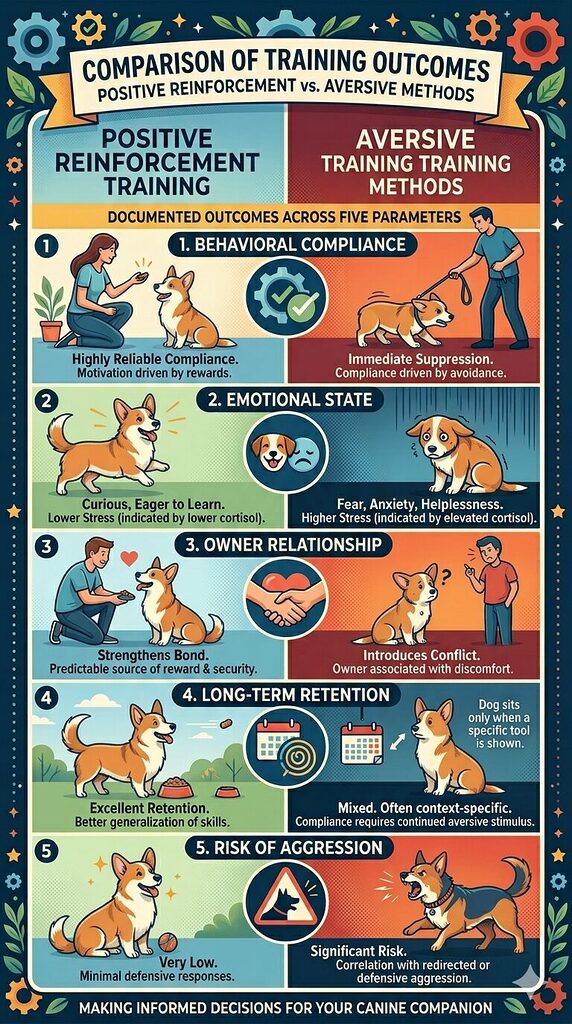
Aversive training methods (shock, prong, intimidation-based approaches) were linked not only to suppression of behavior without resolution, but to increased arousal, fear-based aggression, and worsened long-term outcomes.
Poor body-language literacy in owners was cited as a near-universal contributing factor to escalation — owners who miss early stress signals allow threshold breaches to compound over time.
Unmet needs — insufficient exercise, under-stimulation, social isolation — were identified as the environmental substrate on which misbehavior reliably develops.
The professional implication for breeders is direct. The work of producing a well-adjusted dog extends beyond the whelping box and the socialisation programme. It extends into the owner.
The Seven Misbehavior Dimensions - A Professional Classification Framework
The expert consensus does not treat "misbehavior" as a single construct. It organises canine problem behavior into seven distinct dimensions, each with its own causal profile, developmental trajectory, and owner-management connection. Understanding this classification framework allows breeders to target their owner education with precision rather than generality.
1. Attachment and Attention-Seeking Behavior
This dimension encompasses persistent demands for contact, vocalisation when ignored, pawing, nudging, and inability to settle independently. The owner-management driver is typically inadvertent reinforcement — owners who respond to attention-seeking behavior with engagement, even negative engagement, reliably increase its frequency. Breeders should educate new owners that rewarding calm, settled behavior proactively is far more effective than attempting to extinguish attention-seeking once established.
Prevalence increases sharply in dogs whose owners work from home and provide near-constant access, then suddenly return to office schedules. Teaching a "place" or "settle" cue during the first eight weeks of ownership is significantly more effective than attempting to introduce independence skills after attachment patterns are set.
2. Destructiveness
Destructive behavior — chewing, digging, shredding — is almost always either a symptom of under-stimulation, a stress-relief behavior, or both. The 2026 consensus identifies owner failure to provide adequate physical and cognitive enrichment as the dominant driver, not breed predisposition alone. Chew-drive is a normal, necessary behavior in dogs; the problem is exclusively about redirection and environmental management, which is entirely within owner control.
Dogs left for more than four hours without enrichment or appropriate outlets demonstrate measurably higher rates of destructive behavior within six weeks. Breeders placing puppies in households where extended alone-time is routine should discuss structured enrichment protocols at handover — not as optional advice, but as a non-negotiable care requirement.
3. Unruliness and Disobedience
Jumping, pulling on lead, ignoring recall, counter-surfing — the cluster of behaviors owners most commonly describe as the dog "just not listening." The owner-management connection here is among the clearest in the research: unruliness is almost universally the product of inconsistent reinforcement histories. The dog has learned, through repeated experience, that rules are sometimes enforced and sometimes not — and has optimised its behavior accordingly.
A dog that is permitted to jump for greeting on weekends but corrected for it on weekdays will not reliably stop jumping. It will continue jumping and accept the occasional correction as an acceptable cost.
Breeders should communicate clearly to new owners that consistency across all household members is not a training preference — it is a behavioral prerequisite.
4. Escaping and Truancy
This dimension covers fence-jumping, door-dashing, lead-slipping, and self-directed roaming. In scent-driven and high-drive breeds, the motivational pull is strong. But the owner-management contribution lies in environmental management failures — inadequate fencing, unsecured exits, lack of reliable recall conditioning — and, critically, in the inadvertent reinforcement of exploratory independence when puppies are allowed to self-reward through unsupervised roaming.
Every successful escape attempt reinforces the behavior. A puppy that gets out and explores for twenty minutes before being retrieved has been rewarded twenty minutes for escaping.
Secure environment audits and recall conditioning initiated before twelve weeks of age are the breeder's most direct lever in this dimension.
5. Aggression
Aggression is the misbehavior dimension with the greatest welfare and public safety implications, and it is also the dimension where the University of Lincoln 2026 consensus is most directly relevant. The expert panel was unambiguous: owner management factors — particularly the use of aversive methods, failure to read escalating stress signals, and forced exposure to fear-inducing stimuli — are the primary drivers of aggression, ahead of breed, sex, or genetic factors in the population studied.
Fear-based aggression, the most commonly reported type, is frequently the result of owners not recognising or acting on early warning signals — lip-licking, yawning, whale eye, stiffening — before the dog reaches threshold. Resource guarding, a second common aggression type, is almost always worsened by owner responses: attempting to remove items by force, approaching a guarding dog without conditioning, or punishing the growl (the warning signal) rather than the underlying anxiety. Breeders have a responsibility to discuss the full bite-escalation ladder with new owners at handover — not as alarmism, but as prevention literacy.
6. Abnormal Ingestive Behavior
This dimension encompasses pica (eating non-food items), coprophagia (eating faeces), rapid eating, food guarding, and extreme food-seeking. Owner-management contributions include irregular feeding schedules that create food-scarcity anxiety, failure to manage the environment to prevent scavenging self-reward, and reinforcement of food-guarding by approaching the dog's bowl during eating.
Regular, predictable feeding schedules reduce food-anxiety-driven ingestive behaviors in most dogs within four to six weeks. First-time owners frequently underestimate the reinforcing value of scavenging and require explicit guidance on environmental management rather than just behavioral correction.
7. Separation Anxiety and Fear
Separation anxiety represents one of the most distressing behavioral dimensions for both dogs and owners, and it is among the most preventable. The owner-management drivers are well-documented: over-attachment fostered by constant contact during puppyhood, absence of independence training, dramatic departure and arrival rituals that amplify the emotional significance of the owner's presence, and abrupt transitions from constant company to extended alone-time.
Gradual independence training, beginning from the first week of placement, is consistently more effective than any remedial intervention applied after full anxiety is established. Breeders who begin independence foundations in the whelping environment — brief, positive separations from littermates — give new owners a meaningful head start.
Critical Developmental Windows and the Breeder’s Foundational Role
The owner's dominant role in canine misbehavior development does not diminish the breeder's. It depends on it. The neurological and behavioral foundations laid during the critical developmental windows — from birth through approximately sixteen weeks — establish the structural resilience on which good owner management can then build. Without those foundations, even excellent owners face an uphill task.
The critical windows, and what breeders must do within each:
Neonatal Period (0–2 weeks): Gentle handling by multiple people daily. Early neurological stimulation protocols (ENS), where applied, have demonstrated measurable improvements in stress tolerance, trainability, and cardiac recovery from startling stimuli in later life.
Transitional Period (2–4 weeks): Introduction of novel surfaces, mild auditory stimuli, and varied handling environments. The nervous system is developing rapidly; positive sensory exposure during this window has long-lasting effects on novelty tolerance.
Socialisation Window (3–12 weeks, with peak sensitivity 3–8 weeks): The single most consequential period in behavioral development. Every positive exposure — to people, children, handling types, sounds, surfaces, other animals — during this window reduces the probability of fear-based reactivity in adulthood. Breeders who close this window by eight weeks with a robust socialisation record are providing something no amount of later training can fully replicate.
Fear Imprint Period (8–11 weeks, with a secondary period around 6–14 months): Negative experiences during these windows can produce lasting fear responses. Breeders must be alert to inadvertent negative exposures — painful veterinary procedures without adequate recovery support, sudden loud events, rough handling — that could imprint during sensitive fear windows.
Key breeder responsibilities by window:
Document all socialisation exposures systematically and provide written records to new owners at handover.
Begin independence foundations — short positive separations — before the puppy leaves the litter.
Introduce basic lure-reward conditioning (name, sit, recall) before eight weeks to establish the learning pattern before placement.
Conduct temperament assessments at seven to eight weeks to match puppy personality to owner lifestyle with precision.
The “Sassy Teenager” Phase
What the Science Tells Breeders
A 2023 study by Owczarczak-Garstecka and colleagues introduced a framework that professional breeders will recognise immediately from experience, even if the scientific framing is newer: the adolescent dog, typically between six and eighteen months, enters a developmental phase characterised by increased independence-seeking, reduced responsiveness to previously reliable cues, heightened arousal, and intensified boundary-testing — behaviourally analogous to human adolescence.
The study's relevance for breeders is specific and actionable. The "sassy teenager" phase is not a behavioral regression or a sign of training failure. It is a neurologically predictable developmental stage, driven by hormonal shifts and prefrontal cortex maturation, during which the dog's behavior is genuinely more difficult to manage consistently — regardless of the quality of early foundation work.
The owner-management risk during this phase is substantial. Owners who are not forewarned frequently interpret the adolescent dog's behavior as defiance, stubbornness, or character deterioration. They escalate to aversive methods. They become inconsistent out of frustration. They reduce exercise and engagement precisely when the dog most needs structured activity. Each of these responses directly worsens outcomes.
What breeders can do:
Include explicit adolescence guidance in handover documentation — not as a footnote, but as a dedicated section with specific management strategies for the six-to-eighteen-month window.
Frame the phase positively: this is not a crisis, it is a predictable developmental passage that responds well to consistent, patient, positive management.
Recommend that owners enrol in structured training classes before adolescence begins, so that the owner-dog relationship has established reliable communication patterns before the hormonal disruption hits.
Offer a six-month check-in call or contact point specifically timed for the adolescent window — proactive engagement at this stage prevents a significant proportion of the relinquishment cases that occur at twelve to eighteen months.
For an owner-facing exploration of how this phase presents in Corgi-specific behavioral terms, and practical community strategies for navigating it, this community-oriented guide for Corgi owners navigating the sassy teenager phase provides directly applicable guidance breeders can share with new owners.
Exosystemic Factors in Canine Misbehavior
The Bigger Picture
The concept of exosystemic influence — borrowed from developmental psychology — applies directly to canine behavioral development. The dog does not exist in isolation; it exists within a system of relationships, environments, routines, and social structures that shape its behavior as powerfully as any individual training interaction.
The key exosystemic factors that breeders must account for in owner education:
Household consistence. A dog trained by one household member will not generalize that training to others unless all members apply the same rules, cues, and responses consistently. Households with children, multiple adults, or regular visitors are high-risk environments for inconsistency-driven misbehavior.
Environmental design. The physical environment — what the dog has access to, what it cannot access, what self-rewarding behaviors are available — shapes behavioral patterns continuously. An environment that makes good choices easy and bad choices difficult is the most powerful behavioral management tool available to any owner.
Routine and predictability. Dogs are pattern-seeking animals. Predictable feeding, exercise, training, and rest schedules reduce anxiety, improve focus, and increase responsiveness to owner cues. Erratic routines are a direct contributor to anxiety-driven misbehavior across multiple dimensions.
Social environment. The dog's relationship with other animals in the household, the frequency and quality of social interaction with people, and the level of social isolation it experiences on a daily basis are all exosystemic factors with direct behavioral implications.
Owner wellbeing. The research is clear that owner stress, inconsistency in the owner's own emotional regulation, and owner-level anxiety are transmitted to dogs through micro-interactions — tone of voice, body tension, unpredictable responses. Owner mental health is, in this framing, a legitimate canine behavioral variable.
Breeders who discuss exosystemic factors with new owners at handover — framed not as criticism but as professional preparation — equip those owners to design environments and routines that support the dog's behavioral development from day one.
Aversive Training Methods
Evidence-Based Risks Every Breeder Must Understand
The 2026 University of Lincoln consensus was unambiguous on aversive training methods: they are not a neutral alternative to positive reinforcement. They carry documented risks that responsible breeders must understand, communicate, and actively discourage.
The mechanisms of harm are specific:
Suppression without resolution. Aversive methods suppress the behavioral expression of an emotional state without addressing the underlying state itself. A dog that stops growling because growling was punished has not become less afraid or less conflicted — it has become less able to communicate that fear. The behavioral consequence is frequently an increase in biting without warning, because the warning signal has been removed.
Increased arousal and sensitisation. Aversive stimuli — particularly those applied inconsistently or at inappropriate intensity — increase baseline arousal levels and sensitise the dog to the stimuli associated with their delivery. This frequently presents as generalised reactivity that the owner attributes to "bad temperament" rather than to the training approach.
Fear-based conditioning. Repeated aversive experiences associated with the owner, training environments, or specific contexts produce fear-based conditioning that can persist for the dog's lifetime and generalise to contexts far beyond the original training setting.
Owner relationship degradation. Dogs trained primarily through aversive methods demonstrate lower approach rates toward their owners, higher avoidance behaviors, and reduced initiative in social interaction — measurable relationship costs that compound over time.
Breeders’ practical responsibilities:
Include specific guidance on evidence-based aversive training risks in all handover materials.
Recommend only trainers and training programmes that operate within positive reinforcement frameworks.
Proactively name the tools to avoid — shock collars, prong collars, spray bottles, alpha rolls — and explain specifically why.
Position this guidance as professional advice grounded in current science, not personal preference.
The Breeder’s Handover Protocol
Equipping Owners Before Problems Begin
The handover appointment is the single highest-leverage moment in the breeder-owner relationship. It is the point at which professional knowledge is transferred to the person who will shape this dog's behavioral future for the next twelve to fifteen years. Breeders who treat it as primarily a paperwork transaction are leaving that leverage on the table. A comprehensive handover protocol for behavioral prevention should include: Documentation:
Written socialisation record covering all exposures completed during the breeder's care
Developmental stage guide — a timeline of what to expect, month by month, through to eighteen months
Adolescence preparation guide — a dedicated document for the six-to-eighteen-month window
Environmental management principles. What to set up, what to remove, what to gate off before the puppy arrives
The first-week protocol. How to establish sleep, feeding, and toileting routines from day one
Warning signs that warrant early veterinary or behavioral consultation — listed specifically, not vaguely
Owner expectations calibration:
Realistic developmental timeline. Puppies are not fully emotionally mature until two to three years of age
The adolescence warning. Explicit, positive framing of the sassy teenager phase with practical preparation
The relinquishment risk conversation. A direct, non-judgmental discussion of what support is available and when to ask for it
Post-placement support structure:
Scheduled check-in contacts at four weeks, three months, and six to eight months (adolescence window)
Clear communication channel for behavioral questions — not a guarantee of behavioral consultation, but a signal that the breeder remains a professional resource
Referral list for qualified behavioural support
For a practical illustration of how these handover principles translate into breed-specific daily care for scent-driven breeds, this gentle guide for new Beagle puppy owners demonstrates the accessible, empowering framing that helps first-time owners implement behavioral prevention from day one.
Reducing Relinquishment Risk
Long-Term Strategies for Ethical Breeders
Relinquishment — the surrender of a dog to rescue, rehoming, or a shelter — represents the most visible failure point in the breeder-owner chain. It is also, in the majority of cases, a preventable outcome. The behavioral research is consistent: relinquishment is most commonly driven by behavioral problems, and behavioral problems are most commonly driven by owner management failures in the first twelve to eighteen months of the dog's life.
Ethical breeders who take a long-term view of their responsibility have specific, practical tools for reducing relinquishment risk in their placed puppies: Pre-placement:
Thorough lifestyle matching — not just "do they have a garden" but a structured assessment of activity level, work schedules, household composition, previous experience, and behavioral expectations.
Honest capability conversations — informing first-time owners specifically about the demands of the breed and the demands of dog ownership generally, without overselling.
At handover:
Full behavioral preparation documentation as described in Section 7.
Explicit naming of the relinquishment risk factors — isolation, adolescence, unmet exercise needs — in a supportive, forward-planning frame.
Post-placement:
Proactive check-ins, not reactive response to problems.
The six-to-eight-month contact is the single most valuable intervention point — catching developing adolescence problems before they become entrenched behavioral patterns.
A clear, non-judgmental re-purchase or return policy that removes the owner's fear of "failing" and gives them a supported option rather than a rescue drop.
Community and peer support:
Connecting new owners with other owners of the breed — WhatsApp groups, online communities, breed club networks — provides peer normalisation of developmental challenges and reduces the isolation that precedes many relinquishment decisions.
Breed-specific communities such as Without Cattle on CorgiCrew and owner forums provide the social infrastructure that supports owner resilience through difficult developmental phases.
The professional standard for ethical breeding is not measured only by the quality of puppies placed. It is measured by the outcomes of those placements — and those outcomes are substantially within the breeder's sphere of influence.
EXPERT INSIGHT
From a Professional Breeding Perspective
"One of the most persistently underestimated owner-management variables is what I call the "greeting ritual problem." Most owners instinctively greet their returning puppy with high-energy, exuberant contact — crouching, excited voices, immediate physical engagement. This feels natural and loving. Behaviorally, however, it communicates that arrivals are neurologically significant events, which is precisely the message that lays the groundwork for separation anxiety. The dog that becomes dysregulated by departures is almost always the dog whose arrivals were taught to be emotionally explosive.
The fix is counterintuitive and requires explicit instruction at handover: calm, low-energy arrivals and departures — no drama, no prolonged goodbye rituals, no extended greeting sequences — are not coldness. They are the most direct behavioral tool for communicating to the dog that the owner's absence is a normal, manageable event. In twelve years of placing puppies, the households that follow this guidance consistently report lower separation anxiety rates than those that don't, across breeds and temperament types. It's not in the research headlines, but it's in the outcomes.
The broader professional lesson is this: owner behavior during the first fourteen days of placement is disproportionately formative. The patterns established in that window — how arrivals are greeted, how night-time crying is responded to, how resource-holding is managed — often persist as behavioral defaults for years. Breeders who spend thirty minutes on first-fourteen-days protocols at handover are making a more meaningful behavioral investment than those who spend hours on cue lists and training schedules. The early emotional routines matter more than the early commands."
FAQ
1. What does the University of Lincoln 2026 study actually say about the owner’s role in dog misbehavior?
The study, drawing on the knowledge of over 180 professional trainers and behavioural scientists, identified owner management as the primary driver of canine misbehavior — specifically inconsistency, use of aversive methods, poor body-language reading, and failure to meet the dog's needs. Breed and genetics were ranked as secondary factors, consistently below owner behavior in causal significance across multiple misbehavior categories.
2. How does owner inconsistency specifically cause misbehavior in dogs?
When a dog receives inconsistent responses to the same behavior — sometimes rewarded, sometimes corrected, sometimes ignored — it cannot form a reliable behavioral rule. The result is a dog that continues every behavior at some frequency because the inconsistent history has taught it that the rule isn't fixed. Consistency across all household members, at all times, is the foundational prerequisite for reliable behavioral outcomes.
3. What is the “sassy teenager” phase and when should breeders warn owners about it?
The adolescent phase, approximately six to eighteen months, involves neurologically predictable increases in independence-seeking, reduced cue responsiveness, and heightened arousal. Breeders should include written adolescence guidance in all handover documentation and schedule a proactive check-in contact specifically timed for the six-to-eight-month mark — before the phase peaks, not after problems emerge.
4. Can a well-bred puppy still develop misbehavior problems if the owner makes management mistakes?
Yes. The research is unambiguous on this point. A puppy from resilient temperament lines, socialised through all critical developmental windows, remains vulnerable to misbehavior development if the owner applies inconsistent rules, uses aversive training methods, or fails to meet the dog's physical and cognitive needs. Genetic resilience reduces risk — it does not eliminate it.
5. What are the most dangerous aversive training tools breeders should specifically warn owners against?
The evidence base is most robust for shock collars (electronic training collars), prong collars, and confrontational handling techniques including alpha rolls and scruff shakes. Each of these has been linked in peer-reviewed research to increased fear responses, heightened aggression, and degraded owner-dog relationships. Breeders should name these specifically in handover materials rather than speaking only in generalities about "harsh methods."
6. How early should breeders begin independence training in the litter environment?
Independence foundations — brief, positive separations from littermates and from human handlers — should begin as early as four weeks of age in a low-stress, developmentally appropriate form. By seven weeks, short positive crate introductions and individual calm periods are appropriate. Puppies that have never experienced positive brief separation before placement are at measurably higher risk of separation anxiety development.
7. What is the most effective post-placement contact strategy for reducing behavioral problems in placed puppies?
Research and professional experience both support a three-contact minimum: at four weeks (early settling), three months (first training milestone check), and six to eight months (adolescence preparation). Of these, the six-to-eight-month contact carries the highest preventive value — it catches developing behavioral problems before they become entrenched and before the owner has escalated to aversive responses out of frustration.
8. How should breeders handle the relinquishment risk conversation at handover without alarming new owners?
Frame it proactively and positively: "Most relinquishments happen during adolescence, and most are preventable with preparation. Here's what that phase looks like, here's how to manage it, and here's how to reach me if you need support." Name the return policy clearly and non-judgmentally. Owners who know there is a supported exit option are less likely to panic-surrender — and more likely to reach out for guidance before problems become crises.
9. What role does environmental design play in preventing canine misbehavior?
Environmental design is one of the most powerful and most underutilised behavioral tools available to owners. A well-designed environment — where self-rewarding misbehaviors are structurally prevented and good behavioral choices are made easy — reduces behavioral problems more consistently than any training programme applied in a poorly designed environment. Breeders should provide specific environmental setup guidance as part of the handover protocol.
10. How does owner wellbeing affect canine behavioral outcomes?
Research confirms that owner stress, anxiety, and inconsistent emotional regulation are transmitted to dogs through micro-interactions — vocal tone, body tension, unpredictable responses — and measurably affect the dog's baseline arousal and behavioral stability. This is not a peripheral consideration. Owner mental health is a legitimate canine behavioral variable, and breeders who normalise the difficulty of dog ownership — without shame, with practical support — reduce the compounding stress that drives many behavioral cascades.
CONCLUSION
Three truths emerge from the evidence with clarity. First, the owner's dominant role in canine misbehavior development is not a matter of professional opinion — it is the conclusion of the most comprehensive expert consensus to date, and it should inform every aspect of how responsible breeders approach placement and post-placement support. Second, the seven misbehavior dimensions each have owner-management drivers that are well-understood, preventable, and directly addressable through structured breeder education — meaning that a significant proportion of behavioral problems that lead to distress or relinquishment are not inevitable. Third, the handover appointment is the highest-leverage point in the entire breeder-owner relationship, and the quality of preparation delivered there shapes behavioral outcomes more than almost any subsequent intervention.
For professional breeders working within the Breeding Best Practices framework, this is not additional burden — it is the natural extension of the standard of care that already defines ethical, excellence-focused breeding. A puppy placed with knowledge, supported through adolescence, and owned by a consistent, well-prepared first-time owner is a puppy that lives its best behavioral life. That outcome is within reach. The research, the frameworks, and the professional tools to achieve it exist. The question is only whether breeders choose to use them.
Breed the dog well. Then equip the human. Both matter.
CALL TO ACTION
For professional breeders who want to deepen their understanding of owner-temperament matching and behavioral preparation across the full canine development arc, Navigating the Spectrum of Owner-Corgi Personalities and Unlocking Canine Capabilities on PemberDiamonds explores the personality dynamics that determine long-term placement success — a directly applicable companion to the prevention framework developed in this guide. For a structured foundation on training fundamentals that inform both breeder education and owner preparation, Essential Puppy Training Questions Answered provides the practical baseline every breeder-client conversation should build from.