Pember Diamonds – A Member Of KUSA, Registration Number 1031350
Puppy Growth Milestones
Every litter tells a different story, but puppy development milestones follow a remarkably consistent biological script. Miss a window — even by a week — and you may spend months correcting what a few days of targeted input could have shaped. For intermediate Pembroke Welsh Corgi owners and breeders, that precision matters enormously.
Corgi puppies are physically robust but socially complex. Their developmental trajectory is compressed, their sensitive periods are narrow, and the consequences of under-stimulation during critical phases can persist well into adulthood. Understanding the puppy growth timeline is not a passive exercise — it is an active breeding and management tool.
This article walks through every major developmental stage from birth to adolescence, with specific guidance on what to monitor, when to intervene, and how each phase sets the foundation for the next.
Puppy development milestones are the biologically defined stages through which all dogs pass in the weeks following birth. Each stage — neonatal, transitional, socialisation, and juvenile — introduces new neurological, physical, and behavioural capacities. Understanding these puppy development milestones allows breeders and owners to provide precisely timed interventions that shape health, temperament, and trainability.
1. The Neonatal Stage (Weeks 0–2)
Survival and Sensory Awakening
The neonatal stage spans birth to approximately 14 days and is defined by total dependency. Puppies are born with their eyes and ear canals sealed, their thermoregulation non-functional, and their locomotion limited to a swimming crawl toward warmth and milk. Yet this is not a passive phase.
Key characteristics and breeder responsibilities:
Thermoregulation - Neonates cannot regulate body temperature. Whelping box temperature should be maintained at 29–32°C (85–90°F) for the first week, dropping gradually to 26°C by the end of week two. Chilling is the primary cause of neonatal death in the first 72 hours.
Birth weight and daily gains - Healthy Corgi neonates typically weigh between 200–280g at birth. Expect 5–10% of birth weight gained per day; any puppy failing to gain weight by day 3 warrants immediate attention.
Neonatal puppy care and Early Neurological Stimulation (ENS) - The Bio Sensor or ENS programme — developed for military working dogs — involves five mild stimulation exercises performed daily from days 3–16. Research indicates ENS-stimulated puppies show improved cardiovascular efficiency, stronger adrenal systems, and greater stress tolerance. These are not arbitrary handling sessions; they are precise neurological inputs.
Elimination - Dams stimulate elimination; puppies cannot do so independently. Monitor that all puppies are being attended to equally.
Fading Puppy Syndrome - Watch for puppies that nurse but fail to thrive — crying persistently, losing weight, or being pushed aside. Tube feeding may be required to save a fading neonate before the cause is identified.
At no other stage is hands-on breeder monitoring more consequential than these first two weeks.
2. The Transitional Stage (Weeks 2–3): Eyes Open, World Begins
The transitional stage is the shortest phase — roughly seven days — but neurologically, it is among the most significant. Ear canals open around day 14–16. Eyes open between days 10–14, though vision remains blurred until approximately three weeks. Within a single week, a puppy's sensory world expands from tactile and olfactory input to include sound and light.
What to expect and manage:
Startle responses emerge - As hearing develops, loud or sudden sounds can provoke strong fear responses if the puppy has had no prior auditory exposure. Begin playing recorded household sounds — appliances, traffic, children — at low volume from day 14 onward.
First voluntary elimination - Puppies begin eliminating without maternal stimulation by the end of week three. This is the earliest observable sign of autonomy.
First teeth - Deciduous incisors begin erupting around days 14–21, which naturally prompts increased mouthing behaviour and early litter interaction.
Social awareness - Puppies begin to recognise littermates as distinct individuals — the earliest observable developmental stages of canine social behaviour.
Do not interpret this phase as an invitation for intensive handling or exposure. The transitional stage is a neurological bridge; stimulation should be gentle and incremental.
3. The Socialisation Window (Weeks 3–12): The Most Critical Phase
No phase of development carries more long-term weight than the socialisation period. Between three and twelve weeks, the canine brain is uniquely primed to form associations without a strong fear response — a biological window that closes, with increasing neurological rigidity, by week 12. Research consistently identifies the socialisation period as the single greatest determinant of adult temperament.
What must happen during this phase:
Human contact - Puppies should have positive, varied contact with multiple humans — including men, women, children, and people wearing hats, glasses, or uniforms — before week 12. Each new person is a novel stimulus that, handled well, becomes a positive association.
Environmental exposure - Introduce puppies to varied surfaces (grass, gravel, tile, carpet), sounds (traffic, doors, household appliances), and contexts (car journeys, crates, grooming tables) progressively. Each novel experience during this window is processed with relatively low fear arousal.
Litter interaction - Bite inhibition is learned primarily through litter play between weeks 4–8. Puppies removed from the litter before week 7–8 consistently show reduced bite inhibition and higher reactivity scores in adulthood.
Dog-to-dog socialisation - Beyond littermates, puppies benefit from brief, positive exposure to calm adult dogs. This shapes their fluency in canine communication signals — a skill that cannot be reliably taught once the window closes.
For Corgi breeders, this phase coincides precisely with the busiest period of whelping management. Structured socialisation must be embedded into daily routine, not treated as optional enrichment.
Refer to: First Time Corgi Owners for a practical overview of preparing new owners to continue socialisation after the puppy leaves the breeder.
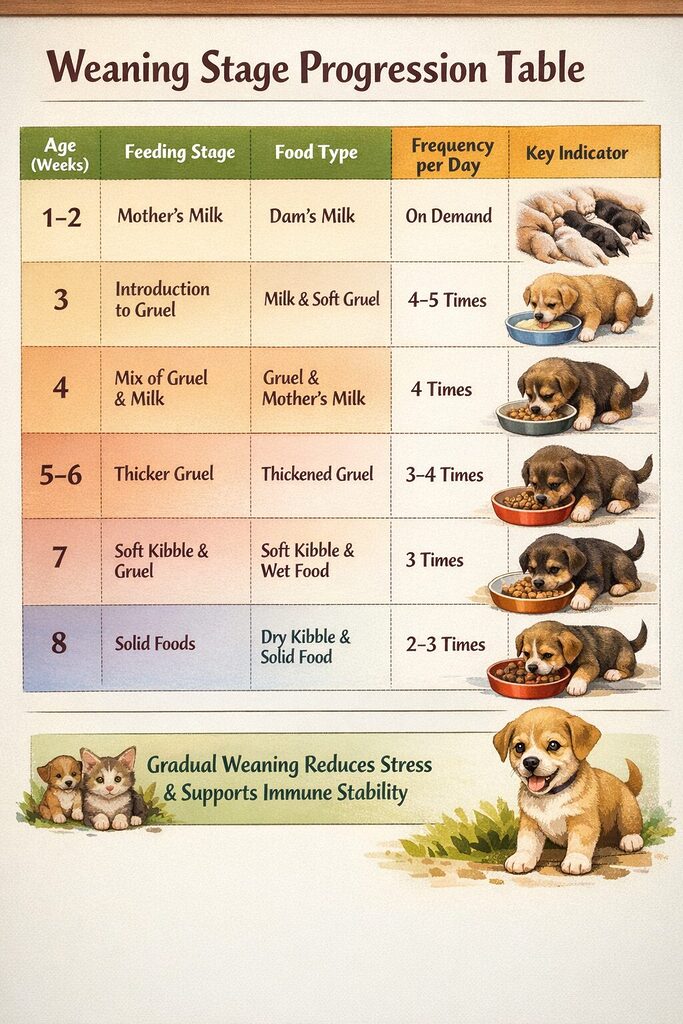
4. Weaning Schedule and Early Nutrition
Weaning is a physiological and psychological transition. Introduced too abruptly, it creates stress that temporarily suppresses immune function. Managed progressively, it mirrors the natural process and allows puppies to develop independent feeding behaviour at their own pace.
Standard weaning schedule:
Critical points
Introduce gruel in a flat, shallow dish. Puppies should be able to walk through it initially — this is normal and not a hygiene concern.
Do not use cow's milk as a supplement. Canine milk replacer (CMR) is required if supplemental feeding is needed; cow's milk causes osmotic diarrhoea.
By week five, puppies should be consuming approximately 8–10% of their body weight daily in food — a critical benchmark for growth tracking.
5. Behavioural Milestones and Puppy Behavior Patterns
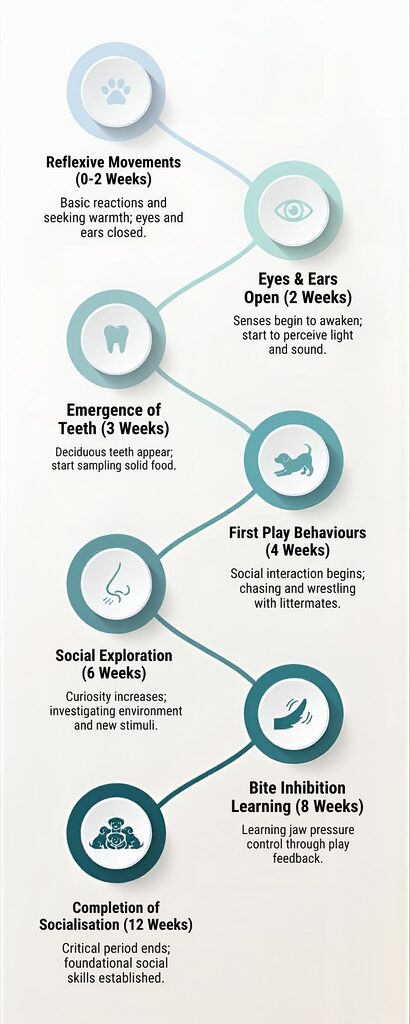
Between weeks four and twelve, behavioural development accelerates rapidly. These puppy behavior patterns are not random — they are observable indicators of neurological maturation that breeders can use to assess individual temperament and identify early deviations.
Key behavioural milestones by age:
Week 4
Play behaviour begins. Puppies initiate contact with littermates. Vocalisation diversifies beyond distress calls to include growls, barks, and play whines.
Week 5
Social hierarchy forms within the litter. Dominant and more submissive tendencies become observable — though these are plastic at this stage and should not be over-interpreted.
Week 6
Fear responses to novel stimuli begin to increase. This signals the opening edge of the fear imprint period; all novelty exposure must be carefully positive from this point.
Week 7–8
Peak of social sensitivity. The puppy is most receptive to bonding and least fearful of novelty. This is the optimal window for temperament testing (Volhard Puppy Aptitude Test or equivalent).
Week 8–11
First fear imprint period. Negative experiences — even single incidents — can create lasting associations. Vet visits, transportation, and rehoming during this phase must be managed with particular care.
6. Breeder Monitoring Protocols and Early Health Checks
Systematic breeder monitoring is what separates a reactive response to problems from their prevention. The developmental stages outlined above are only useful if the breeder has structured observation frameworks in place.
Weekly monitoring checklist (birth to 8 weeks)
Daily (Weeks 1–2) - Weigh every puppy at the same time each day. Record weights individually. Any puppy losing weight for two consecutive weighings requires intervention.
Daily (Weeks 1–8) - Observe nursing sessions. Confirm all puppies are latching, no puppy is being consistently displaced, and the dam shows no signs of mastitis.
Week 2–3 - Check eye and ear canal opening. Note any asymmetry or discharge — these can indicate early infection.
Week 4 - Observe social interaction. Flag any puppy showing persistent social withdrawal, which may indicate pain, neurological issues, or early temperament concerns.
Week 6 - Early health checks — first veterinary examination, deworming protocol, and beginning of vaccination schedule per your vet's recommendation. Confirm patellar patellar development, bite alignment, and coat condition.
Week 8 - Final pre-rehoming health check. Microchipping (mandatory in South Africa for all dogs), health certificate, and disclosure of any developmental observations to the incoming owner.
Refer to:Corgi Puppies in South Africa for a detailed overview of health protocols specific to Pembroke Welsh Corgis in the South African context.
7. Growth Charts and Physical Development Tracking
Weight gain is the most reliable single indicator of neonatal and early puppy health. Growth charts provide a visual framework for identifying deviations before they become crises.
Note:These are reference ranges, not absolute standards. Individual variation within a litter is normal. Consistent growth trajectory matters more than any single weight measurement.
Structural milestones to track:
Head shape and skull width (Corgis have a characteristic foxy skull — asymmetrical broadening can signal overcrowding in utero)
Ear set and carriage — erect ears typically present by weeks 8–12, though some fluctuation is normal during teething
Tail — Pembrokes are naturally bobtail or have surgically docked tails; document tail status at birth for health records
8. The Juvenile Period (Weeks 12–24): Independence and Fear Periods
After week 12, the first sensitive period closes and puppies enter a phase of increasing independence, drive development, and environmental consolidation. This is the period during which a puppy's new owner bears primary responsibility for continued development.
Key characteristics
Second fear imprint period (approximately weeks 14–16) - A briefer but significant second window during which novel frightening experiences can have lasting effects. Avoid overwhelming environments or forced exposure during this period.
Drive emergence - Herding instinct, play drive, and prey drive begin to assert themselves more clearly between weeks 12–20. For working or sport-prospect Corgis, early observation of these drives informs future training paths.
Adolescence (months 4–8) - Hormonal changes begin to influence behaviour. Previously reliable responses may become inconsistent — this is neurological, not wilful defiance. Patience and consistency are the only effective tools.
Cognitive consolidation - Between 12 and 24 weeks, puppies consolidate the socialisation experiences of the prior phase. Positive early experiences become stable foundations; gaps from the socialisation window become increasingly difficult to address.
Breeders who provide detailed developmental notes to incoming owners — including what exposures the puppy has had and what gaps remain — give those owners a meaningful head start.
Cross-ecosystem reference. Dog development principles apply broadly across breeds. For comparison, see theComplete Guide to the Beagle.
Expert Insight
From a specialist Corgi breeder with over 15 years of whelping experience:
Most breeders know the socialisation window exists. Fewer understand that the window doesn't simply close at week 12 — it narrows progressively from week six onward. A puppy exposed to ten different people at week 10 is not getting the same neurological benefit as a puppy exposed to ten different people across weeks 4 through 9. The brain's capacity to process novel stimuli without elevated cortisol is highest between weeks 4 and 7. That's your prime window. After week 8, you're banking on what you've already built.
The other thing experienced breeders learn to watch for is what I call 'quiet withdrawal' in a litter. One puppy consistently sitting at the edge of play, not initiating, not being targeted — that's not a personality trait at this age. That's a flag. It could be pain, it could be early temperament deviation, it could be a hierarchical dynamic that needs managing. A puppy that withdraws at week five and isn't assessed is the puppy whose new owner calls you at week 20 wondering why their dog is reactive."
This observation underscores a critical point that generic development guides rarely address: individual variation within a single litter requires the same systematic attention as population-level milestones.
Frequently Asked Questions
1. What are the main puppy development milestones I should track? The primary milestones are: eyes and ears opening (weeks 1–2), voluntary locomotion (week 3), socialisation sensitivity (weeks 3–12), weaning completion (week 6–7), first veterinary health check (week 6), and rehoming readiness (week 8 minimum). Weight gain benchmarks run throughout — consistent daily gains are the most reliable indicator of health across all stages.
2. When does the socialisation period begin and end in puppies? The primary socialisation period begins at approximately three weeks, when puppies first become aware of their social environment, and closes progressively from week 10 through week 12. Neurological plasticity — the brain's readiness to form low-fear associations with novel stimuli — is highest between weeks 4 and 7 and diminishes steadily thereafter. Missing this window entirely is associated with higher rates of fear-based behaviour in adult dogs.
3. What is the neonatal puppy care period and what does it involve? The neonatal period covers birth to approximately 14 days. It requires intensive monitoring of weight gain (at least once daily), whelping environment temperature management, observation of nursing behaviour, stimulation of elimination if the dam is absent, and Early Neurological Stimulation (ENS) exercises from days 3–16. Neonatal puppies are entirely unable to self-regulate temperature, so environmental control is life-critical.
4. What is a healthy weaning schedule for Corgi puppies? Begin introducing puppy gruel (soaked kibble or wet food) around day 21. Reduce moisture content gradually through weeks 4–5. By week 6–7, puppies should be fully eating solids with the dam's milk serving primarily as comfort rather than nutrition. Puppies should not be weaned abruptly, as stress during this transition temporarily suppresses immune function.
5. How do I use growth charts to monitor puppy development? Weigh each puppy individually at the same time each day for the first two weeks, then at minimum twice weekly through week eight. Plot weights on a growth chart and compare against breed-specific benchmarks. The trajectory — consistent upward progress — matters more than hitting exact numbers. Any puppy who fails to gain weight for two consecutive days requires immediate veterinary review.
6. What puppy behavior patterns indicate a developmental concern? Red flags include: failure to root or nurse in the first 48 hours, persistent crying not resolved by warmth or feeding, social withdrawal at week 4 onward, failure to initiate play by week 5, disproportionate fear response to mild stimuli at week 6, and failure to establish eye contact or respond to name by week 8. Any combination of these warrants veterinary and behavioural assessment.
7. At what age should breeders conduct early health checks on puppies? Initial health assessments should occur at birth (birth weight, palate check, limb formation), weekly during the neonatal period, at week 4–5 by the breeder, and at week 6 by a veterinarian for a formal health examination prior to vaccination. The week 8 check should include microchipping, parasitology, vaccination, and full physical assessment before rehoming.
8. As a Corgi breeder, what should I document about each puppy's developmental progress? Document birth weight and daily gains for the first two weeks; ENS sessions (dates performed); eye and ear canal opening dates; first teeth; first solid food consumption; temperament test results (week 7–8); first veterinary examination findings; vaccination and microchip records; and a narrative summary of socialisation exposures — surfaces, sounds, people, and environments encountered before rehoming. This documentation is a professional obligation and a meaningful gift to the incoming owner.
9. What is the second fear imprint period and how should breeders manage it? The second fear imprint period occurs at approximately weeks 14–16 and is shorter but neurologically significant. Unlike the primary socialisation window, this phase affects dogs that are typically already in their new homes. Breeders should advise incoming owners of this period specifically — and recommend avoiding elective high-stress experiences (dog shows, boarding, large crowds) during these two to three weeks. Negative experiences imprinted during this phase have been documented to persist into adulthood.
10. How do puppy development milestones differ across breeds? The core biological milestones — neonatal, transitional, socialisation, juvenile — are consistent across all domestic dog breeds. What varies is the timing of breed-specific trait expression (herding instinct in Corgis, scent drive in Beagles), adult size benchmarks, and the degree to which early handling influences breed-typical temperament. Herding breeds like the Pembroke Welsh Corgi tend to show higher sensitivity during fear imprint periods than many other breed groups, making precise socialisation management particularly important.
Conclusion
Three principles emerge from a thorough understanding of puppy development milestones that every serious breeder and engaged Corgi owner should internalise.
First, developmental windows are not guidelines — they are neurobiological deadlines. The socialisation period does not pause or extend because a breeder is busy; it closes on schedule, and what was not built inside it cannot be fully reconstructed outside it.
Second, systematic monitoring is not optional — it is the mechanism through which good outcomes are reliably produced. Daily weight records, structured observation, and documented health checks are not bureaucratic exercises. They are the difference between noticing a fading puppy at day three and losing one at day five.
Third, the puppy you hand over at eight weeks is the direct product of everything that happened in the preceding weeks. Every socialisation exposure, every weaning transition, every early health check shapes the dog that new owner will live with for twelve to fifteen years. That is the weight — and the privilege — of responsible puppy development and care.
The developmental stages described in this guide represent current best practice for breeders who take that responsibility seriously. The science continues to evolve, but the core principle does not: what you invest in the first twelve weeks returns compound dividends for the life of the dog.
Call to Action
If this guide has clarified how much precision the early weeks of puppy development actually demand, the next step is to explore the broader resources available on www.pemberdiamonds.co.za — built specifically for Corgi breeders who hold themselves to a higher standard.
Explore the Corgi Puppies in South Africa health guide for breed-specific protocols, and review the First Time Corgi Owners resource to understand exactly what your buyers need to know to continue the work you've started. The quality of your litters doesn't end at rehoming — it extends into every home they enter.