Pember Diamonds – A Member Of KUSA, Registration Number 1031350
Breeder Owner Communication Best Practices
Placing a Corgi puppy with a new owner is not the end of the breeding process — it is the beginning of a relationship that reflects directly on your programme's reputation. Yet many breeders invest years perfecting their genetics and health protocols, then leave the owner relationship almost entirely to chance. Communication gaps are where trust breaks down, returns happen, and referrals are lost.
For those raising show-quality puppies and positioning their lines at the highest level, the standard of breeder communication must match the standard of the dogs themselves. The expectations of today's informed buyer have risen considerably, and a Corgi breeder who cannot meet those expectations professionally will lose ground to those who can. This guide sets out a structured, professional approach to corgi breeder communication — from the first inquiry through to long-term post-sale support. Every stage is practical, every recommendation is implementable, and the result is an ownership experience that generates loyalty, referrals, and a breed community that reflects well on your name.
What does effective corgi breeder communication look like?
Effective corgi breeder communication is structured, proactive, and consistent across every stage of the owner relationship — from initial inquiry through puppy placement and post-sale follow-up. It combines written documentation, scheduled updates, and clear contract guidance to build transparency and maintain trust between breeder and owner throughout the puppy's developmental stage and beyond.
Why Breeder-Owner Communication Is a Professional Standard, Not a Courtesy
In serious breeding programmes, the quality of corgi breeder communication is as measurable as any health metric. Owners who feel informed, respected, and supported are statistically less likely to return a puppy, more likely to comply with health certificate requirements, and more likely to refer new buyers. Communication is not a soft skill — it is a core function of responsible breeding.
Miscommunication about breed standard expectations is one of the leading causes of owner dissatisfaction in the first six months post-placement. Research in canine welfare indicates that owners who receive structured support in the first eight weeks after puppy placement report significantly higher satisfaction and lower incidence of behavioural problems attributed to the breeder.
The reputation of a breeding programme is built cumulatively — every owner interaction either strengthens or erodes that foundation.
The Three Communication Failures Most Breeders Make
Assuming owners have read and retained written documents. Most first-time owners absorb roughly 40% of written material provided at collection. Verbal reinforcement of key points at handover is not optional.
Delaying responses to owner inquiries post-sale. A response window of more than 48 hours signals disengagement. Many returns and disputes escalate during communication gaps.
Conflating social media presence with genuine support. Posting puppy photos is not owner communication. Direct, individualised contact is irreplaceable.
Managing the Inquiry and Pre-Sale Process
The tone of a breeder-owner relationship is established at first contact. An inquiry response that is warm but professionally structured signals the standard an owner can expect throughout their puppy's developmental stage and beyond.
Respond to all inquiries within 24 hours, even if only to acknowledge receipt and set a timeline for a fuller response. Use a standardised intake questionnaire that covers living situation, experience level, household composition, and expectations around breed standard. This serves dual purposes: it screens applicants and it begins the education process. Provide a clear written summary of your breeding programme's philosophy, health protocols, and placement criteria. This document should be sent before any waitlist deposit is accepted.
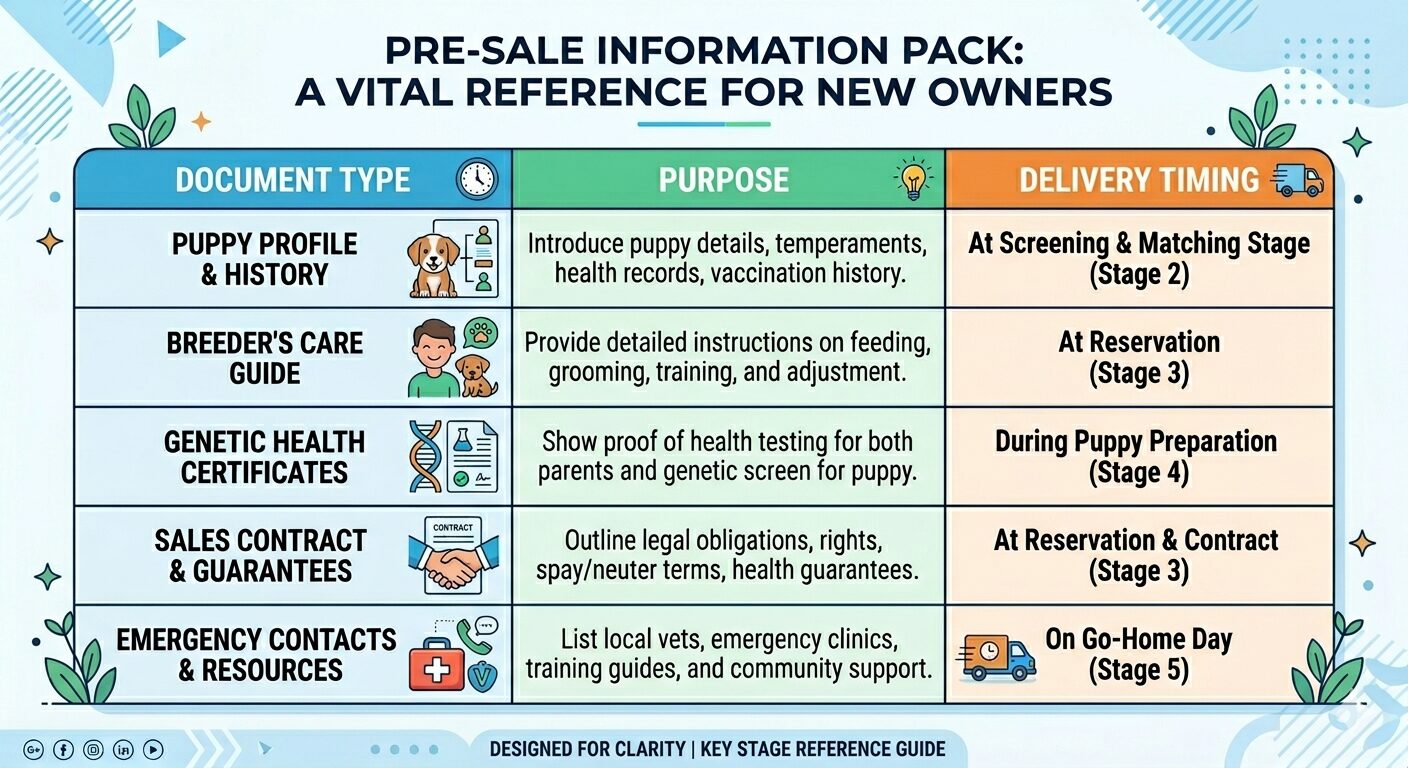
What to Include in a Pre-Sale Information Pack
Delivering these documents in stages — rather than as a single overwhelming packet — improves retention and signals a thoughtful, structured programme. It also demonstrates maintaining trust through transparency at every step.
Using Written Contracts to Set Clear Expectations
A well-drafted contract is the single most important document in any breeding placement. It is not merely a legal instrument — it is a communication tool that defines the relationship, articulates the breeder's values, and protects both parties. Contract guidance provided clearly at the right time prevents the majority of post-sale disputes.
Contracts should be shared well before collection day — ideally at waitlist confirmation, with a second review reminder two weeks before the puppy is ready. Every clause must be explained, not just presented. A clause the owner does not understand is a clause that will create conflict when it becomes relevant. Clearly distinguish between mandatory requirements (health certificate submission deadlines, return clauses, breed standard conditions for co-owned show dogs) and advisory recommendations (feeding programmes, training approaches).
Key Clauses That Prevent the Most Common Disputes
Return and rehoming clause: Define under what circumstances you will accept a dog back, and within what timeframe. A breeder who commits to taking back any puppy placed from their programme — regardless of age — demonstrates responsible ownership and removes the option of abandonment from an owner's mind.
Health certificate clause - Specify the veterinary health certificate requirements expected within the puppy's first 72 hours, and clarify that the health certificate provided at collection is the breeder's certification of the puppy's condition at departure — not a substitute for the owner's own veterinary assessment.
Breeding rights clause - If the puppy is sold on limited registration, the conditions under which breeding rights may be granted must be explicit, including any health screening requirements that must be met.
Feeding and care requirements clause - State any non-negotiable care requirements during the first eight weeks at minimum — particularly if the puppy has been on a specific programme that the breeder's veterinarian has endorsed.
For breeders whose programme includes show-quality placements, the distinction between a show prospect and a companion placement must be defined in the contract, not communicated informally. Refer to our article on Corgi Ethical Breeding for the standards that underpin these distinctions.
Structuring Puppy Updates During the Waiting Period
The period between deposit and collection is one of the highest-anxiety phases for any new owner — and one of the most underserved by most breeders. Structured puppy updates during this period do more to build loyalty than any marketing effort. They also significantly reduce the volume of ad hoc inquiries a breeder must manage.
Establish a fixed update schedule at the point of deposit confirmation. Weekly updates for the final four weeks before collection are the professional standard. Updates should be structured consistently: developmental milestone, photo or short video, care preparation reminder, and one practical task for the owner to complete before collection (puppy-proofing checklist items, purchasing specific equipment, booking the veterinary appointment).
Avoid generic updates that could apply to any puppy. Reference the individual puppy by name, note specific behaviours or characteristics that have emerged, and connect these observations to the owner's known household context where possible.
A Recommended Weekly Update Framework
WeekDevelopmental FocusOwner Preparation TaskWeek 5 (post-deposit)Eyes and ears fully open, beginning to show individual characterPurchase crate and bedding; research local veterinary clinicsWeek 6Socialisation programme underway; exposure to household soundsBook the post-collection veterinary appointmentWeek 7Weaning complete; established on the breeder's feeding programmePurchase the correct food; confirm collection logisticsWeek 8 (pre-collection)Full temperament assessment complete; health certificate preparedReview contract; prepare list of questions for collection day
Each update is also an opportunity to reinforce key messages from the contract and care documentation — delivered in context, rather than as a separate administrative exercise. This approach to maintaining trust through consistent communication pays dividends at and after handover.
The Handover
Communication That Reduces Anxiety and Returns
Collection day is the most information-dense moment in any placement, and it is routinely mismanaged. Owners arrive excited, emotionally elevated, and cognitively overloaded. Presenting them with a folder of documents and a verbal briefing they will retain perhaps 30% of is a structural failure, not a communication success.
Separate emotional and informational elements. Allow the owner time to meet and bond with the puppy before beginning any formal handover briefing. Use a handover checklist that the owner signs, acknowledging receipt and verbal explanation of each item. This is both a professional record and a psychological anchor — it signals that the information transfer was intentional and structured.
Provide a digital copy of all documents in addition to physical copies. A shared folder or email with organised documents is accessible at 2am when the puppy is unsettled and the owner has questions.
Handover Briefing Sequence
The 72-hour guidance note deserves particular attention. Most owner panics occur within the first three days — the puppy is not eating, not sleeping, crying at night, or displaying unfamiliar behaviours. A one-page document that anticipates these scenarios and normalises them will reduce your after-hours call volume by a substantial margin and demonstrate the kind of client education that marks a serious breeding programme.
Post-Sale Support and Ongoing Guidance
Post-sale support is where most breeding programmes either distinguish themselves or disappear. The professional standard is a structured, scheduled engagement programme — not reactive availability to owner-initiated calls.
Schedule a check-in at 48 hours post-collection, one week, one month, three months, and six months. Each check-in should have a defined purpose aligned to the puppy's developmental stage. At six months, request a health update and photos. This is also the appropriate moment to introduce the owner to any breed-specific health screening that should be planned for adulthood. Maintain a simple owner record that logs each contact, the puppy's reported status, and any issues raised. This record is invaluable if a dispute or health concern arises later.
Scheduled Post-Sale Communication Framework
Ongoing guidance should be proactive, not reactive. Share relevant articles, remind owners of upcoming developmental stages, and keep them engaged with your programme's content. Our guide on How Breeders Shape Pembroke Welsh Corgi Champions provides additional context on the breeder's role in long-term canine development that is worth sharing with owners at the three-month stage.
Handling Difficult Conversations and Disputes Professionally
No breeding programme is immune to difficult owner relationships. A puppy develops a health condition, an owner feels a contract clause was not adequately explained, a return is requested. How a breeder handles these situations publicly defines their programme's character more than any marketing does.
Respond to all complaints in writing, within 24 hours, even if only to acknowledge receipt and set a timeline. Never allow a complaint to go unanswered. Separate the emotional content of a complaint from the factual content. Address factual matters first, with reference to the relevant contract clause and documentation. Acknowledge emotional distress without admitting liability.
If a return is requested, honour the process outlined in the contract. A breeder who creates barriers to a legitimate return is a breeder whose next placement is endangered. When a veterinary opinion is disputed, request the owner's veterinary report in writing and, where appropriate, commission an independent veterinary review. The health certificate at placement provides the baseline; any subsequent condition must be assessed against that baseline.
Dispute Resolution Principle
The goal of dispute resolution in a professional breeding programme is not to win the argument — it is to resolve the situation in a way that either preserves the relationship or concludes it with the breeder's integrity intact. Owners talk. Every resolved dispute well-handled is a future referral. Every dispute poorly managed is a public reputational liability.
Building a Long-Term Owner Community
The most sophisticated breeding programmes do not merely place puppies — they build communities. A network of satisfied, informed, and engaged owners is the most powerful marketing tool available to any breeder, and it costs less than any advertising campaign.
Create an owner alumni group — a private group, email list, or structured communication channel — that gives past owners access to ongoing guidance, breed updates, and a connection to your programme. Host an annual owner event or virtual Q&A. This serves both relationship maintenance and knowledge-sharing purposes.
Encourage responsible ownership within your community by sharing content on breed-specific health, training, and care. For owners interested in Corgi health screening protocols, the resources available at Corgi Health Screening Essentials provide an accessible, owner-facing complement to the professional guidance you provide directly. Recognise owners who go above and beyond — those who complete advanced health screening, achieve titles in performance sports, or contribute to breed improvement through responsible breeding. Public acknowledgement costs nothing and builds programme loyalty.
Fostering relationships at this level transforms the transactional nature of a puppy placement into a long-term connection that benefits the breed, the owner, and the programme equally.
Expert Insight
"The most consistent predictor of a smooth placement is not the puppy's temperament at collection — it is the owner's preparation in the four weeks before it. Breeders who treat the waiting period as a passive holding phase are missing the highest-leverage communication window in the entire relationship. An owner who arrives on collection day having already assembled the crate, booked the veterinary appointment, and read the contract twice is an owner who is neurologically ready to absorb the handover briefing. One who has not done any of these things is already in reactive mode before the puppy has left the property. Weekly structured updates that include a specific preparation task are not administrative burden — they are the architecture of a placement that succeeds." — Breeding Programme Management, PemberDiamonds.co.za
The non-obvious insight here is neurological, not procedural: cognitive load on collection day is the single most underestimated factor in owner retention of critical information. Experienced breeders often attribute post-sale compliance failures to owner irresponsibility when the actual cause is information overload at a high-emotion moment. Distributing information across the waiting period is not a courtesy — it is a memory management strategy.
FAQ
1. How often should a breeder communicate with a new owner before collection?
A minimum of four structured weekly updates in the final month before collection is the professional standard. Each update should include a developmental milestone report, a photo or short video of the individual puppy, and one specific preparation task for the owner to complete. This frequency balances genuine engagement with the operational demands of a working breeding programme.
2. What should a corgi breeder’s post-sale communication schedule look like?
A professional post-sale schedule includes touchpoints at 48 hours, one week, one month, three months, and six months post-collection. Each touchpoint should have a defined purpose aligned to the puppy's developmental stage. Beyond six months, annual contact maintains the relationship and supports long-term responsible ownership without placing undue burden on either party.
3. What should be included in a handover document pack?
The pack should include the signed contract, the health certificate with a plain-English explanation of what it covers, the feeding programme with specific quantities and schedule, a first 72-hour guide, the breeder's contact details and response protocol, and a checklist of items the owner should action in the first week. Digital and physical copies should both be provided.
4. How should a breeder handle an owner who contacts them excessively after collection?
Set clear response protocols at handover — define what constitutes a routine inquiry versus an urgent concern, state expected response windows for each, and direct routine questions to written resources where possible. An owner who contacts excessively is usually an owner whose information needs were not adequately met during the waiting period. Address the root cause, not just the symptom.
5. What is the best way to deliver contract guidance without overwhelming a new owner?
Share the draft contract at waitlist confirmation — weeks or months before collection — and invite questions in writing. Send a contract reminder two weeks before the puppy is ready. At collection, review only the three clauses most likely to be relevant in the first 30 days. Full contract review at collection day is procedurally sound but cognitively counterproductive.
6. How can a breeder maintain trust if a puppy develops a health issue post-placement?
Respond promptly and in writing, acknowledge the owner's concern, and reference the health certificate and contract provisions calmly. Request the owner's veterinary report and assess the situation against the documented condition at placement. Where warranted, facilitate an independent veterinary opinion. Maintaining trust in difficult situations requires transparency, consistency, and the absence of defensiveness.
7. Is it appropriate for a breeder to have a private owner community group?
Yes, and it is increasingly the mark of a serious programme. A private owner alumni group — whether a social media group, email list, or dedicated platform — provides breeders with a managed environment for sharing ongoing guidance, reinforcing responsible ownership standards, and building the kind of community that generates reliable referrals. It also gives owners a peer network that reduces dependence on ad hoc breeder contact.
8. What corgi breeder communication strategies are most effective for managing expectations around show-quality placements?
Expectations for show-quality placements must be set in writing before the deposit is accepted, reinforced in the contract, and revisited at the three-month developmental stage assessment. Clearly distinguish between a show prospect at eight weeks — which carries inherent uncertainty — and a confirmed show-quality placement, which requires a later assessment. Overpromising show potential is one of the most common sources of placement disputes.
9. How should breeders handle clients who want to breach the contract’s breeding rights clause?
Address the matter in writing, with calm reference to the specific clause and the rationale behind it. If the breach is proposed in advance, explain the conditions under which breeding rights may be legitimately sought — including any health screening requirements. If the breach has already occurred, follow the remedy provisions in the contract. Disputes of this nature are almost always preventable with clear upfront contract guidance.
10. When is the right time to discuss long-term health screening with a new owner?
The six-month post-sale check-in is the appropriate moment to introduce breed-specific adult health screening requirements. At this stage, the owner is settled, the puppy is through the most intensive developmental stage demands, and the relationship is established enough to carry a more technical conversation. Providing written resources alongside the verbal discussion improves compliance significantly.
Conclusion
Effective corgi breeder communication is not an adjunct to a serious breeding programme — it is one of its defining features. The three most important takeaways from this guide are: first, that communication must be structured and proactive at every stage, not reactive to owner-initiated contact; second, that the waiting period before collection is the highest-leverage communication window in the entire relationship and should be treated accordingly; and third, that post-sale support, handled through scheduled touchpoints with defined purposes, transforms a transactional placement into a long-term relationship that benefits both parties and the breed.
The promise made at the opening of this guide holds: a communication standard that matches the quality of your dogs will build the kind of ownership experience that generates referrals, reinforces responsible ownership, and reflects well on every animal that carries your programme's name.
Breeding Best Practices at this level demand nothing less. The breeders who will define the next decade of Pembroke Welsh Corgi excellence are those who recognise that the relationship with the owner is as important as the genetics of the puppy — and who build their communication systems accordingly.
Call to Action
The frameworks in this guide are most effective when built into a breeding programme systematically, not applied case by case. For breeders who want to go deeper on the ethical and professional standards that underpin responsible placement — including the health protocols that complement every communication framework discussed here — the Corgi Ethical Breeding guide on PemberDiamonds provides the professional foundation. And for questions about what owners themselves are reading and learning about Corgi health, the owner-facing resources at CorgiCrew are a valuable window into the expectations your buyers bring to every conversation.