Every defining trait of the Pembroke Welsh Corgi traces back to two forces: a single dominant mutation (the FGF4 retrogene) that shaped its frame, and centuries of purpose-bred cattle work that shaped its mind. For breeders, the two are inseparable — the same biology that produces the breed's celebrated silhouette also dictates its most important health-testing priorities. Understanding the Pembroke at this level, rather than at the level of "short legs and big ears," is what separates casual ownership from serious stewardship of the breed.
At Pember Diamonds, we believe that breeding well starts with understanding deeply. Before a single pairing decision is made, a serious breeder should be able to explain *why* this dog looks and behaves the way it does — not as trivia, but as the foundation for every judgment call that follows. This is that foundation.
The Mutation That Built the Breed
The name itself is instructive. Corgi derives from the Welsh cor ("dwarf") and gi ("dog") — a breed name that is, quite literally, a diagnosis.
In 2009, a research team led by Heidi Parker at the National Human Genome Research Institute traced the Pembroke's signature build to a precise genetic event: a retrotransposed, duplicated copy of the FGF4 gene, inserted at an atypical site on chromosome 18. This retrogene produces chondrodysplasia — the short-legged phenotype shared by at least nineteen modern breeds, including the corgi, the dachshund, and the basset hound — and because it arose from a single evolutionary retrotransposition event, this trait connects the Pembroke to a much wider family tree of short-limbed breeds than most owners ever realize.
For the breeder, the mechanics matter:
Growth plate calcification occurs early and abnormally, arresting long-bone growth while the rest of the skeletal structure proceeds normally
The trait is dominant, which is precisely why it breeds true across the entire population rather than surfacing inconsistently
The condition sits in the same biological family as human achondroplasia — FGF4 governs bone growth, and its relocation to a new genomic site produces the same disproportionate-limb pattern observed in certain human skeletal conditions
This single mutation is the Pembroke's defining trait — and, as we'll return to below, its most important health consideration.
RESEARCH SPOTLIGHT
FGF4 Retrogene and Chondrodysplasia
Study: Parker et al. (2009), Science — multibreed genome-wide association analysis across dogs.
Key Finding: Expression of a recently acquired FGF4 retrogene (inserted on chromosome 18) is strongly associated with chondrodysplasia/short-legged phenotype in at least 19 breeds, including Pembrokes, dachshunds, and basset hounds; it arose from a single evolutionary event.
Why it matters here: This dominant mutation directly explains the Pembroke’s defining short-legged build and links it structurally to elevated IVDD risk via the same cartilage/bone growth mechanism — core to ethical breeding priorities
Two Bloodlines, Not One Breed With Two Looks
A distinction worth making precisely, particularly for anyone new to the breed: the Pembroke and the Cardigan Welsh Corgi are not variations on a theme. They are separate breeds with entirely distinct ancestral lines, united only by geography.
The Cardigan is the elder line by a wide margin, descending from Celtic settlers' Dachshund-related dogs (known as *Bronant*) brought into Cardiganshire around 1200 BCE.
The Pembroke is considerably younger. Its lineage has been documented back to AD 1107 most commonly attributed to Flemish weavers who settled in Pembrokeshire after the Norman invasion, bringing Spitz-type dogs such as Pomeranians and Schipperkes with them. A competing account credits
Norse settlers and the Swedish Vallhund.
The Pembroke descends from the Spitz family — placing it in the same lineage as the Pomeranian, the Keeshond, and the Samoyed, which accounts for the fox-like head and set of ears the breed carries today.
The Kennel Club did not formally separate the two breeds until 1934, before that, both were shown under a single standard, and cross-breeding between them was common practice. Any pedigree research into a Pembroke line older than the mid-1930s should account for this shared registration history.
The Tail
A Point of Genuine Breed Distinction, Not Just Aesthetics
Considerable misunderstanding surrounds the Pembroke's tail, and it is worth correcting precisely. The breed is **not naturally born tailless** — most Pembroke puppies arrive with a short, low-set natural tail, historically shortened further through docking to meet show requirements. This is a genuine point of separation from the Cardigan, which was never bred toward a shortened tail and always retains its full brush.
Docking has become a matter of real consequence for the breed's presentation. The UK's 2006 Animal Welfare Act, which prohibited cosmetic tail-docking, has been cited as a factor in a temporary decline in Pembroke registrations, as the silhouette many buyers expected became harder to produce within the law. Breeders working in jurisdictions with docking restrictions should expect, and plan for, naturally short-tailed litters — which remain fully standard-compliant in most kennel clubs.
RESEARCH SPOTLIGHT
Tail Docking Legislation Impact
Study/Reference: UK Animal Welfare Act 2006 (prohibiting cosmetic tail docking) and subsequent Kennel Club registration data analysis.
Key Finding: The ban on cosmetic docking contributed to a temporary decline in Pembroke registrations, as the expected short-tailed silhouette became harder to achieve under legal constraints.
Why it matters here: Naturally short/bobbed tails remain fully standard-compliant; breeders in restricted jurisdictions must plan litters accordingly while preserving correct type without relying on docking.
Refined Details
The Traits That Reward Close Attention
Beyond frame and tail, several finer characteristics distinguish the Pembroke — details worth knowing for anyone evaluating breed type closely:
The fairy saddle. Welsh folklore holds that the Pembroke once carried fairy warriors into battle and pulled their coaches. The faint shoulder markings some individuals carry are, by tradition, the marks left by that fairy saddle. Not a matter of genetics, but a piece of provenance worth knowing — this breed's mythology is as old as its documented history.
The Spitz-family head. Fox-like proportions and erect, well-set ears give the Pembroke its characteristically alert expression — a trait inherited directly from its Nordic ancestry and central to correct breed type.
The characteristic smile. A function of jaw structure and lip conformation, the Pembroke's tendency to draw its lips back into an apparent grin is one of the breed's most recognizable and photographed traits.
The double coat. A coarse, weather-resistant outer layer over a dense undercoat — practical for a dog historically worked outdoors year-round, and the source of the breed's substantial shedding.
The long-coat ("fluffy") variant. A recessive mutation in the FGF5 gene alters the hair-follicle growth signal, producing a longer coat. This coat variant carries no known additional health implication of its own — it is a cosmetic trait, not a health one— though it falls outside current breed standard and warrants disclosure in any breeding program where the recessive allele is present.
Temperament as Working History
The Heeler’s Legacy
No assessment of the Pembroke is complete without understanding its original function, because nearly every temperament trait breeders navigate today is a direct inheritance from that work.
The Pembroke is classified as a heeler. Its low stance and natural agility allowed it to work close to cattle, dodging hooves while nipping at the animals' heels to drive them forward — a fundamentally different approach from breeds that herd by circling and eyeing at a distance. This proximity-based working style is the origin point for most of what follows:
RESEARCH SPOTLIGHT
Canine Intelligence Rankings
Study/Reference: Stanley Coren, The Intelligence of Dogs (1994/2006) — survey of ~199 obedience trial judges evaluating working/obedience intelligence across breeds.
Key Finding: Pembroke Welsh Corgi ranked #11 overall (Excellent Working Dogs category): learns new commands in 5–15 repetitions and obeys first command ~85%+ of the time.
Why it matters here: This high trainability pairs with herding-derived traits (nipping, vocalization, independent judgment), requiring structured outlets to prevent self-directed behaviors in modern homes.
Where Type Meets Health
The Consideration Every Breeding Program Must Prioritize
This is, arguably, the section that matters most for a breeder-facing readership — because in the Pembroke, breed-defining structure and breed-defining health risk are not separate conversations. They are the same conversation.
A breeding program built on full awareness of this connection — rather than treating "correct type" and "sound health" as competing priorities — is, in our view, the clearest marker of serious, ethical breeding practice.
From Farmyard to Royal Household
How Reputation Was Built
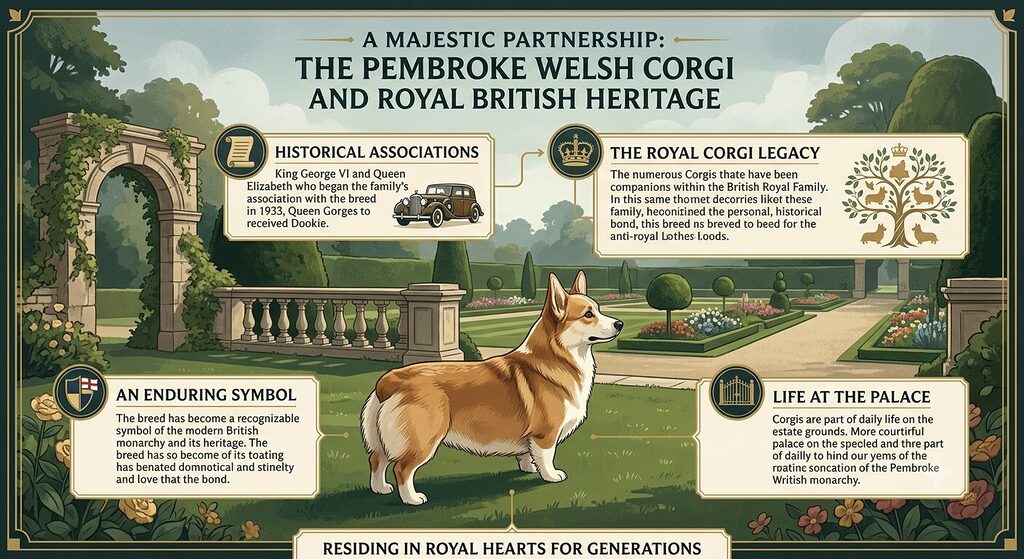
The Pembroke's modern prominence owes a great deal to one source: sustained royal patronage. Queen Elizabeth II owned more than thirty Pembrokes, along with several Corgi-Dachshund "dorgi" crosses, across her reign, beginning in childhood. That decades-long association transformed a regional Welsh working dog into one of the most recognized breeds in the world — and firmly established the Pembroke, rather than the older Cardigan, as the public face of the "Corgi" name.
More recently, a 34% rise in UK Pembroke registrations in 2015 was attributed to the breed's growing visibility on social media — a second, distinctly modern inflection point in the breed's reputation, and one that continues to shape demand and public perception today.
Frequently Asked Questions
1. What does the word “Corgi” actually mean?
It derives from the Welsh *cor* ("dwarf") and *gi* ("dog") — "dwarf dog," a direct reference to the breed's short-legged structure.
2. What causes the Pembroke’s short-legged build?
A duplicated copy of the FGF4 gene, inserted at an atypical location on chromosome 18, halts long-bone growth early in development. The same mechanism (chondrodysplasia) defines the dachshund and basset hound.
3. Are Pembroke and Cardigan Welsh Corgis the same breed under different names?
No. They are genetically distinct breeds with separate ancestral lines that happened to develop in adjoining Welsh counties. The Cardigan descends from Dachshund-related stock; the Pembroke from Spitz-type dogs.
4. What’s the most reliable way to distinguish a Pembroke from a Cardigan?
Tail length. Pembrokes carry a naturally short or bobbed tail; Cardigans retain a long, fox-brush tail that is never docked.
5. Are Pembrokes born entirely tailless?
No — most are born with a short, natural tail rather than a full-length one. Historic docking shortened it further for the show ring; where cosmetic docking is now restricted, naturally short tails remain fully standard-compliant.
6. What is the “fairy saddle” referenced in breed folklore?
A piece of Welsh legend describing faint shoulder markings some Pembrokes carry, said to be traces left by fairy riders. It's cultural provenance rather than a genetic classification, but a well-established part of the breed's story.
7. Why do Pembrokes nip at heels?
The behavior descends directly from the breed's role as a cattle heeler — working low and close to livestock, nipping at heels to drive the herd forward. It surfaces reliably in puppies and young dogs and warrants deliberate, early management.
8. Is the Pembroke suitable for households with children?
Generally, yes — the breed tends to be affectionate and engaged with children. That said, its herding instinct can express itself as heel-nipping directed at kids in motion, so early socialization and clear guidance should be part of any placement.
9. How does the Pembroke rank for trainability and intelligence?
Highly — the breed regularly places among the more trainable working lines (commonly cited around #11 in Stanley Coren's rankings). That intelligence pairs with a low tolerance for under-stimulation, which should factor into any placement conversation.
10. Why is the Pembroke considered a vocal breed?
Barking functioned as a working tool historically, used alongside exceptional hearing to help direct cattle. The tendency toward vocalization in the modern breed is a direct carryover of that function.
11. What distinguishes a “fluffy” Pembroke?
A recessive FGF5 gene mutation that produces a longer coat. It is a purely cosmetic variation with no known additional health implications, though it falls outside current breed standard.
12. What are the primary health considerations for the breed?
Intervertebral Disc Disease (IVDD), given the structural link to the breed's defining chondrodysplasia; Degenerative Myelopathy (DM); weight-related spinal strain; and Von Willebrand's Disease Type 1 and Exercise-Induced Collapse (EIC), both of which merit inclusion in a comprehensive health-testing panel.
13. Why did the Pembroke, specifically, become the more globally recognized Corgi breed?
Largely due to sustained royal patronage — Queen Elizabeth II's decades of Pembroke ownership elevated the breed's international profile well beyond that of the older Cardigan.
14. Does the Pembroke adapt well to non-rural or apartment living?
With sufficient daily exercise and mental engagement, yes — though its working-dog instincts (vocalization, chasing, digging) require consistent outlets regardless of living arrangement. Space alone does not substitute for structured stimulation.
15. How does Pembroke temperament generally compare to Cardigan temperament?
Both are intelligent and loyal, but Pembrokes tend to present as more energetic and vocal, while Cardigans are generally regarded as calmer and quieter. Individual variation within either breed remains significant.
Expert Opinion
Veterinary geneticists regard the Pembroke Welsh Corgi as one of the clearest illustrations in canine science of a single mutation defining an entire breed identity. The 2009 identification of the FGF4 retrogene did more than explain the breed's silhouette — it reframed the broader study of breed-defining traits, given that the same mutation independently accounts for the structure of nearly twenty other breeds.
From a working-dog behavioral standpoint, the Pembroke rewards a breeder's or owner's willingness to treat temperament as a direct extension of function rather than an incidental personality quirk. The nipping, the vocalization, the independent judgment, even a characteristic reluctance toward being lifted (a low-slung heeler's instinct to stay grounded) — none of it is arbitrary. Structured exercise, herding-appropriate outlets, and deliberate early management of instinctive behaviors consistently produce the most well-adjusted representatives of the breed.
On the orthopedic side, specialists are consistent: because the Pembroke's principal spinal risk is structurally bound to the same trait that defines its type, weight management in this breed is not a matter of aesthetic preference — it is one of the most direct, controllable interventions available for long-term spinal health.
Call to Action
At Pember Diamonds, we hold the view that the finest breeding decisions begin with the finest understanding — of structure, of temperament, and of the health considerations that come bound to both. If you're evaluating a pairing, researching testing panels, or simply want to talk through what correct Pembroke type looks like in practice, we invite you to reach out.
Explore our breeding program, review our health-testing standards, or get in touch directly — we welcome the conversation, whether you're a longtime breeder or just beginning to study this exceptional breed in earnest.